By Tim Frazer
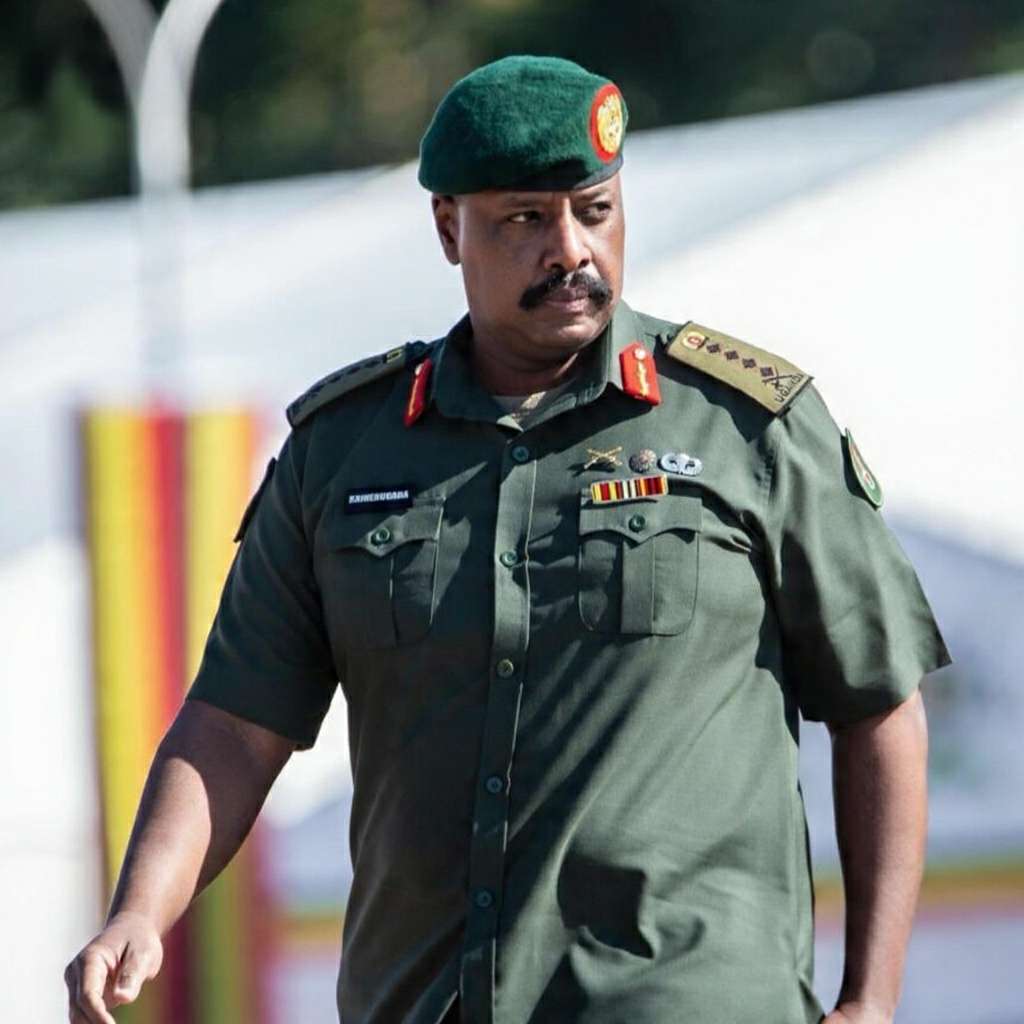
In the hills above Kampala, or in the dusty barracks of Uganda’s elite units, people speak of him in hushed tones or with outright fury. General Muhoozi Kainerugaba is many things at once: the eldest son of President Yoweri Museveni, the country’s current Chief of Defence Forces, a decorated combat veteran, a prolific and often explosive presence on social media, and the figure many Ugandans see as the most likely person to succeed his 81-year-old father one day.
His story is inseparable from Uganda’s own turbulent history — from exile and rebellion to decades of one-family dominance. It is also the story of a man who has risen with remarkable speed through the ranks while repeatedly testing the boundaries of what a serving general can say and do in public.
Muhoozi Kainerugaba entered the world on April 24, 1974, in Dar es Salaam, Tanzania. His parents, Yoweri and Janet Museveni, were Ugandan exiles plotting the overthrow of Idi Amin’s brutal regime. The family name “Kainerugaba” honors his mother’s brother. As a child he moved between Tanzania, Kenya, and Sweden before returning to Uganda after his father’s National Resistance Army took power in 1986.
Schooling was scattered: Kabale Preparatory, Mount Kenya Academy, and later King’s College Budo and St. Mary’s College Kisubi in Uganda. He earned a degree in political science from the University of Nottingham in Britain. Raised in a Christian household, he became born-again during secondary school and remains a practising Anglican.
In 1999 he joined the Uganda People’s Defence Force (UPDF) as an officer cadet. The following year he graduated from Britain’s prestigious Royal Military Academy Sandhurst — a credential that immediately set him apart. He was commissioned as a second lieutenant and posted to the Presidential Protection Unit, the precursor to today’s elite Special Forces Command (SFC).
Muhoozi’s military career reads like a highlight reel of Uganda’s post-1986 conflicts. In 2003 his battalion helped defeat Lord’s Resistance Army fighters in Soroti. In 2007 he led operations against the Allied Democratic Forces (ADF) in Bundibugyo, where his unit killed dozens of rebels, including a senior commander. He was second-in-command of Operation Lightning Thunder, the 2008–2009 cross-border campaign in the Democratic Republic of Congo that targeted LRA remnants in Garamba.
He became Uganda’s first paratrooper since the 1970s after training at Fort Benning, Georgia, in 2008. He helped build and command the Special Forces Command, an elite formation responsible for counter-terrorism, VIP protection, and special reconnaissance. His troops deployed to Somalia as part of AMISOM, contributing to the push against Al-Shabaab in Mogadishu. He also served in South Sudan during its civil war years, helping stabilise key areas.
Promotions came quickly: colonel in 2011, brigadier general in 2012, lieutenant general in 2019, and full general in 2022. In March 2024 his father appointed him Chief of Defence Forces the top military post in the country.
He has also written a book, *Battles of the Ugandan Resistance: A Tradition of Maneuver*, and is known among colleagues as someone who reads widely on strategy and history.
For years Ugandans whispered about the “Muhoozi Project” — the idea that the president was quietly grooming his only son to take over. In 2013 the notion surfaced publicly and was angrily denied. In 2022–2023 Muhoozi himself fuelled speculation by launching the MK Movement (later rebranded the Patriotic League of Uganda), a civic-style organisation that organised community projects, youth mobilisation, and high-profile birthday celebrations for him.
In March 2023 he appeared to announce he would run for president in 2026. In September 2024 he reversed course, saying God had told him to focus on the army and fully endorsing his father for another term. The Patriotic League continues to function, embedding supporters in parliament, local government, and parts of the ruling National Resistance Movement (NRM).
Critics see this as classic dynastic positioning. Supporters argue it is simply a capable officer building a patriotic base. A 2026 opinion study found him deeply unpopular in many parts of the country, even in the president’s western heartland.
If Muhoozi’s military record is conventional, his social media presence is anything but. On X (formerly Twitter) under @mkainerugaba he has become known as the “tweeting general.” His posts often written in all caps, laced with religious references, or delivered with deliberate provocation have repeatedly embarrassed the government and strained foreign relations.
He has praised Vladimir Putin’s invasion of Ukraine, offered 100 cows as bride-price for Italian politician Giorgia Meloni (and joked about conquering Rome if rejected), threatened to invade Kenya and capture Nairobi in two weeks (prompting a rare public apology from his father), and made inflammatory remarks about opposition figures.
During and after the January 2026 presidential election which Museveni won with a large margin amid opposition claims of rigging Muhoozi posted about opposition supporters being killed and threatened Bobi Wine, the main challenger, with castration and other violence (some posts were later deleted). He has also made bizarre recent statements about Turkey, Iran, and deploying Ugandan troops far from home.
His account has been deactivated or deleted multiple times, only to reappear. In person, associates say, he is thoughtful and measured; online he often sounds like a different man. The contrast has become part of his public brand or burden.
Muhoozi’s rapid ascent has drawn accusations of nepotism. Human-rights groups have long alleged that units under his command, particularly the Special Forces Command, were involved in abductions, torture, and excessive force against opposition activists and journalists, especially around the 2021 elections. The government and Muhoozi’s spokespeople have denied these claims.
His wife Charlotte’s company was awarded a large government tender for oxygen equipment during COVID-19, sparking corruption allegations. Opposition figures and civil-society activists have sued him or filed complaints over threats and alleged rights abuses.
Even within the ruling elite there are reportedly officers and politicians uneasy about one family holding so many levers of power: the president, his brother (and powerful adviser) Salim Saleh, and now the son as army chief.
At 52, Muhoozi Kainerugaba sits at the apex of Uganda’s security apparatus while his father, now in his seventh term, shows no sign of stepping aside soon. The Patriotic League gives him a political vehicle outside the formal military structure. His son has already joined the army, continuing the family tradition.
Yet Uganda is not a monarchy. Public fatigue with prolonged rule, economic pressures, and a restive opposition mean any succession will be watched nervously both inside and outside the country. Muhoozi’s combination of military authority, political ambition, and unpredictable public voice makes him either the natural heir or a lightning rod, depending on whom you ask.
For now he remains what he has always been: a man shaped by exile and war, loyal to his father’s revolution, comfortable in uniform, and unafraid perhaps too unafraid of saying exactly what is on his mind.
Uganda’s future, like its past, will likely be decided as much in barracks and WhatsApp groups as in polling stations. And General Muhoozi Kainerugaba will almost certainly remain at the centre of that story for years to come.