By Dr. Abdel Aziz Tarekji
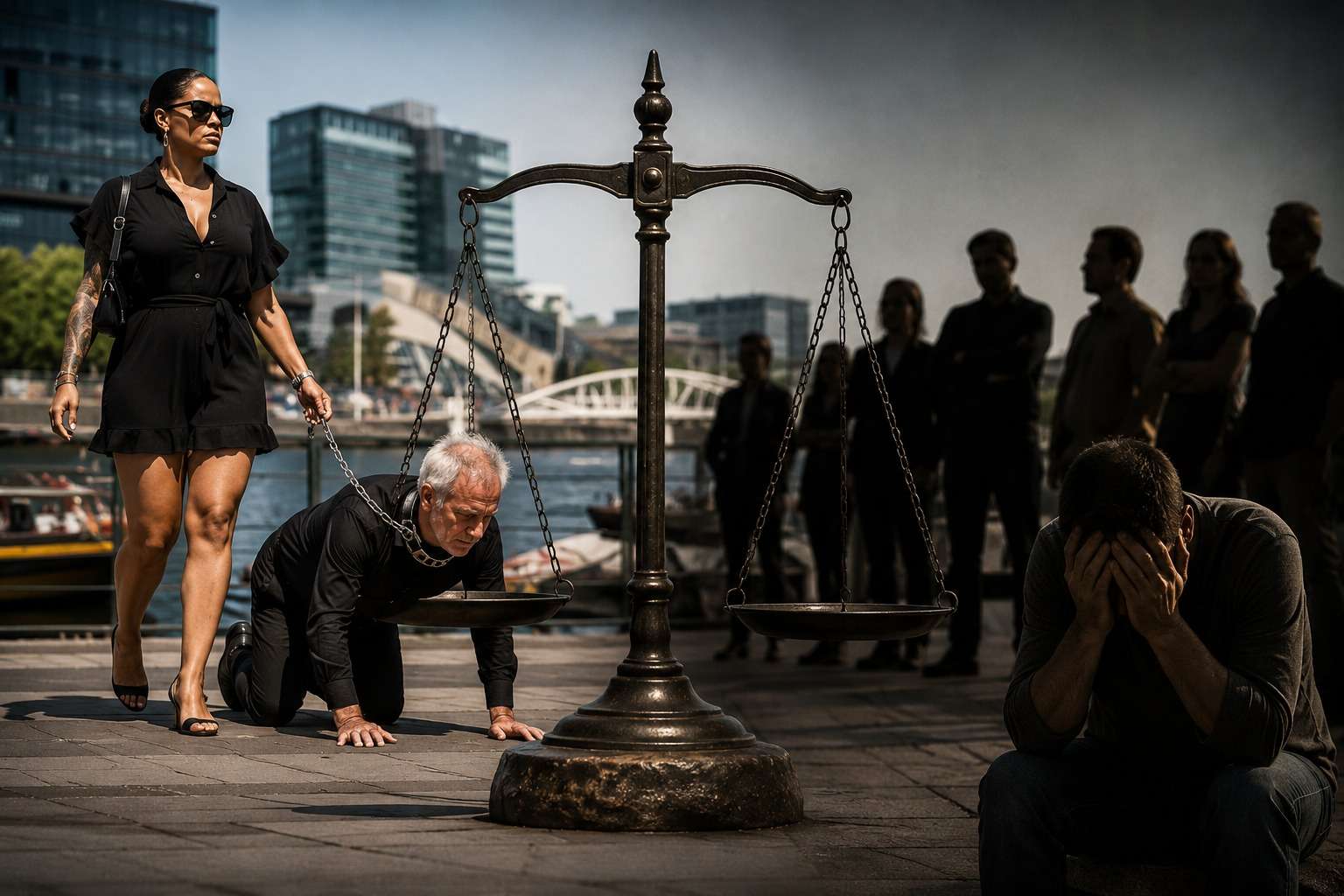
Over the past few days, a video recorded in Amsterdam, the Netherlands, has circulated widely across social media.
It shows a woman walking through a public street while leading a man by a chain fastened around his necka scene that has sparked widespread debate and public discussion.
Regardless of the nature of the relationship between the two individuals, or whether the act was personal, performative, or intended as artistic expression, the real human rights question does not lie in the motivation behind the act. It lies in the act itself once it is displayed in a public space.
Reducing a human being to a condition resembling that of an animal before the eyes of the public is neither an expression of freedom, nor a symbol of equality, nor evidence of social progress. It is an affront to human dignitythe very principle enshrined in Article 1 of the Universal Declaration of Human Rights, which states that “All human beings are born free and equal in dignity and rights.”
The more troubling question, however, is this:
Would the global reaction have been the same if the roles had been reversed?
Had a man been seen dragging a woman by a chain through the streets of a European city, it is difficult to imagine the response being so restrained. News channels would likely have interrupted their programming. Feminist organizations and human rights groups would almost certainly have issued statements of condemnation. Social media would have been flooded with campaigns of outrage, while political leaders would have rushed to denounce the incident.
The defense of human rights cannot be selective. Once selectivity becomes acceptable, justice itself begins to lose its moral legitimacy.
In recent years, several public displays involving individuals being led on collars or chains have appeared in some Western societies, including Amsterdam and earlier incidents that generated public debate in London. Although the circumstances and motivations behind such events may differ, they demonstrate that these scenes are not entirely isolated and continue to raise fundamental questions about the limits of personal freedom, public conduct, and respect for human dignity.
At the same time, it would be both inaccurate and unfair to attribute such incidents to the feminist movement as a whole. Nevertheless, it is entirely legitimate to criticize those ideological currents or public narratives that apply a clear double standardcondemning humiliation when the victim is a woman while remaining silent, minimizing, or even justifying it when the victim is a man.
True equality never means replacing one form of discrimination with another, nor transferring injustice from one sex to the other. Equality means rejecting humiliation and degrading treatment regardless of who the victim may be.
Men are not the enemies of women, just as women are not the enemies of men.
A man is someone’s father, brother, son, or husband, just as a woman is someone’s mother, sister, daughter, or wife. Any discourse that incites one sex against the other, or portrays the relationship between men and women as an endless conflict, does not advance human rights. Instead, it fuels resentment, legitimizes hostility, and weakens the very foundations of family and society.
Human dignity is not determined by the victim’s sex, race, religion, or identity. When public outrage becomes dependent on who the victim is rather than what was done to the victim, we cease defending human rights and begin practicing discrimination under the banner of justice.
For that reason, any public act that humiliates or degrades a human beingwhether the victim is a man or a womanshould be met with the same moral, legal, and social condemnation. Justice that changes according to the sex of the victim is not justice at all; it is privilege disguised as human rights.
True justice does not take sides with men or womenit takes sides with human dignity.
Ultimately, human dignity is neither a privilege granted by the majority nor a right conditioned upon the victim’s sex. It is an inherent and inalienable right belonging to every human being.
Article 1 of the Universal Declaration of Human Rights proclaims that “All human beings are born free and equal in dignity and rights.”
Article 2 further guarantees that everyone is entitled to all the rights and freedoms set forth in the Declaration without distinction of any kind, including sex.
Likewise, Article 26 of the International Covenant on Civil and Political Rights (ICCPR) affirms that all persons are equal before the law and are entitled, without discrimination, to the equal protection of the law.
Furthermore, the Convention on the Elimination of All Forms of Discrimination against Women (CEDAW) was adopted to promote equality and protect women’s dignitynot to replace one form of discrimination with another, nor to justify the humiliation or degradation of any human being.
Accordingly, any practice that degrades a person or strips them of their inherent dignitywhether the victim is a man or a womanstands in direct contradiction to the core principles of international human rights law.
Human rights are universal, indivisible, and cannot be applied selectively. Human dignity does not belong to one sex more than the other. Equality does not mean granting privileges to one group at the expense of another; it means protecting every human being equally from humiliation, discrimination, and degrading treatment. Only then can justice remain worthy of its name.