By Nash Seman
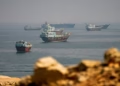
A state’s strength is not built by wealth alone. In moments of crisis, the route that carries that wealth can become more valuable than the resource itself. That is the central lesson of the instability surrounding the Strait of Hormuz. The struggle is no longer only about oil, production capacity, or ownership. It is about a harder strategic question: Who can continue selling energy when the road to the market becomes a weapon in the hands of an adversary? This is where the United Arab Emirates stands apart.
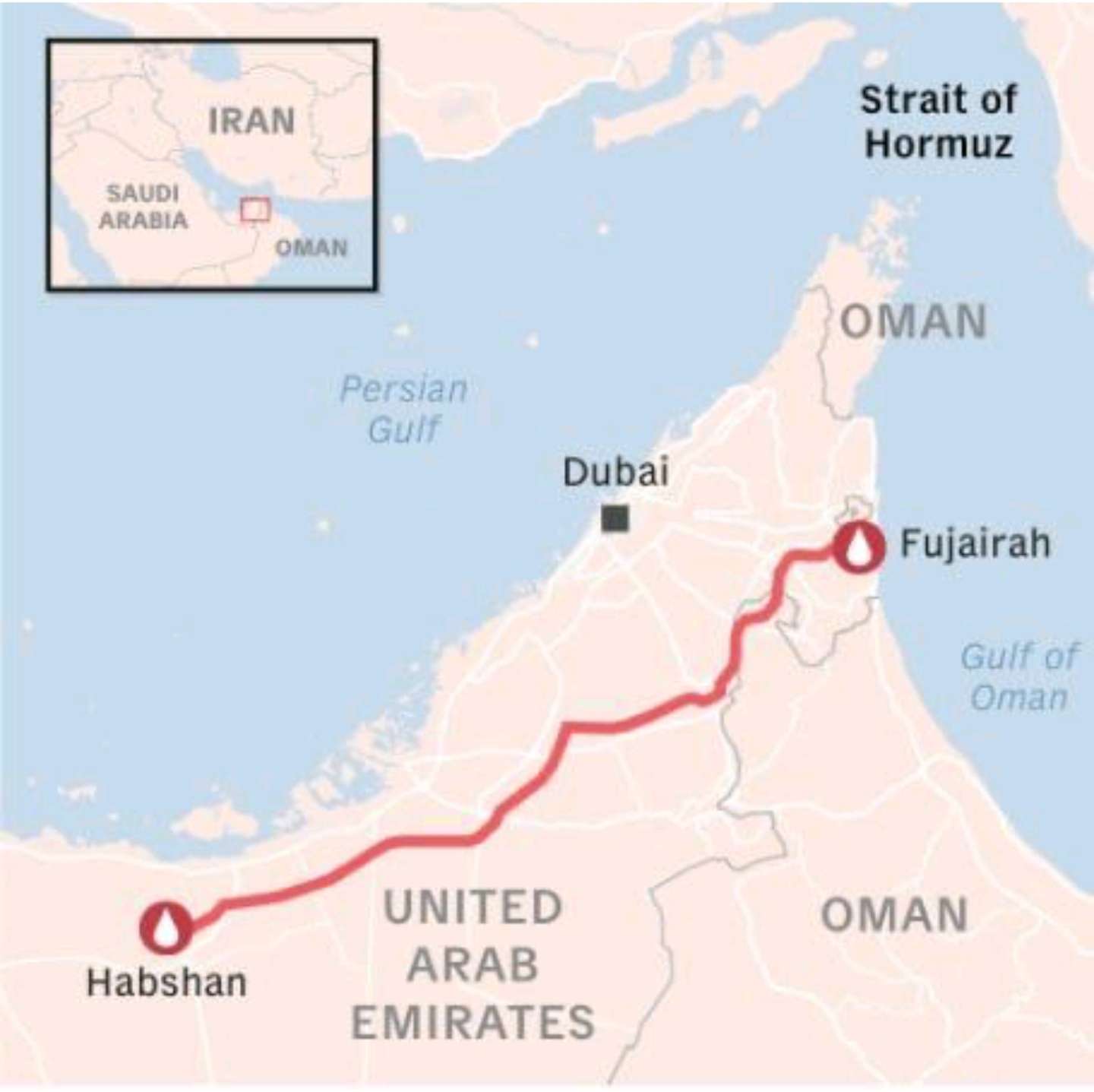
The UAE did not wait for a crisis in Hormuz before searching for an alternative. Years in advance, it invested in the Habshan–Fujairah oil pipeline, also known as the Abu Dhabi Crude Oil Pipeline, connecting the oil fields of Abu Dhabi to the Port of Fujairah on the Gulf of Oman, beyond the Strait of Hormuz. With a capacity of approximately 1.8 million barrels per day, the pipeline gives Emirati crude a direct route to international waters, while work continues to strengthen export capacity through Fujairah. But the true strategic value does not lie in the pipeline alone. It lies in the construction of an entire alternative system.
A pipeline needs a port. A port needs storage facilities. Storage requires tankers, commercial networks, insurance, security, and reliable access to global buyers. When these elements are integrated, infrastructure stops being a simple instrument of transportation and becomes a source of national power. It gives a state room to maneuver when traditional routes are threatened, disrupted, or transformed into political leverage. The difference between a country that responds to a crisis and one that prepares for it becomes visible when geography ceases to be neutral and begins to function as an instrument of coercion. At that point, pipelines, ports, storage tanks, shipping fleets, and trading networks are no longer technical details. Together, they form a unified system of economic security.
For that reason, the UAE’s strategy should not be viewed merely as an attempt to bypass Hormuz. Its deeper achievement was to reduce the dependence of its export capacity on a single chokepoint. The Emirates linked an overland alternative to maritime infrastructure, storage capacity, and international markets. It created not just an emergency exit, but a parallel strategic option. Oil strength in the twenty-first century is no longer measured only by how many barrels a country can produce. It must also be measured by how many barrels that country can deliver when conditions deteriorate, shipping lanes are threatened, insurance costs rise, and traditional export routes become vulnerable.
This is why Fujairah has acquired an importance far greater than its location on a map. It is not simply a port outside the Strait of Hormuz. It is the central node in a wider system that distributes risk across pipelines, ports, storage facilities, tankers, and global markets. Its value comes from connectivity: the ability to receive crude, store it, load it, redirect it, and keep it moving even when regional pressure intensifies. The strategic question therefore changes. It is no longer simply: How much oil does the UAE produce? The more important question is: How much of its export capacity can the UAE preserve if the traditional route is interrupted? That is the essence of economic security.
A country dependent on one route also becomes dependent on the stability of the environment surrounding it. Its sovereignty is constrained by geography and by anyone capable of disrupting that geography. A country that builds alternatives before it is forced to use them preserves a greater share of its freedom of action when stability collapses. Hormuz, therefore, is more than a strait. It is a test of economic sovereignty itself. In the age of strategic corridors, sovereignty does not mean merely possessing a resource beneath the ground. It means possessing the capacity to protect it, transport it, store it, redirect it, insure it, finance it, and deliver its revenues to the state even when geography turns hostile. The resource matters, but the chain that carries it matters just as much.
This is what makes the Emirati experience larger than the story of a single pipeline. It is a model of the engineering of strategic dependence: reducing the number of pressure points an adversary can exploit while expanding the number of options available to the state. The UAE did not defeat geography. It invested so that geography would not defeat the UAE. That distinction matters. Geography is permanent, but dependence is not. Chokepoints may be unavoidable, but overdependence on them is a policy choice. By developing Fujairah as an energy and maritime hub and connecting it to Abu Dhabi’s production base, the UAE converted foresight into resilience—and resilience into strategic leverage.
In a world where maritime corridors can quickly become instruments of political pressure, the strongest state is not necessarily the one with the largest resource base. It is the one with the greatest capacity to keep that resource moving under stress. Oil gives a state wealth. But control over the road gives it freedom of decision. That is the lesson of the UAE: when the route itself becomes power.