By Ampamya Ronah
U.S. President Donald Trump, on a high-profile visit to Turkey for the 2026 NATO summit, announced that Washington will lift long-standing sanctions on Turkey and is open to selling the country F-35 fighter jets. The move marks a significant thaw in U.S.-Turkey relations after years of tension over Ankara’s defense choices.
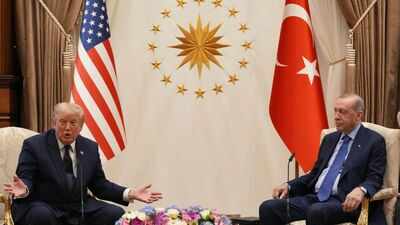
Trump made the remarks Tuesday during a bilateral meeting with Turkish President Recep Tayyip Erdoğan at the Presidential Complex in Ankara, just before the start of the NATO leaders’ summit. “We’re going to be taking the sanctions off,” Trump told reporters.
“We don’t want to sanction friends.” He added that the U.S. would “certainly consider” restoring Turkey’s access to the F-35 program, calling the jet “the best plane by far.”
The sanctions in question stem from 2020, when the U.S. imposed measures under the Countering America’s Adversaries Through Sanctions Act (CAATSA) after Turkey purchased Russia’s S-400 air defense system. That purchase led to Turkey’s exclusion from the multinational F-35 stealth fighter program, despite Ankara having invested billions and trained pilots for the aircraft.
The sanctions targeted Turkey’s Presidency of Defence Industries and included restrictions on U.S. export licenses, financial dealings, and banking transactions. They strained NATO’s second-largest army and complicated cooperation on regional security issues, including Syria, the Black Sea, and counterterrorism.
Trump’s announcement reverses a policy that had persisted through the Biden administration and into his second term until now.
Trump arrived in Ankara on July 7 for the NATO summit (July 7–8), where leaders are discussing defense spending, support for Ukraine, and alliance burden-sharing. He was greeted with a ceremonial welcome by Erdoğan, including an honor guard review and national anthems.
During their one-on-one talks, Trump praised Turkey’s role in NATO and described the bilateral relationship as stronger than ever. He indicated he was coordinating the sanctions relief with Secretary of State Marco Rubio, Treasury Secretary Scott Bessent, and Defense Secretary Pete Hegseth.
While Trump expressed willingness to consider F-35 sales and Turkey’s reintegration into the program, the path forward faces significant obstacles. Congressional opposition remains strong, particularly from lawmakers concerned about Turkey’s S-400 system, its human rights record, and regional policies (including tensions with Israel and Greece). Some reports note resistance from parts of the GOP and Israeli officials.
Legal requirements tied to the original sanctions legislation would likely require certifications from the Defense and State Departments before any sales or program re-entry could proceed. Analysts describe Trump as having “wiggle room” on the CAATSA sanctions but note that full reversal of F-35 restrictions is not automatic.
The announcement could strengthen NATO’s southeastern flank at a time of heightened regional tensions. Turkey, a key NATO member with significant military capabilities and strategic location bordering Syria, Iraq, Iran, and the Black Sea, has often pursued an independent foreign policy — including closer ties with Russia on energy and defense.
Lifting the sanctions may ease frictions within the alliance and open doors for deeper U.S.-Turkey defense and economic cooperation. It also aligns with Trump’s broader “America First” approach of prioritizing pragmatic deals with strategic partners over punitive measures.
The U.S. administration is expected to work through the necessary bureaucratic and legal channels in the coming weeks and months. Any F-35 deal would still require congressional notification and could face pushback.
For now, the development represents a diplomatic win for Erdoğan and a notable shift in Trump’s second-term foreign policy toward Turkey.