By Dr. Abdelaziz Tarekji
There is something even more painful than the crimes themselves: the sight of people who, after everything Syria has endured killing, torture, displacement and enforced disappearance still glorify Hafez al-Assad and his son Bashar, celebrate the supposed glories of the Assad era, and even promote fantasies of their return. As though half a century of oppression had never happened. As though mass graves had never been uncovered. As though the cries of prisoners had never reached the outside world.
More astonishing still is that some of these individuals present themselves as intellectuals, writers, artists, journalists and politicians people who might reasonably be expected to uphold moral and humanitarian principles and understand that human dignity is not a privilege bestowed by those in power upon their supporters. It is an inherent right that no authority may violate under any pretext.
What kind of culture finds room to glorify a dictator but none to acknowledge the suffering of his victims? What kind of patriotism justifies the killing and torture of citizens in the name of protecting their country?
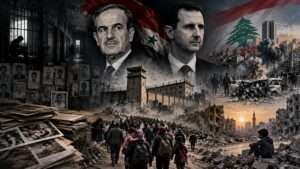
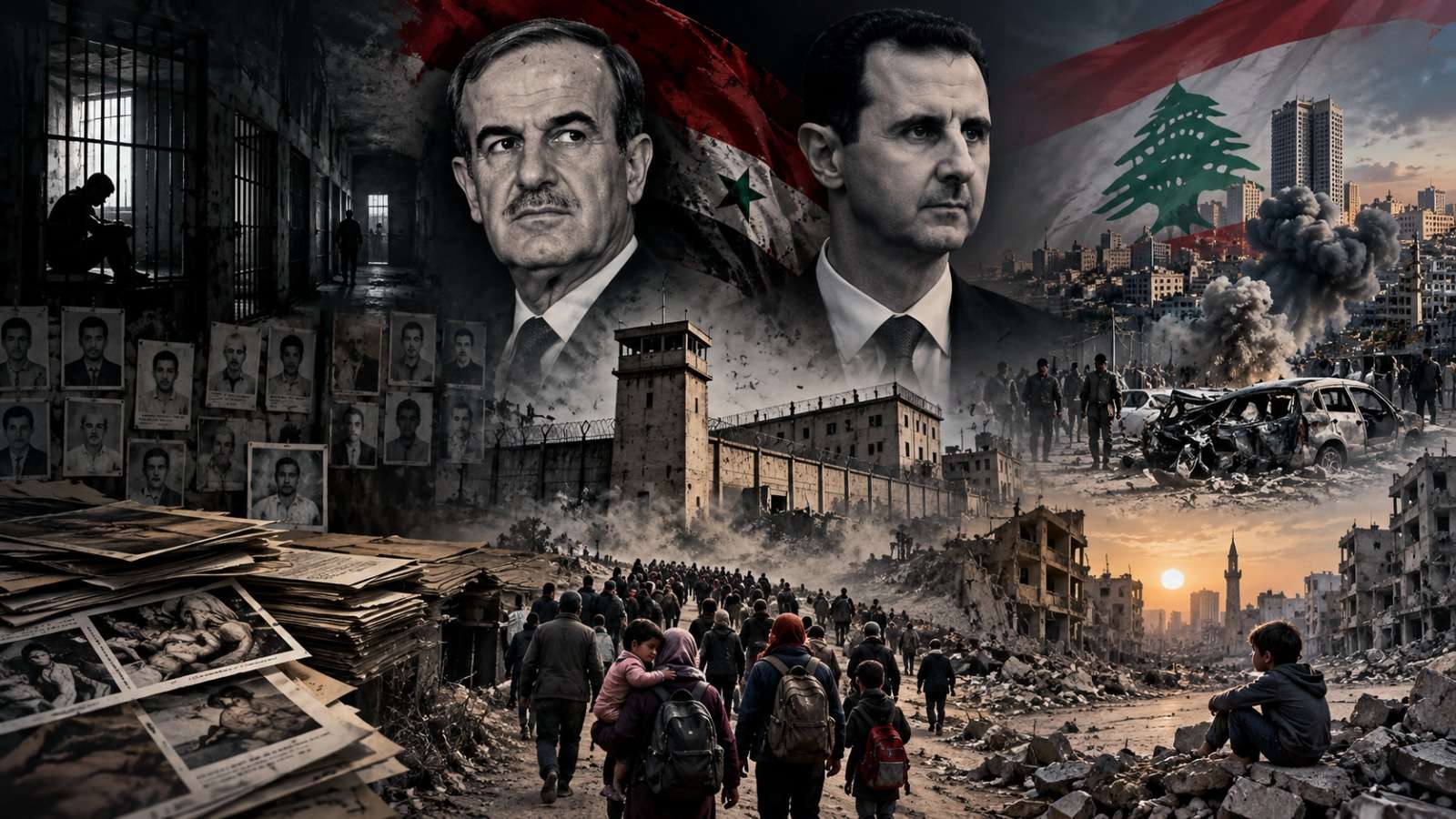
The Assad dictatorship was not merely an authoritarian political regime. It was a military and security apparatus that ruled for 54 years, from 1970 until Bashar al-Assad’s fall in December 2024, leaving behind a legacy of grave human rights violations that will remain etched in the memory of Syrians for generations.
From the dictatorship of Hafez to that of Bashar al-Assad, Syria’s tragedy was neither an isolated episode nor a mistake committed by a government during a moment of turmoil. It was a prolonged history of political repression, arbitrary detention, torture and enforced disappearance, reaching horrifying levels of organized violence against civilians at different points in time.
Under Hafez al-Assad, the abuses extended far beyond the 1980 massacre at Tadmur Prison and the 1982 Hama massacre. They formed part of an entrenched system of political and security repression built on the monopolization of power, the subordination of state institutions to intelligence agencies, and the expansion of surveillance, detention, torture and enforced disappearance until fear became an ordinary feature of Syrian daily life.
That period also witnessed the elimination of political opponents, assassinations attributed to the regime’s security services and their allies, and prisons in which thousands of detainees disappeared. State institutions were transformed into instruments for consolidating the ruling family’s authority and protecting its interests.
The consequences of these policies did not stop at Syria’s borders. They extended particularly into Lebanon, where Syrian military and intelligence involvement was associated with documented allegations of grave abuses, interference in political life, and involvement in assassinations and repression targeting opposition figures and groups.
Hafez al-Assad established a highly centralized security state in which presidential authority, family interests, military institutions and intelligence agencies became deeply intertwined, undermining institutional independence, fundamental rights and public freedoms.
The tragedy was not confined to those killed in massacres or held in prisons. It engulfed a society that lived under fear for decades, families denied knowledge of their loved ones’ fate, and generations raised within a system where loyalty to those in power became a condition of personal safety, while political dissent could lead to persecution, imprisonment or disappearance.
Then came the dictator Bashar al-Assad. The hereditary transfer of power did not usher in the rule of law. Instead, it perpetuated the police-state apparatus established by his father and strengthened the intelligence services and networks of influence tied to the ruling family. His policies did not merely tighten the security grip inside Syria; their consequences also reached Lebanon, before Syria entered one of the bloodiest and most destructive periods of its modern history in 2011.
During Bashar al-Assad’s rule, Lebanon experienced a deadly series of political assassinations and bombings targeting prominent national, political, media and security figures, particularly those opposed to Syrian influence.
The violence included the attempted assassination of minister and parliamentarian Marwan Hamadeh in 2004; the assassination of former Lebanese Prime Minister Rafik Hariri on February 14, 2005; and, later that year, the killings of journalist and intellectual Samir Kassir, former Lebanese Communist Party Secretary-General Georges Hawi, and parliamentarian and journalist Gebran Tueni.
The assassinations continued with the killing of Industry Minister and parliamentarian Pierre Amine Gemayel in 2006; parliamentarians Walid Eido and Antoine Ghanem, and Lebanese Army Brigadier General François al-Hajj in 2007; Major Wissam Eid, a prominent officer involved in investigations into Hariri’s assassination, in 2008; and Major General Wissam al-Hassan, head of the Information Branch of Lebanon’s Internal Security Forces, in 2012.
Other public figures, including minister Elias Murr and journalist May Chidiac, survived assassination attempts. These attacks unfolded amid intimidation and political and security instability, prompting repeated allegations concerning the role of Syrian intelligence agencies and their allies in targeting opponents and destabilizing Lebanon. Criminal responsibility for several of these attacks remains judicially unresolved.
Following the collapse of the Assad regime, intelligence documents emerged that renewed scrutiny of this history. Among them were documents published in February 2026 concerning an alleged plan involving former Syrian intelligence chief Ali Mamlouk to influence media narratives and mislead the international investigation.
Although the Special Tribunal for Lebanon convicted three Hezbollah members in connection with Hariri’s assassination without establishing the criminal responsibility of the Syrian leadership, the information that subsequently emerged reinforces the need for further investigation into possible coordination between Syrian regime intelligence agencies and those implicated in the crime, and for identifying everyone responsible for its planning, execution and concealment.
The Assad regime’s political and security interventions beyond Syria’s borders were therefore more than a struggle for regional influence. They were associated with a period marked by assassinations, political intimidation and serious violations of Lebanese sovereignty, leaving unresolved questions of accountability that persist to this day.
Within Syria, decades of repression, authoritarian rule, restrictions on freedom, arbitrary detention, corruption and the expanding power of the security services fueled public anger that erupted with the beginning of the Syrian revolution in 2011. Protesters demanded freedom, dignity and an end to the Assad dictatorship.
The regime responded to peaceful demonstrations with repression and violence before the country descended into a devastating armed conflict. Massacres and mass killings followed, along with the bombardment and siege of cities and residential neighborhoods, the destruction of hospitals and civilian infrastructure, and the displacement of millions of Syrians.
The scale of the tragedy could no longer be measured by the death toll alone. It was reflected in the devastation inflicted on society, generations who lost their families, homes and futures, and cities reduced to rubble by military operations and sieges.
International investigations and survivors’ testimonies revealed horrifying patterns of systematic killing, brutal torture and deliberate humiliation. Some practices were marked by extraordinary cruelty, including starvation, executions, sexual violence and the denial of medical care.
These violations were not simply isolated misconduct or instances of excessive force. International investigative bodies and human rights organizations documented their widespread and systematic nature and the involvement of military and intelligence institutions in their commission, against a backdrop of prolonged impunity.
The Caesar Files, containing thousands of photographs documenting the bodies of detainees who died within Syria’s detention system, exposed a shocking dimension of these crimes. Together with survivors’ accounts and human rights documentation, the photographs revealed evidence of torture, starvation and medical neglect, while countless families remained deprived of even the most basic knowledge of their loved ones’ fate or burial places.
Sednaya Prison, which became an international symbol of torture and executions, was only one manifestation of this system. The network of prisons and detention facilities extended through Air Force Intelligence, Military Intelligence, Political Security and other detention sites, where human rights organizations and international commissions documented extensive cases of torture, enforced disappearance and deaths in custody.
The full truth about the number of victims, the disappeared and their burial sites has yet to be established, documented and subjected to judicial accountability.
The crimes committed during that era can no longer be dismissed as mere political allegations. The Independent International Commission of Inquiry on Syria concluded that government and pro-government forces committed war crimes and crimes against humanity, including murder, torture, rape, enforced disappearance and attacks against civilians. Such violations cannot be justified by any political or security slogan.
The tragedy left by the Assad dictatorship was not simply a war that destroyed cities. It was a system of rule that trampled human dignity, tore families apart, drove millions into exile and left a legacy of mass graves, prisons, missing persons and assassinations. No political propaganda can erase that legacy. No rhetoric of sovereignty or counterterrorism can cleanse it. And its moral and legal consequences do not disappear merely because the regime has fallen and its leaders have departed.
The question is this: How can anyone, in good conscience, still glorify that era?
Have these defenders not seen photographs of detainees whose bodies were reduced to skeletal remains by torture and starvation? Have they not heard the testimonies of mothers who waited years for their sons, only to discover that they had died in detention? Have they not seen the destroyed cities, the children who lost their families, and the households scattered across countries of exile?
At this point, a moral question arises that transcends every political affiliation.
If the child of someone who now glorifies the regime had been tortured, if their daughter had been killed in a bombardment, if their brother had been forcibly disappeared, or if their mother had spent decades waiting for news of a missing loved one, would they still appear before television cameras to praise Assad and defend his rule?
Would they call the perpetrator a hero? Would they regard the suffering of their own family as an acceptable price for keeping a regime in power?
The distance between political slogans and the cries of victims sometimes reveals the depth of moral collapse among those who justify human rights abuses so long as their own families remain untouched.
Among the most offensive excuses is the attempt to whitewash decades of repression under the banner of counterterrorism, or to portray Bashar al-Assad as a leader who never bowed to foreign powers.
Under international law, combating terrorism does not grant any government the right to torture detainees, forcibly disappear citizens, starve civilian populations or launch indiscriminate attacks against civilians. Crimes against humanity do not become national achievements simply because they are presented in the language of security and stability.
Claims of national sovereignty, meanwhile, collide with the reality that Syria under Bashar al-Assad became a theater for multiple foreign military interventions, while the regime’s survival came to depend, to varying degrees, on external military and political support, particularly from Russia and Iran.
What sovereignty can be celebrated when a country becomes an open battlefield and its people are forced to pay such a devastating price with their lives and futures?
Human history has witnessed regimes and campaigns of conquest associated with massacres and repression, from the campaigns of destruction led by Hulagu Khan to the crimes of Nazi Germany under Adolf Hitler. Every era has its own context, scale of atrocities and historical responsibilities, and meaningful comparisons require careful scholarly examination.
Yet the moral lesson connecting them is unmistakable: Neither military power, political propaganda nor the cult of a ruler can legitimize crimes or erase the memory of their victims.
The Assad dictatorship will enter the historical record as one of the most repressive and bloodiest experiences of government in modern Syrian history not for the heroic achievements its propaganda claimed, but for the prisons, massacres, disappeared persons, destroyed cities and generations burdened by loss and fear that it left behind.
The fall of Assad’s rule does not mean that Syria has recovered or that the suffering of its people has ended. Wounds accumulated over decades do not heal through a political decision, vanish with a change of government or disappear simply because prison gates have been opened.
There are families who still do not know what happened to their children, young people who grew up far from their homeland, survivors who carry the marks of torture on their bodies and in their memories, and communities that will need many years of justice, redress and reconstruction.
Speaking about this tragedy does not mean endorsing Syria’s current government or granting it immunity from criticism and accountability. One’s position on the Assad dictatorship should not depend on one’s opinion of the authorities that succeeded it.
It is entirely possible to disagree with any government, criticize its policies and demand peaceful change without allowing that disagreement to become nostalgia for a system whose institutions were implicated in grave human rights violations.
Rejecting dictatorship is not a partisan position. Defending the dignity of victims is not a political alignment. And condemning torture and massacres is not a matter open to bargaining, selective outrage or political convenience.
Syrians, regardless of their backgrounds and political positions, have the right to unite around one fundamental moral and historical truth: the grave abuses inflicted upon their people cannot be justified; those responsible for crimes must be held accountable on the basis of evidence and law; and victims’ rights do not expire when governments change.
Those who continue to promote fantasies of Assad’s return and treat the dictatorship’s collapse as a personal loss should understand that history is not written through songs of praise, slogans or portraits raised in honor of tyrants. It is written through facts, documents and the testimony of those who paid the price of authoritarian rule.
Assad’s government has fallen, and the era of his family’s monopoly on power has ended. But Syria may need a long time to overcome the networks of interest and the political narratives created during that period.
Anyone who glorifies that regime today should remember that behind every number in the records of victims was a human being with a name, a life, a family and dreams. And behind every photograph of a prisoner who died under torture was a mother, father, spouse or child deprived of someone they loved.
The Assad dictatorship has ended. What remains is the duty to pursue truth and justice not to whitewash the past or wash bloodstained hands clean.
Its historical legacy will not be defined by the resilience and heroic achievements it claimed, but by the immense human tragedy revealed in detainee records, survivors’ testimonies and mass graves.
Tyrants may succeed in silencing their people for many years. They may impose their portraits and slogans upon walls and public squares. But they cannot compel history to remember them as heroes when the testimony of their victims stands as evidence of their crimes. The Assad dictatorship is gone for good. The suffering of Syrians remains a testimony that must never be erased, and a memory that no one has the right to desecrate by glorifying those who tormented them.