By Nabil (Bill) S. Mikhail
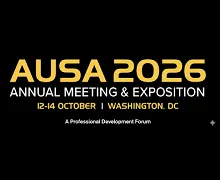
The enormous growth of the United States’ military power and technological might was at display during The AUSA (The Association of the United States Army) 2026 Annual Meeting & Exposition which took place from October 12–14, 2026, at the Walter E. Washington Convention Center in the District of Columbia. The first reaction by any lay person visiting this great place of scientific research and discoveries is that everyone should benefit from such marvelous wonders of science and technology and not just the military. While the exhibition reflected the influence of the U.S. military-industrial complex, it promulgates as well the dominant political and social ideas of the West as an advanced, sustainable, and superior human civilization.
That military fair drew over 40,000 attendees and had more than 750 exhibits. Next-generation military gears and applications were on display such as “autonomous unmanned ground vehicles (like the Overland AI IBEX), advanced counter-drone systems (like the Bullfrog C-UxS), next-generation aircraft, new carbine rifles, the Bell MV-75 Cheyenne II, Hanwha Defense USA XM1776 mobile tactical cannon, autonomous ground and drone systems.”
There are many advantages derived from this great panoramic view of military technology. It is a good strategy to maintain a mix among the leaders from the military and political establishments to mingle with the government personnel, the private sector representatives, the media, the average citizens, the tourists, and others. It is a smart way to compare the status of military technology found among the 90 countries which participated in the exhibition. Comparable also are the products of the companies that were involved in that event. Definitely, the United States monopolizes the best quality of the military equipment in the world. The exhibition as well allows for the signing of many new contracts that will be awarded to governments and companies. It builds trust among the military industry and the military apparatus since brands are the most valuable asset in that type of economy. It is a good test of how far AI (Artificial Intelligence,) has taken human knowledge especially in military areas. Noticeable is how quick remarks by the visitors became thoughtful feedbacks to the organizations taking part in that military show. Studies ought to be made to measure the marketing capabilities of this exhibition, and how much interactions and even possible collaboration is found among these firms displaying their inventories. Obviously, the army exhibition made it known that the demand for military materials is high, and that defense spending is growing. Interestingly, it is not difficult to find cases of espionage and surveillance among a number of visitors.
The army exhibition confirms this close articulation between the state and the making of war. This is no less important than the politics of holding that military exhibition and its experience to be seen by the whole world in the first place. Not too many developing countries have the capacity to do that type of military exposition. The United States distributes so many military goods and services and the conditions of being an allay or a partner with America are to be conferred on those weapons-buyers nations. The fair is a good reminder how nations exercise powers. Military power is no longer independent from other powers possessed by states, governments, corporations, organizations, groups, and individuals. The lesson one gets from the exhibition is that war is the domain of who manufactures weapons. Global trade is as much military as it is in civilian goods and commodities. Regrettably, the U.S. is the object of envy and hatred by many who do not have the same level of power like the American Republic.
Another lesson is not just to be amazed at to the great minds that designed these weapon systems but from the fact that the United States organizes its military to the highest standards of human operations and human dignity. The American military is a historical institution, the product of long historical developments, and military technology engineers that type of work ethics. The exhibition tells that the American military is an institution of war as well as an institution of peace.
Expectedly, it is impossible to put a stop to the ever accelerating pace of procuring weapons with advanced technology. Yet, that fair confirms that the United States will always be ahead in military technology. China was not an exhibitor at the conference. A good question is: If China is
rapidly modernizing its military power, why it does not display it since the United States will never be able to catch up with Peking? Another inquiry is: Since the exhibition was a prime example of how advanced American military technology could be, what other realistic military resources might be available for the Chinese to rival America since America’s military developments, growth, maturation, are the state of art and so enhanced, refined, and enriched. In conclusion, the AUSA Annual Meeting & Exposition in October 2026 proved that U.S. technology is the pillar of America’s military strategy and strength. The American military is the superstructure of a very strong foundation of scientific and technological knowledge.