By Lawson Kasshanna
Let us begin where a prominent veteran Gulf politician left off. In a lengthy post published on X (formerly Twitter), he addressed the renewed military confrontation between the United States and Iran and warned of the growing danger posed by the Iranian regime’s conduct toward the Gulf states, Jordan, and Iraqi Kurdistan—even as American naval forces remain deployed across the Arabian Gulf, the Gulf of Oman, and the Arabian Sea.
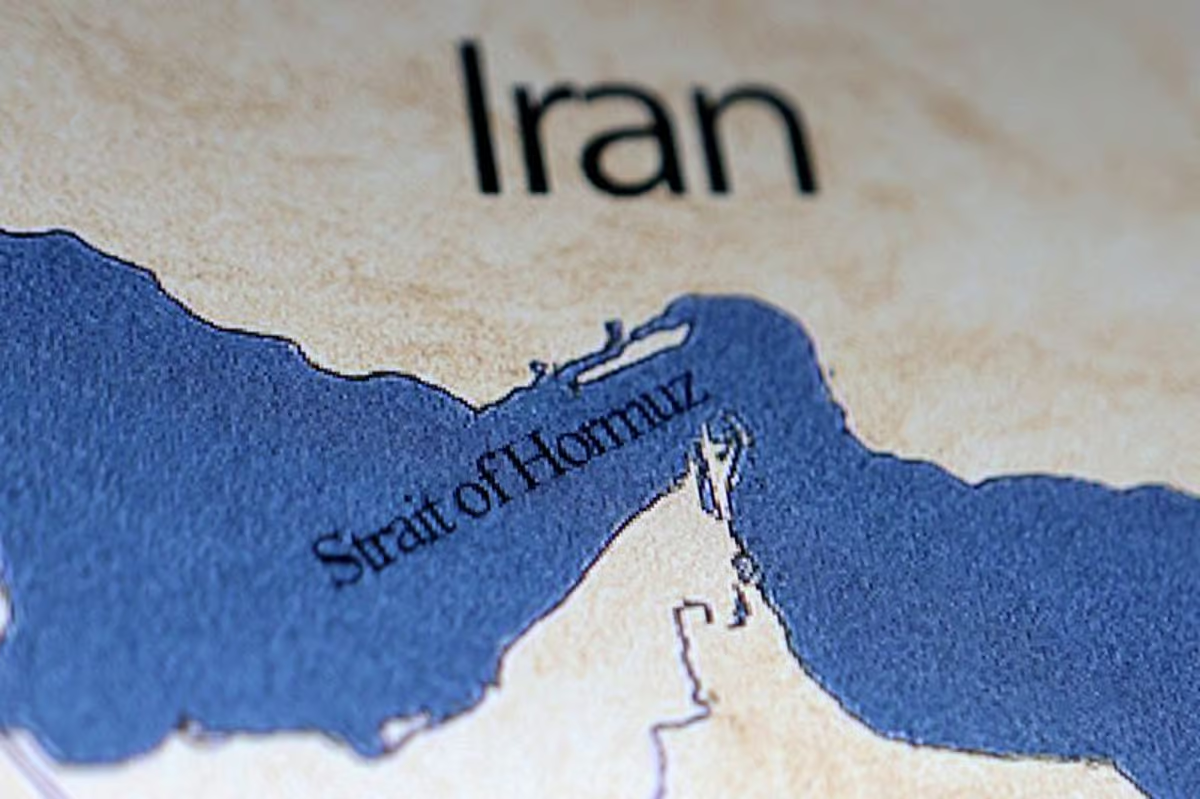
His central conclusion was unmistakable: Iran continues to exploit the Strait of Hormuz as an instrument of political coercion, demonstrating no genuine intention of changing the policies that have defined its regional behavior for decades.
He posed a direct question to the rulers of Iran:
“What, frankly, do you want from the Gulf Cooperation Council states? Do you seek domination, or relations based on good neighborliness?”
He then urged the Gulf nations to fundamentally reassess their approach toward Tehran, arguing that even if such a reassessment carries significant costs, it is necessary for Iran to understand that relations must be built upon clear principles of mutual respect—not intimidation and blackmail.
Particularly, he rejected any notion that the Strait of Hormuz could be used as a political bargaining chip, emphasizing that it is an international waterway through which no nation should be forced to pay tribute or political concessions in exchange for safe passage.
His assessment deserves serious consideration. The threat posed by the Iranian regime—especially through the Islamic Revolutionary Guard Corps and its regional proxy network—touches the existential interests of every Gulf state. It therefore demands not isolated responses, but a unified strategy of deterrence supported by coordinated political, economic, and security planning.
We have repeatedly argued that, at best, relations with the Khomeinist regime can only produce temporary truces between recurring crises. The reason is structural rather than circumstantial. The impulse to manufacture confrontation is embedded in the ideological foundations of the regime itself.
The evidence is clear.
President Donald Trump demonstrated considerable determination to pursue a negotiated agreement with Tehran. His commitment to diplomacy was so strong that some within his own political camp criticized him for being excessively accommodating.
Yet one question remains unavoidable:
What would the leaders of the Revolutionary Guard have lost had they simply exercised patience instead of escalating tensions by targeting Qatari and Saudi vessels only days earlier?
What harm would have come from allowing Trump a symbolic diplomatic success—even if only as a tactical maneuver under the ancient principle that “war is deception”?
Instead, they once again revealed the nature of the regime’s strategic thinking: confrontation is preferred over stability, escalation over coexistence.
Applying these observations to today’s reality leads to a straightforward conclusion.
The Gulf’s highest strategic interest lies in forging a coherent and unified policy toward Iran. This is not merely a political recommendation; it is advice drawn from decades of direct experience with the Islamic Republic by those who have observed its methods, confronted its ambitions, and understood its long-term objectives.
A wise call is not enough.
It must be accompanied by clarity.
It must be accompanied by determination.
My own conclusion is even more direct.
The terrorist regime in Iran and the terrorist organizations operating under its command—including Hezbollah—share the same defining characteristics. Their political culture is built upon deception, intimidation, betrayal, violence, and murder. Those who choose to trust their promises ignore a long record of repeated violations and broken commitments.
Looking toward the future, the Middle East must begin considering entirely new strategic frameworks capable of delivering lasting peace, security, and prosperity.
One possible vision would be a broader regional commonwealth bringing together willing partners—including Israel and neighboring Arab societies—through economic integration, shared markets, coordinated security, and institutional cooperation while respecting the identities and local governance of participating communities. Such a framework could include common economic mechanisms, closer financial coordination, and unified efforts against terrorism.
Under such a model, regional defense cooperation would become significantly stronger, economic opportunity would expand, and the ability of terrorist organizations to threaten the region would be greatly diminished.
Whether one agrees with every element of this vision or not, one reality is increasingly difficult to deny: the Middle East stands at a historic crossroads.
The choices made today will determine whether the region continues to cycle through endless crises—or finally begins building a stable future founded upon cooperation, security, and mutual strength.