By Khalil El Kadi
Saudi Arabia’s ambitious NEOM Green Hydrogen Project has reached a significant milestone, with 80% of its construction now complete, positioning the Kingdom as a global leader in the clean energy transition. Set to become the world’s largest renewable-powered ammonia production facility, the project is on track to begin exporting green ammonia by 2027, offering a sustainable solution for decarbonizing industries and transportation worldwide.
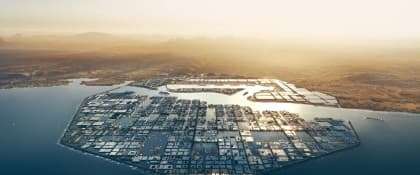
Located within NEOM, Saudi Arabia’s futuristic megacity in the northwest, the project integrates a massive green hydrogen production facility with 4 gigawatts of solar and wind power farms and a dedicated transmission grid. Jointly owned by ACWA Power, Air Products, and NEOM, the initiative is a cornerstone of Saudi Arabia’s Vision 2030, which aims to diversify the economy and advance environmental sustainability. Once operational, the facility will produce 600 metric tons of green hydrogen daily, converted into ammonia for efficient global transport. This output is expected to offset 5 million metric tons of CO2 annually—equivalent to removing 210,000 cars from the roads.
The NEOM project’s progress stands out against a backdrop of global challenges for green hydrogen development. High production costs, limited offtake agreements, and the need for costly industrial retrofits have slowed many projects worldwide. According to BloombergNEF, only about 12% of green hydrogen initiatives globally have secured firm purchase commitments. Green hydrogen remains up to four times more expensive than gray hydrogen, produced from natural gas, making it a tough sell for cost-conscious industries.
Yet, NEOM Green Hydrogen Company (NGHC) has defied these trends by securing early demand commitments. In March 2025, ACWA Power signed a memorandum of understanding with Germany’s SEFE to supply up to 200,000 tons of green hydrogen annually by 2030. While not yet a binding contract, this agreement underscores growing European interest and supports efforts to establish a “hydrogen bridge” between Saudi Arabia and Europe. These tentative commitments cover a significant portion of NEOM’s planned production, giving the project a competitive edge.
Saudi Arabia’s push into green hydrogen does not signal a retreat from its oil and gas dominance. The Kingdom, through Saudi Aramco, continues to produce approximately 9 million barrels of crude oil daily while investing in technologies to reduce emissions. Aramco’s research and development efforts aim to cut emissions by 15% by 2035, equivalent to 51.1 million metric tons of CO2 annually. At its Hawiyah gas processing facility, Aramco is capturing CO2 for enhanced oil recovery, with plans to store 9 million tons annually at its Jubail facility starting in 2028. Additionally, Aramco has acquired a 50% stake in Blue Hydrogen Industrial Gases Company, expanding its hydrogen portfolio.
This dual strategy—advancing clean energy while optimizing fossil fuel production—reflects Saudi Arabia’s pragmatic approach to global energy demands. “Our goal is to enhance the efficiency and sustainability of all energy sources to meet rising global needs,” said Ahmad Al-Khowaiter, Aramco’s executive vice president for technology and innovation.
Saudi Arabia’s vision extends beyond energy into critical minerals and manufacturing. The Kingdom is rapidly developing its mining sector, aiming to grow its contribution to GDP from $17 billion to $75 billion by 2035. Recent partnerships with global mining giants like Barrick Gold, Ma’aden, and China’s Zijin Group highlight Saudi Arabia’s focus on critical minerals for battery technologies. In December 2024, the Kingdom signed nine investment deals worth $9.3 billion under its Global Supply Chain Resilience Initiative, reinforcing its role as a key supplier in global supply chains.
“These agreements bolster Saudi Arabia’s position as a hub for critical materials while fostering domestic manufacturing and sustainability,” said Khalid Al-Falih, Saudi Minister of Investment.
The NEOM Green Hydrogen Project exemplifies Saudi Arabia’s ability to blend ambition with execution. By leveraging its abundant renewable resources, strategic partnerships, and early market commitments, the Kingdom is overcoming the hurdles that have stalled green hydrogen projects elsewhere. As the world races to decarbonize, NEOM’s success could serve as a blueprint for large-scale clean energy initiatives, proving that bold investments in sustainability can yield both environmental and economic dividends.
With operations set to begin in 2026 and exports slated for 2027, the NEOM Green Hydrogen Project is not just a milestone for Saudi Arabia but a beacon of hope for a cleaner, greener global energy future.