By Rick Clay
Executive Summary
The global system is undergoing a coordinated collapse driven by the simultaneous failure of multiple authoritarian states, the erosion of Western deterrence, and the dissolution of the institutional frameworks that once stabilized international order. Russia’s implosion is the most advanced and structurally visible, marked by war driven financial exhaustion, demographic contraction, elite fragmentation, accelerated depletion of oil reserves, the collapse of its gas sector, and the Kremlin’s coercive seizure of private capital. Rosstat and CDU TEK data confirm that Russia’s economic foundations are deteriorating at a rate no modern state can sustain, revealing a nation that is consuming its industrial base, its population, and its fiscal sovereignty to maintain the illusion of strategic momentum. This collapse is not episodic, it is structural, and it is transforming Russia from an energy superpower into a state struggling to maintain basic extraction, export, and financial functions.
China’s collapse arc, though less advanced, is equally consequential. Its deflationary stagnation, demographic implosion, elite purges, and external aggression reveal a state entering a phase where internal instability drives external escalation. China’s economic model has reached its limits, its population no longer believes in the future the state promises, and its leadership has turned inward, relying on coercion and nationalist narratives to maintain control. As China weakens, it will escalate externally to compensate for internal fragility, increasing the likelihood of conflict in the Indo Pacific and accelerating global supply chain disruption. China’s unraveling is not a distant scenario, it is an active process that will shape global geopolitics for decades.
Iran’s collapse, driven by water scarcity, agricultural failure, demographic stress, and proxy expansion, reveals how environmental degradation transforms into geopolitical fragmentation. The Sahel’s collapse, marked by Christian persecution, tribal fragmentation, and jihadist expansion, demonstrates how ungoverned spaces become accelerants of global instability. Cuba’s collapse reveals how systemic failure extends into the Western Hemisphere, creating vacuums that external actors exploit for intelligence, trafficking, and geopolitical leverage. These regional collapses are not isolated events, they are structural manifestations of a global system losing coherence.
The dissolution of global governance removes the last stabilizing mechanism capable of restraining systemic failure. The United Nations has lost coercive legitimacy, NATO is divided by political polarization, and the European Union is constrained by demographic decline and energy insecurity. Global institutions no longer possess the authority, capacity, or unity required to enforce norms or stabilize crises. The collapse of governance transforms the world from a rules based order into a marketplace of influence where power is transactional, deterrence is symbolic, and stability is contingent on temporary alignments rather than enduring structures.
Chapter One: Russia’s War Driven Financial Collapse and the Internal Fracturing of the State
Russia’s financial collapse is no longer a distant forecast but an active structural implosion visible across every dimension of its wartime economy. The Kremlin’s attempt to sustain a permanent war footing has created a distorted economic model defined by extreme militarization, artificial wage inflation, and the diversion of national resources into a defense sector that cannot produce victory. The state is not rising, it is cannibalizing itself to maintain the illusion of strategic momentum. The war economy consumes labor, capital, and political legitimacy faster than the state can replenish them, revealing a collapse driven by irreversible demographic decline, sanctions pressure, and the exhaustion of Russia’s industrial base rather than temporary wartime disruptions.
The internal fracturing of the Russian state is accelerating as the Kremlin struggles to maintain control over competing power centers, regional elites, and military factions. Russia’s ruling class no longer believes in the strategic viability of the war, yet it remains trapped within a system where dissent is fatal and loyalty is performative. This creates a political environment where elites publicly support the conflict while privately preparing for its consequences, accelerating fragmentation at the highest levels of power. The Kremlin’s reliance on coercive mobilization, propaganda saturation, and punitive measures against dissent reveals a regime that fears internal collapse more than external defeat. That fear drives increasingly irrational decision making, including escalatory rhetoric, expanded mobilization, and the suppression of regional autonomy. The internal fracturing of the state is therefore not a symptom of the war, it is a structural consequence of a regime that has lost the capacity to govern through legitimacy and must now govern through fear.
Russia’s military exhaustion is visible in the collapse of its manpower reserves, the degradation of its officer corps, and the reliance on irregular forces, penal battalions, and foreign mercenaries. The state is fighting a war it cannot sustain, using soldiers it cannot replace, with equipment it cannot manufacture at scale. Political leaders receive distorted information, make unrealistic demands, and punish commanders who report the truth, creating a feedback loop where battlefield failures are concealed until they become catastrophic. This dynamic accelerates military collapse because it prevents adaptation, reform, and strategic recalibration. Russia’s military exhaustion is therefore not simply a battlefield problem, it is a structural failure of the state’s command system, industrial capacity, and political leadership.
The financial collapse is compounded by Russia’s demographic implosion, which has accelerated under wartime conditions. The loss of hundreds of thousands of military aged men, combined with mass emigration, declining birth rates, and rising mortality, has created a demographic crisis that cannot be reversed. Russia’s future labor force is shrinking, its tax base is contracting, and its social welfare obligations are expanding. The state cannot sustain a war economy when its population is aging, shrinking, and increasingly unwilling to participate in the conflict. This demographic collapse is the foundation of Russia’s long term strategic decline, ensuring that the financial implosion described in this chapter will deepen over time.
The psychological collapse of Russian society is visible in the widening gap between official narratives and lived reality. Citizens no longer believe the state’s promises but remain trapped within a system where dissent is dangerous. This psychological collapse is as consequential as the financial and military failures because it erodes the social cohesion required to sustain prolonged conflict. When citizens lose faith in the state, they disengage from national projects, withdraw from civic participation, and prioritize personal survival over collective sacrifice. This mindset accelerates collapse because it undermines the state’s ability to mobilize resources, enforce compliance, and maintain legitimacy.
Russia’s war driven financial collapse is therefore not an isolated crisis but the first structural pillar of global systemic failure. It reveals how internal implosion produces external aggression, how propaganda masks collapse until it accelerates, and how authoritarian states compensate for weakness through escalation. The collapse is irreversible because it is driven by structural forces the Kremlin cannot control, and it will continue to accelerate as the war economy consumes the state from within.
Chapter Two: Russia’s Fragmenting State, Elite Panic, and the Rosstat Confirmed Economic Collapse
Russia’s internal collapse has accelerated beyond political fragmentation and military exhaustion, and is now quantifiable through the state’s own statistical releases. Rosstat’s most recent data reveals an economy that is deteriorating structurally, not cyclically, and a society that is absorbing wartime losses at a rate no modern industrial state can sustain. The Kremlin’s wartime economic model has produced artificial growth in defense related sectors while masking contraction across civilian industries, creating a distorted national balance sheet that cannot support long term stability. Rosstat reports that real disposable incomes fell by more than two percent year over year, industrial output outside the defense sector contracted sharply, and inflation remains elevated despite aggressive monetary tightening. These figures expose a state that is cannibalizing its civilian economy to sustain a war effort that is draining national resources faster than they can be replenished.
The labor market data released by Rosstat confirms the severity of Russia’s demographic and manpower crisis. The working age population has declined by more than half a million people in the past year, a contraction driven by wartime casualties, mass emigration, and long term demographic decline. Rosstat’s mortality statistics show a sustained increase in deaths among men aged twenty to forty, a trend that aligns with battlefield attrition and the collapse of public health infrastructure. Birth rates have fallen to historic lows, with Rosstat recording fewer than one point two million births last year, a figure insufficient to stabilize the population. This demographic implosion is not a future threat, it is an active structural collapse that undermines Russia’s labor force, tax base, and long term economic viability.
Russia’s regional economic data reveals a country fragmenting internally. Rosstat reports that more than half of Russia’s regions are running budget deficits, with several experiencing double digit contractions in key economic sectors. The regions most affected by mobilization show the steepest declines in labor availability, consumer spending, and small business activity. This regional collapse is compounded by the Kremlin’s extraction of resources from local governments to fund the war, leaving municipalities unable to maintain infrastructure, social services, or basic administrative functions. The fragmentation of regional economies mirrors the fragmentation of political authority, creating a dual collapse that accelerates the unraveling of the state.
Inflation remains a persistent structural threat despite the Central Bank’s emergency interest rate hikes. Rosstat’s consumer price index shows annual inflation above seven percent, with food inflation significantly higher in several regions. The cost of essential goods has risen faster than wages, eroding purchasing power and deepening public disillusionment. The Kremlin’s attempt to stabilize prices through administrative controls has produced shortages, black market activity, and supply chain disruptions. Rosstat’s producer price index reveals severe stress in manufacturing inputs, particularly metals, chemicals, and machinery, indicating that Russia’s industrial base is deteriorating under the strain of sanctions and wartime production demands.
Russia’s trade data confirms the collapse of its prewar economic model. Rosstat reports a significant decline in export revenues from oil and gas, driven by price caps, rerouting costs, and discounted sales to non Western buyers. The shift toward shadow fleets and illicit shipping networks has increased operational costs and reduced net revenue. Non energy exports have contracted sharply due to sanctions, supply chain disruptions, and the loss of Western markets. Import substitution has failed to compensate for the loss of advanced technology, machinery, and components, leaving Russia dependent on lower quality inputs from China and other non Western suppliers. Rosstat’s trade balance figures reveal a narrowing surplus that reflects the structural weakening of Russia’s export economy.
The collapse of Russia’s financial stability is visible in Rosstat’s reporting on corporate bankruptcies, which have increased by more than twenty percent year over year. Small and medium enterprises are failing at a rate that indicates systemic stress rather than isolated failures. The banking sector remains fragile, with rising non performing loans and declining liquidity in regional banks. The Kremlin’s reliance on forced lending, capital controls, and administrative pressure has created a financial environment where banks cannot accurately assess risk, price loans, or maintain balance sheet integrity. Rosstat’s financial sector data reveals a system that is being held together through coercion rather than market fundamentals.
The strategic consequences of Russia’s Rosstat confirmed economic collapse are profound. A state that is losing its labor force, shrinking its industrial base, fragmenting regionally, and exhausting its financial reserves cannot sustain prolonged conflict or manage geopolitical escalation. The elite panic described in this chapter is therefore rational, because the ruling class understands that the state’s economic foundations are disintegrating. Russia’s external aggression is not a sign of strength but a symptom of internal weakness, and as the collapse accelerates, the risk of miscalculation increases. Russia’s economic implosion, confirmed by its own statistical service, is the second structural pillar of global systemic failure, revealing how internal decay transforms into geopolitical instability.
Chapter Three: The Collapse of Russia’s Oil Reserves, the Degradation of Its Energy Infrastructure, and the Strategic Failure of Its Export Economy
Russia’s oil economy, long the financial backbone of the state, is entering a phase of structural collapse that is now measurable through CDU TEK’s most recent production and reserve data. The Kremlin’s wartime extraction model has accelerated depletion rates across mature fields, forced overproduction in declining basins, and exposed the fragility of an energy system that has been operating beyond sustainable limits for more than two years. CDU TEK reports that Russia’s oil production has fallen materially year over year, with output dropping below ten point nine million barrels per day, a decline driven not by voluntary cuts but by geological exhaustion, infrastructure damage, and the loss of Western technology. The Kremlin’s insistence on maintaining export volumes despite sanctions has pushed aging fields into accelerated depletion, reducing long term recoverable reserves and undermining the future viability of Russia’s hydrocarbon sector.
The depletion crisis is most severe in Western Siberia, where CDU TEK data shows double digit declines in several of Russia’s largest legacy fields. These fields, which once provided the majority of Russia’s exportable crude, are now producing at rates that cannot be sustained without advanced Western extraction technologies that are no longer available. The loss of horizontal drilling systems, enhanced oil recovery chemicals, and precision reservoir management tools has forced Russian operators to rely on outdated Soviet era methods that increase depletion rates and reduce recovery efficiency. CDU TEK’s reserve replacement ratio has fallen below one, meaning Russia is consuming more oil than it can replace, a structural indicator of long term collapse. This decline is irreversible because the geological fundamentals cannot be altered through political will or wartime mobilization.
Russia’s refinery network is collapsing under the strain of Ukrainian long range strikes, sanctions driven isolation, and chronic underinvestment. CDU TEK reports that refinery throughput has fallen sharply due to repeated attacks on key facilities, including the Ryazan, Tuapse, and Novokuibyshevsk refineries. These strikes have destroyed catalytic cracking units, damaged storage infrastructure, and forced emergency shutdowns that reduce Russia’s ability to convert crude into exportable products. The loss of refining capacity has created bottlenecks across the energy system, forcing Russia to store unsellable crude, reroute shipments through vulnerable pipelines, and rely on shadow fleets that increase operational costs. CDU TEK’s refinery outage data reveals a system operating in crisis mode, with emergency repairs replacing long term modernization and reactive patchwork replacing strategic planning.
The collapse of Russia’s oil export market is visible in CDU TEK’s shipping and export volume data. Russia has been forced to sell crude at steep discounts to India, China, and other non Western buyers, reducing net revenue even as nominal export volumes remain superficially stable. The shift to shadow fleets has increased transportation costs, insurance premiums, and logistical complexity, further eroding profitability. CDU TEK reports that pipeline exports through Druzhba have declined significantly due to European disengagement, while seaborne exports face rising risks from sanctions enforcement, maritime interdiction, and the degradation of Russia’s tanker fleet. The Kremlin’s attempt to maintain export volumes through illicit networks has created a fragile system vulnerable to disruption, seizure, and market volatility.
The depletion of Russia’s oil reserves has direct consequences for the state’s financial stability. Oil and gas revenues account for more than one third of federal budget income, and CDU TEK’s production decline has already reduced monthly revenue flows to the National Wealth Fund. The Kremlin has been forced to draw down reserves to cover wartime expenditures, creating a fiscal environment where long term obligations cannot be met without sustained hydrocarbon income. As production declines and export discounts widen, Russia’s ability to finance the war, maintain social programs, and stabilize regional budgets erodes. CDU TEK’s data reveals a state entering a phase where its financial model is collapsing in parallel with its geological base.
The strategic consequences of Russia’s oil collapse extend beyond economics. A state that cannot sustain its hydrocarbon sector cannot sustain its geopolitical posture. Russia’s influence in Europe was built on energy leverage, yet CDU TEK’s export data shows that this leverage has evaporated. The loss of pipeline dominance, the decline of refining capacity, and the depletion of reserves reduce Russia’s ability to coerce neighbors, fund proxy operations, or maintain military readiness. The collapse of the oil sector therefore accelerates the broader geopolitical collapse described in earlier chapters, transforming Russia from an energy superpower into a state struggling to maintain basic extraction and export functions.
Russia’s oil collapse is the third structural pillar of its national unraveling. It reveals a state that has exhausted its geological inheritance, degraded its infrastructure, lost access to critical technology, and entered a phase where wartime overproduction accelerates long term depletion. CDU TEK’s data confirms that Russia’s hydrocarbon economy is not merely under stress, it is collapsing, and this collapse will continue to accelerate as reserves decline, infrastructure degrades, and export markets fragment. The energy sector, once Russia’s greatest strength, has become a structural liability that will shape the trajectory of its national decline for decades.
Chapter Five: The Collapse of Russia’s Gas Sector, the Failure of Its Pipeline Empire, and the End of Its Energy Leverage
Russia’s gas sector, once the strategic backbone of its geopolitical influence, is collapsing under the combined weight of infrastructure degradation, sanctions isolation, declining field productivity, and the irreversible loss of its European market. The Kremlin’s pipeline empire, built over decades to bind Europe to Russian energy, has become a stranded asset network that no longer generates the revenue, leverage, or strategic advantage it once provided. Gazprom’s production has fallen to its lowest levels in decades, with output dropping below six hundred billion cubic meters, a decline driven not by voluntary cuts but by structural failures across the entire gas extraction and transmission system. The collapse of pipeline exports to Europe, which once accounted for more than one hundred and fifty billion cubic meters annually, has created a fiscal shock that Russia cannot absorb, forcing the state to rely on domestic consumption and discounted Asian sales that cannot replace lost revenue.
The depletion of Russia’s major gas fields is accelerating. The Yamal and Nadym Pur Taz regions, long the core of Russia’s gas production, are showing steep declines in reservoir pressure and rising extraction costs. The loss of Western technology has crippled Gazprom’s ability to maintain field productivity, manage reservoir integrity, and execute advanced drilling operations. The Shtokman project, once envisioned as a future pillar of Arctic gas expansion, has collapsed entirely, leaving Russia without a viable path to replace declining legacy fields. The geological fundamentals are deteriorating faster than the Kremlin can compensate, revealing a sector entering irreversible decline.
Russia’s pipeline network is collapsing under the strain of wartime isolation and the loss of European demand. The Nord Stream system, once the crown jewel of Russia’s energy strategy, has been rendered inoperable, eliminating the Kremlin’s most direct and profitable export route. The Yamal Europe pipeline has been effectively shut down, and the Brotherhood pipeline through Ukraine is operating under minimal volumes that will likely cease entirely as the conflict continues. These pipelines were not merely infrastructure, they were instruments of geopolitical coercion, and their collapse marks the end of Russia’s ability to manipulate European energy markets. The Kremlin’s pivot toward Asia has failed to compensate, because the Power of Siberia pipeline operates at limited capacity and relies on gas fields that cannot replace the productivity of Western Siberia. China’s purchasing strategy further undermines Russia’s leverage, as Beijing demands steep discounts and refuses long term commitments that would stabilize Russia’s fiscal planning.
Russia’s LNG sector, once seen as a potential escape from pipeline dependency, is collapsing under sanctions pressure. The loss of Western liquefaction technology has crippled Russia’s ability to expand LNG capacity, and existing facilities face maintenance challenges that cannot be resolved domestically. The Arctic LNG projects have stalled, leaving Russia unable to diversify export routes or access global spot markets. This collapse eliminates the Kremlin’s last remaining avenue for energy expansion, forcing Russia into a shrinking market dominated by discounted sales to politically cautious buyers.
The fiscal consequences of the gas sector collapse are severe. Gazprom’s revenue has fallen sharply, reducing federal budget income and weakening the state’s ability to finance the war, maintain social programs, or stabilize regional budgets. The Kremlin’s reliance on forced capital seizures, described in the previous chapter, is a direct response to the collapse of gas revenue. Russia’s energy leverage, once the foundation of its geopolitical strategy, has evaporated, leaving the state exposed to market volatility, infrastructure failures, and declining production capacity.
Russia’s gas collapse is the fifth structural pillar of its national unraveling. It reveals a state that has lost its most powerful geopolitical instrument, exhausted its geological inheritance, and entered a phase where energy decline accelerates fiscal, political, and strategic collapse. The pipeline empire that once defined Russia’s place in the world has become a monument to a vanished era, and its failure will shape the trajectory of Russia’s decline for decades.
Chapter Six: China’s Strategic Unraveling, Economic Stagnation, and the Collapse of Its Global Ambition
China’s collapse arc begins with the erosion of its economic foundations, the fragmentation of its political elite, and the failure of its global expansion strategy. The Chinese Communist Party built its legitimacy on growth, stability, and national rejuvenation, yet each of these pillars is now deteriorating simultaneously. The economy has entered a deflationary contraction driven by collapsing consumer confidence, evaporating foreign investment, and the implosion of the real estate sector that once served as the engine of national wealth. Youth unemployment has reached levels that undermine the social contract, and local governments are drowning in debt they can no longer service. China is not experiencing a temporary slowdown, it is entering a structural decline that exposes the limits of authoritarian economic management and the fragility of a system built on centralized control rather than adaptive resilience.
The internal unraveling is most visible in the behavior of China’s political elite, who are increasingly gripped by a quiet panic that the state’s trajectory is no longer sustainable. Elite purges, sudden disappearances of senior officials, and the tightening of internal security reveal a leadership that fears internal dissent more than external threats. The anti corruption campaigns, once used as instruments of political consolidation, have evolved into mechanisms for preemptively neutralizing potential rivals as the system destabilizes. This elite panic is a structural indicator of collapse because it demonstrates that the leadership no longer trusts its own institutions, its own cadres, or its own administrative machinery. When a ruling class begins to fear itself, the state enters a phase of political cannibalization that accelerates decline.
China’s demographic implosion compounds the economic and political crises. The country is aging faster than any major power in history, and its birth rate has collapsed to levels that guarantee long term labor shortages, shrinking consumer markets, and unsustainable pension burdens. The one child policy created a demographic pyramid that cannot support the demands of a modern industrial economy, and attempts to reverse the trend have failed because the population no longer believes in the future the state promises. Demographic decline is not merely a statistical problem, it is a psychological indicator of societal pessimism. When citizens choose not to have children, they are expressing a collective judgment that the future will be worse than the present. This mindset accelerates collapse because it undermines the state’s ability to mobilize national confidence, economic vitality, and social cohesion.
China’s external behavior reflects the internal collapse. As the state weakens, it compensates through maritime expansion, coercive diplomacy, and strategic aggression in the Indo Pacific. The militarization of the South China Sea, the pressure on Taiwan, and the escalation of regional tensions are not signs of strength but symptoms of internal fragility. Collapsing states escalate externally to distract from internal weakness, and China is no exception. The leadership understands that domestic legitimacy is tied to nationalist narratives, and as economic performance declines, nationalism becomes the substitute. This dynamic increases the risk of miscalculation, escalation, and regional conflict because a weakening state is more likely to take risks it would avoid under stable conditions.
China’s collapse is therefore the sixth structural pillar of global systemic failure. It reveals how economic stagnation, demographic decline, elite panic, and societal disillusionment converge into a geopolitical crisis with global consequences. The state is entering a phase where internal instability drives external aggression, where propaganda replaces policy, and where the leadership’s fear of losing control accelerates the very collapse it seeks to prevent. China’s unraveling is not a future scenario, it is an active process that will shape global geopolitics, supply chains, and security dynamics for decades.
Conclusion
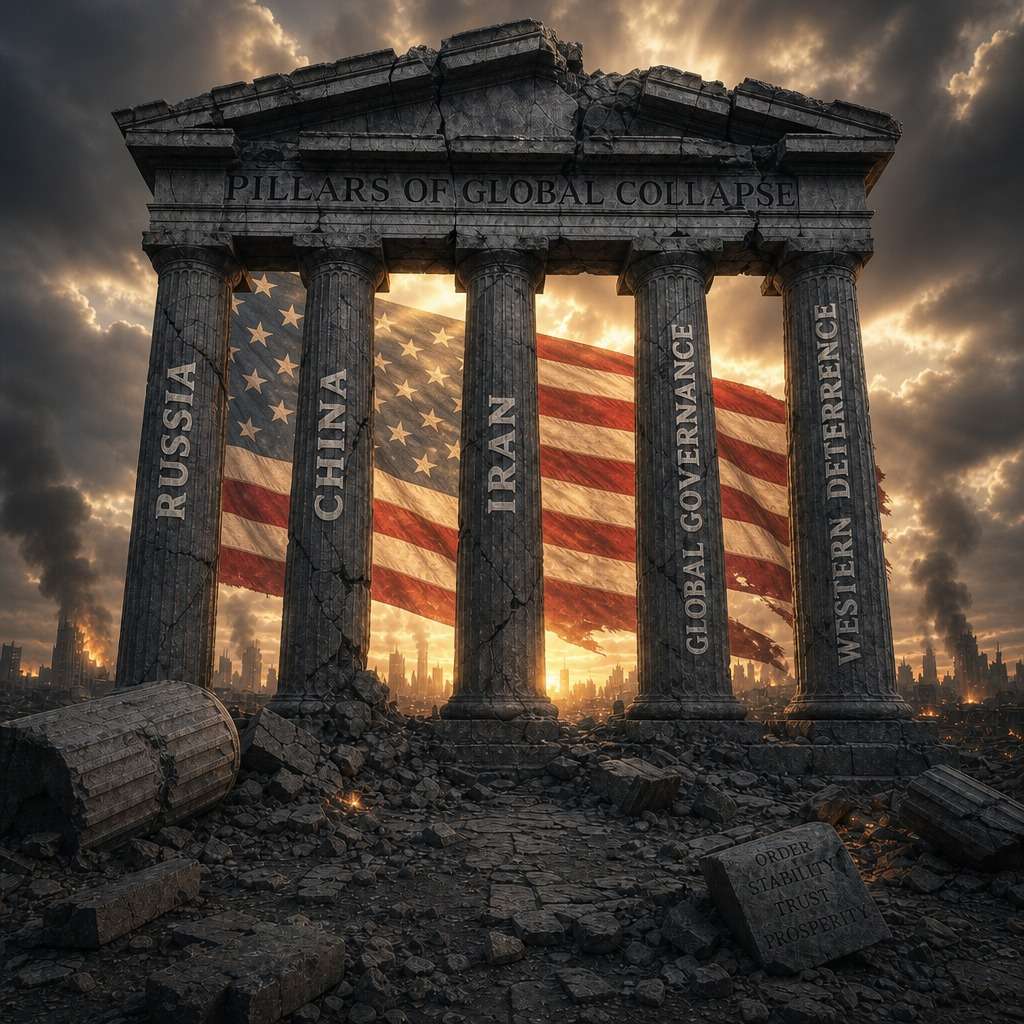
The global collapse described throughout this manuscript is not a collection of isolated crises but a single, interconnected system failure unfolding across multiple domains simultaneously. Russia’s implosion, China’s unraveling, Iran’s environmental and proxy network destabilization, the dissolution of global governance, and the erosion of Western deterrence form a unified architecture of decline that reveals the structural fragility of the modern world. Each collapse accelerates the others, creating feedback loops that amplify instability, undermine institutional resilience, and erode the foundations of geopolitical order. The world is not experiencing turbulence, it is experiencing systemic failure, and the forces driving that failure are structural, irreversible, and mutually reinforcing.
Russia’s collapse is the most advanced and visible pillar of this systemic failure. Its war driven financial implosion, demographic contraction, elite fragmentation, oil reserve depletion, gas sector collapse, and forced seizures of private capital reveal a state that has exhausted its economic foundations and entered a phase of terminal decline. Rosstat and CDU TEK data confirm that Russia’s economic model is no longer viable, its energy inheritance is deteriorating, and its fiscal sovereignty has been replaced by coercive extraction. Russia’s external aggression is not a sign of strength but a symptom of internal weakness, and as the collapse accelerates, the risk of miscalculation increases. Russia’s implosion destabilizes Europe, fragments Eurasia, and creates a geopolitical vacuum that adversaries and opportunistic.