By Nabimara Benson
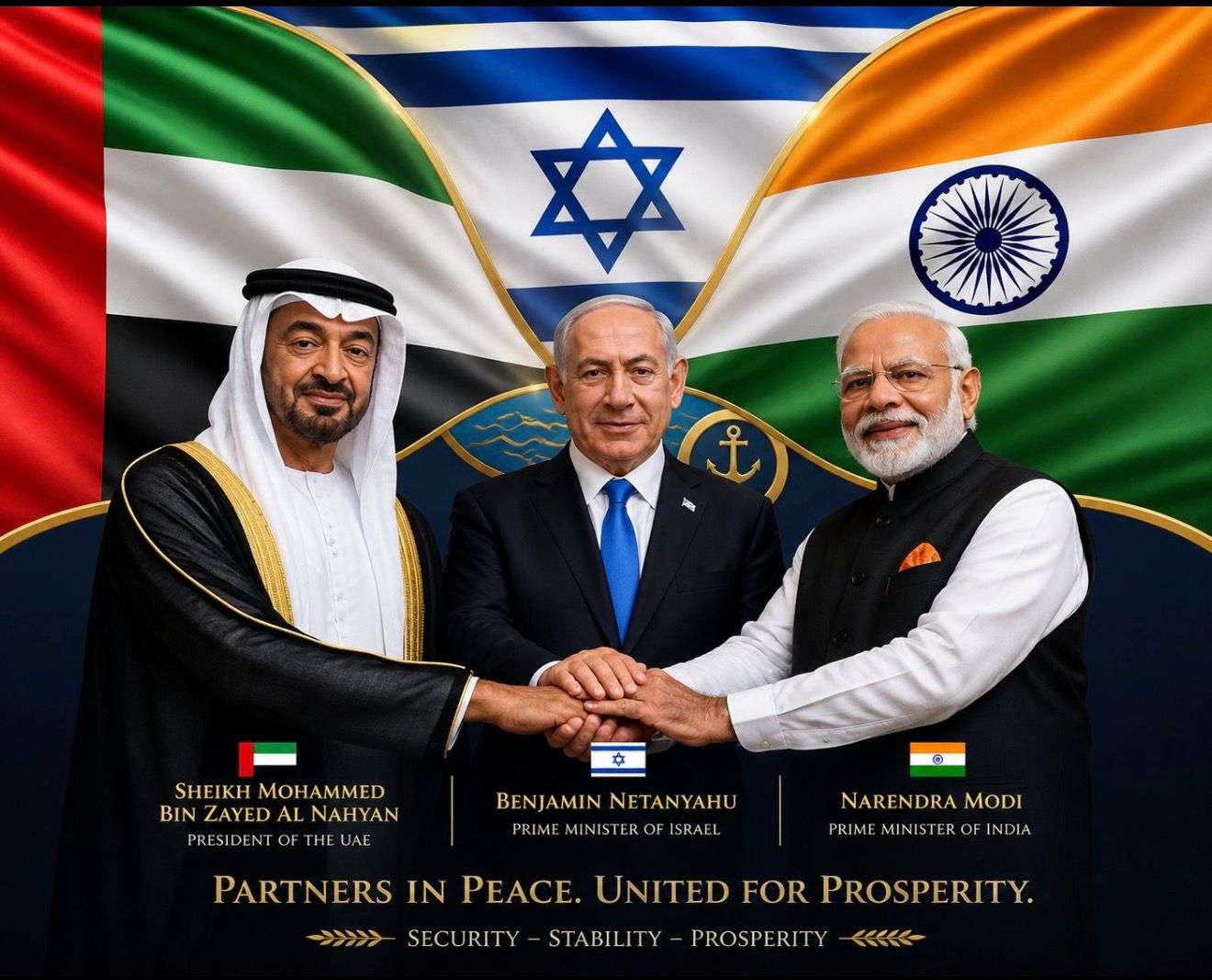
The United Arab Emirates, Israel, and India are deepening their strategic partnership through a combination of bilateral agreements and the multilateral I2U2 framework, which also includes the United States. This alignment emphasizes practical cooperation in economics, technology, defense, and connectivity rather than a formal military pact, reflecting pragmatic responses to shared interests in regional stability, supply chain resilience, and diversified partnerships in a multipolar world.
Launched in 2022, the I2U2 Group focuses on joint initiatives in water, energy, transportation, space, health, food security and technology. Recent discussions have highlighted projects such as hybrid renewable energy efforts, integrated food parks in India leveraging Israeli agri-tech, and advancements in clean energy and climate resilience. The grouping continues to gain momentum with renewed high-level engagements, including commitments to advance projects in 2025 and 2026.
Bilateral foundations underpin the trilateral dynamic. India and the UAE have significantly expanded cooperation following high-level visits, including UAE President Sheikh Mohamed bin Zayed Al Nahyan’s working visit to India in January 2026. The two countries agreed to advance a strategic defense partnership framework, alongside deals in defense, space, energy, and technology. Trade volumes have grown substantially, supported by the Comprehensive Economic Partnership Agreement.
India-Israel relations have similarly advanced, with Prime Minister Narendra Modi’s visit to Israel in February 2026 underscoring defense technology collaboration, intelligence sharing, and joint manufacturing. Discussions during the visit reinforced support for broader initiatives like the India-Middle East-Europe Economic Corridor (IMEC). Israel-UAE ties, normalized via the 2020 Abraham Accords, have expanded rapidly in trade, technology, security, and innovation.
A key connector is the India-Middle East-Europe Economic Corridor (IMEC), which envisions enhanced connectivity through ports, railways, and energy infrastructure linking India to the UAE, other Gulf states, Israel, and onward to Europe. This project complements I2U2 efforts by promoting economic integration, reducing reliance on traditional routes, and fostering private sector involvement across the three nations.
Driving forces include economic complementarity Israel’s technological innovation, the UAE’s capital and logistics expertise and India’s manufacturing scale and market, and shared security concerns such as maritime security, counter-terrorism, and regional stability. Analysts describe this as a flexible, results-oriented axis that builds redundancy in global supply chains and supports diversification away from traditional dependencies.
While implementation faces challenges from geopolitical tensions and logistical hurdles, steady progress in bilateral defense pacts, technology transfers, renewable energy projects and private sector partnerships signals tangible advancement. High-level dialogues continue to prioritize outcomes in food security, AI, space and infrastructure.
This convergence positions the UAE, Israel, and India as increasingly influential players in shaping economic and strategic architectures across Asia, the Middle East, and beyond, with quiet but substantive developments unfolding through established frameworks like I2U2.