By Dr. Abdelaziz Tarekji
When the Hijab (Veil) Is Reduced to a Single Religion
Each time the subject of the hijab (veil) is raised, it is almost entirely reduced to Islam, as if it were a religious phenomenon exclusive to Muslim women.
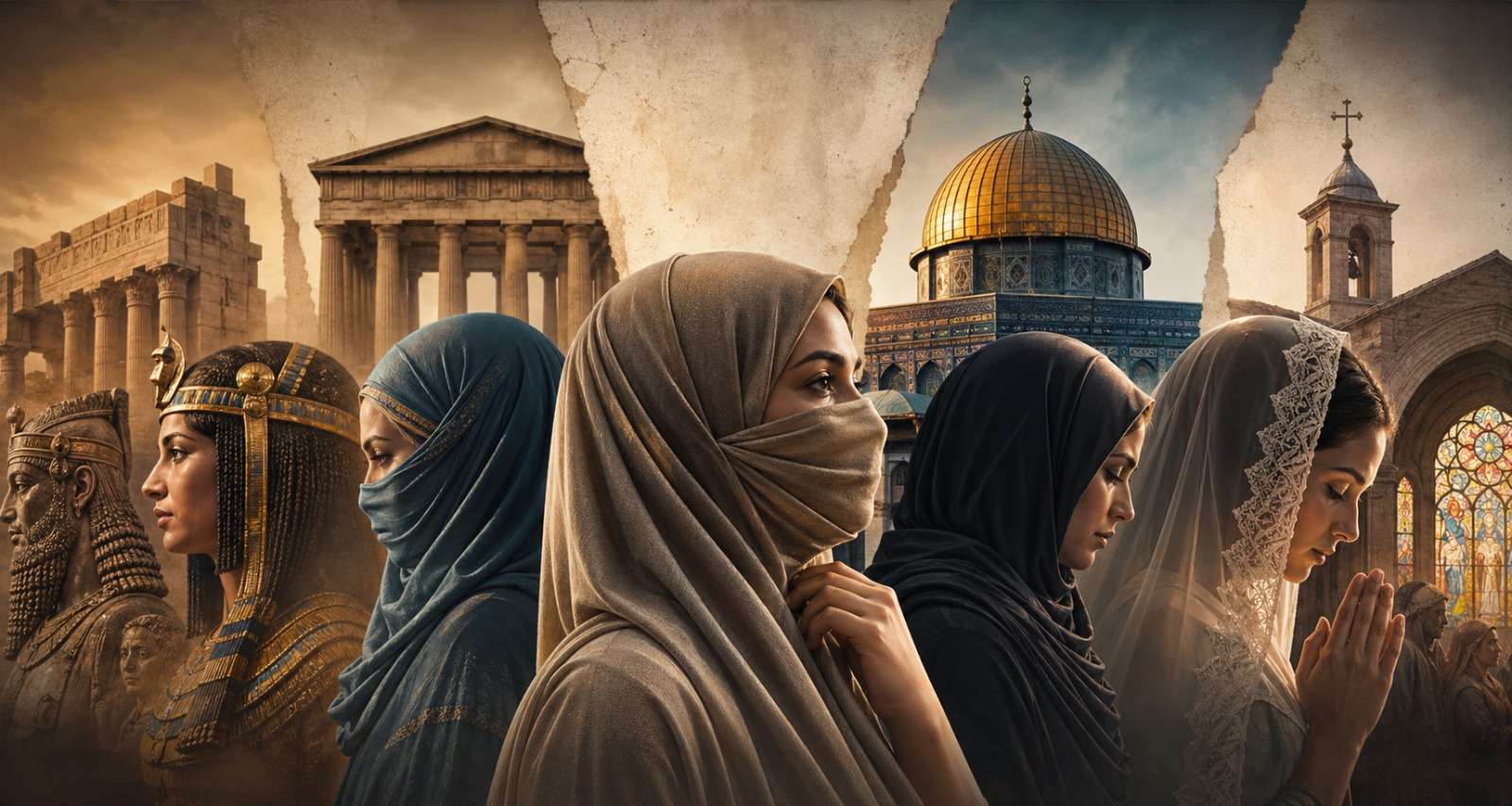
However, a return to history reveals a completely different reality: the hijab (veil) is not an Islamic invention, but rather a practice deeply rooted in human civilizations, carrying evolving social, political, and religious meanings over time.
The veil has not always been an expression of religiosity; in many periods, it served as a tool of class distinction, a means of protection, or even a symbol of social ownership over women.
The Hijab (Veil) in Ancient Civilizations: Society Before Religion
Historical sources indicate that the veil was present in the civilizations of the ancient Near East, particularly in Sumer and Assyria, where it was not merely a garment but a strict social system.
In ancient Assyrian laws, the veil was imposed on free women, while slaves and prostitutes were forbidden from wearing it. The objective was not modesty as much as clear class differentiation: a veiled woman signified that she was protected and belonged to a man or a family, while an unveiled woman was considered outside this framework.
This demonstrates that, at that stage, the veil functioned more as a mechanism of social control than as a religious practice.
From Ancient Egypt to Greece: Between Freedom and Fear.
In ancient Egypt, contrary to common assumptions, women enjoyed considerable freedom, and the veil was not a general rule. However, during periods of instabilitysuch as the Hyksos occupationwomen resorted to covering themselves as a means of protection.
In Greek civilization, the veil was once again linked to social class, with free women covering their heads while slaves were excluded.
In Rome, a significant shift occurred: the veil became more of a personal choice than an obligation, paving the way for a new religious dimension with the emergence of Christianity.
The Hijab (Veil) in Judaism: Explicit Foundations for Head Covering
In Judaism, the veil is not incidental but has clear religious roots. Biblical texts and rabbinic traditions indicate that covering the head of a married woman is a sign of modesty and respect.
In the Talmud, a woman appearing without a head covering is considered a breach of modesty norms and may even serve as grounds in marital disputes.
To this day, women in traditional Jewish communities continue to cover their hair using various methods such as scarves or wigs (sheitel).
This demonstrates that the veil in Judaism is part of a broader religious and ethical framework.
The Hijab (Veil) in Christianity: From Obligation to Social Decline
In early Christianity, the veil was more clearly established. In the Epistles of Paul in the New Testament, explicit references are made to the necessity for women to cover their heads during prayer as a sign of dignity and order within the religious community.
For long periods, Christian womenespecially in Europeadhered to head coverings in churches. However, with the evolution of Western societies and the rise of feminist and secular movements, this practice gradually declined, becoming a limited tradition rather than a general rule.
The Hijab in Islam: A Defined Religious Framework
In Islam, the hijab takes on a clearly normative character, forming part of an ethical system aimed at promoting modesty in society.
Islamic sources (the Quran and Sunnah) establish general guidelines, including that it should cover the body, not be tight or transparent, and not serve as a means of attracting attention.
Importantly, while the hijab is considered a religious obligation by the majority of scholars, it is also connected to broader values such as respect, privacy, and the regulation of gender relations.
The Legal Dimension: Between Personal Freedom and Public Regulation
In the modern era, the debate on the hijab (veil) is no longer purely religious but also legal and rights-based.
Article 18 of the Universal Declaration of Human Rights guarantees freedom of thought and religion, including the freedom to manifest beliefs through practice and dress. This places the wearing of the hijab within the scope of internationally protected individual rights.
However, some European countries have imposed restrictions on the hijab in certain settings (such as schools or public institutions), sparking debate between those who consider it a personal freedom and those who view it as a matter of public neutrality.
This reveals a contradiction: while freedom is proclaimed, a specific religious expression is sometimes selectively restricted.
The Hijab (Veil) Between History, Religion, and Politics
Through this historical, religious, and legal trajectory, it becomes clear that the hijab (veil) has never been a one-dimensional phenomenon.
It has been a social instrument in ancient civilizations, a religious symbol in Judaism, Christianity, and Islam, and today, a political and legal issue.
Reducing the hijab to a single religionor portraying it as a modern phenomenonignores a deeper historical reality:
The Hijab (veil) is a reflection of society far more than it is merely a piece of cloth.