By Prof Bill Michael
It is no coincidence that this file is being opened now. In Washington, timing is not just part of the decision—it often is the decision. When U.S. institutions begin scrutinizing a political actor the size of Yemen’s Islah Party, the matter is neither technical nor purely legal. At its core, it signals a reassessment of the party’s function within a fragile and unresolved regional equation.
The indicators are clear, even in the absence of any formal announcement: detailed inquiries, expansive reviews stretching across dozens of affiliated entities, and a level of attention that goes far beyond surface politics—into financial networks, social reach, and relationships that rarely appear in public statements. Reviews of this nature are not conducted for the sake of “information gathering” alone. More often, they serve as groundwork for options already under consideration.
Yet here lies the paradox.
Washington understands that designation is not a routine step. In Yemen’s case, such a move would not simply target a political party—it would disrupt an already fragile balance. Like it or not, Islah remains embedded in the internationally recognized political structure and maintains a presence—direct or indirect—on the ground. Removing it from the equation would not be a technical adjustment, but a political gamble with uncertain consequences.
This is why what we are witnessing appears less like a final pathway and more like calibrated pressure. The signals are deliberate, the messaging consistent—but the decisive step remains deferred. Put simply, keeping the party under pressure may, for now, be more useful than dismantling it altogether.
This also explains Islah’s response. Routing its position through the Presidential Leadership Council was not a procedural formality—it was a strategic move to tie its fate to that of Yemen’s internationally recognized authority. The message is unmistakable: targeting us will not stop with us. It is a calculated maneuver, but also one that reveals the depth of concern within the party.
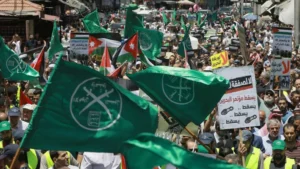
In the background, other actors cannot be ignored. The role of the United Arab Emirates has become increasingly visible—and increasingly strategic. For Abu Dhabi, this issue extends well beyond Yemen, intersecting with a broader confrontation against movements affiliated with the Muslim Brotherhood. Advocacy for designation fits within that wider doctrine—even if it does not fully align with Washington’s more layered calculus.
Within Washington itself, the picture is far from unified. One camp believes the time has come to expand the scope of designations, particularly after the more assertive posture toward the Houthis. Another warns of unintended consequences: weakening the already fragile “legitimacy camp,” creating power vacuums, and potentially pushing actors in the gray zone toward more radical alignments.
It is also worth revisiting a prior signal that, at the time, seemed limited in scope: sanctions imposed on Hamid al-Ahmar. The move passed quietly. Today, it appears more like an early step in a gradually unfolding trajectory—one whose full contours have yet to emerge.
All of this leads to an uncomfortable but realistic conclusion:
Islah is not, at this stage, the final target—it is an instrument still in play.
Washington does not currently need a decisive move as much as it needs leverage. The threat of designation generates pressure, reshapes calculations, and compels actors—inside Yemen and beyond—to make concessions that previously seemed unlikely.
Could this change? Certainly. Should conditions on the ground shift, or new intelligence emerge, escalation remains an open option. But for now, there is no indication of urgency.
What we are witnessing is not the resolution of balances—but their management.
And in files like this, ambiguity is often the most deliberate strategy of all.