By Rick Clay
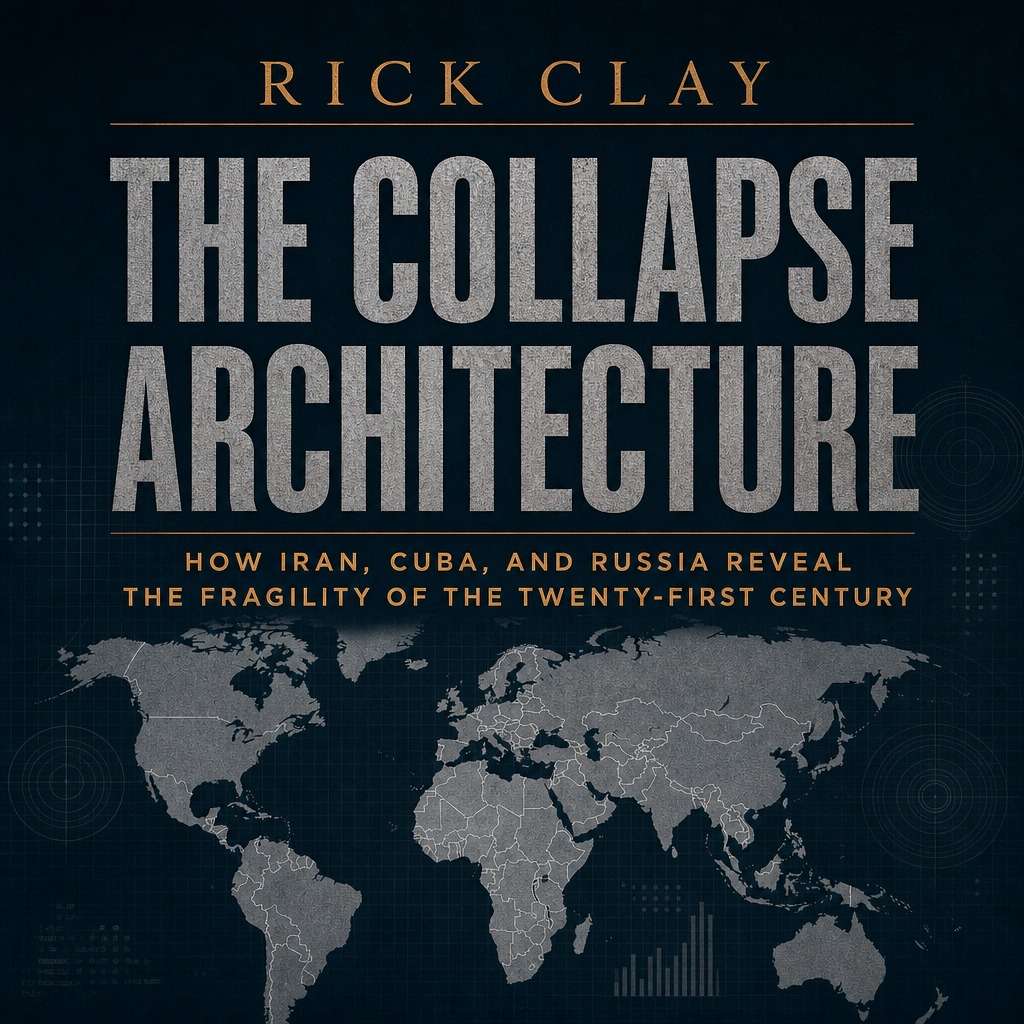
The twenty first century is being reshaped not by the ascent of authoritarian powers but by their structural collapse. Iran, Cuba, and Russia, three regimes that built their legitimacy on the illusion of permanence, are now confronting internal failures that no ideology, no security apparatus, and no foreign adversary narrative can reverse. Their crises are not episodic. They are systemic. Iran is exhausting the hydrological foundations that sustained ten millennia of civilization. Cuba is dismantling the last remnants of its Soviet era energy architecture and sliding into infrastructural insolvency. Russia is experiencing a demographic implosion, an industrial hollowing, a financial contraction, and an elite fragmentation that together erode its capacity to function as a coherent state. These collapses are not isolated events. They are interconnected expressions of a global pattern in which authoritarian systems that denied limits now confront the consequences of exceeding them.
Iran’s collapse is geological. The aquifers that once sustained the Persian heartland are irreversibly depleted, the land is subsiding, and the state is losing the physical capacity to support its population. Cuba’s collapse is infrastructural. The unfinished Huragua nuclear complex, once envisioned as the technological anchor of a socialist future, now stands as a monument to a regime that can no longer maintain the systems required for modern life. Russia’s collapse is demographic and institutional. The manpower losses of the Ukraine war, combined with decades of declining birth rates, economic stagnation, and elite disunity, have pushed the state into a structural decline that no propaganda can conceal. The St. Petersburg International Economic Forum, once the Kremlin’s premier showcase of national strength, has become a public demonstration of industrial dependency, fiscal exhaustion, and political incoherence.
For the United States, the strategic implications are profound. The collapse of adversarial regimes does not produce a safer world. It produces a more volatile one. Iran’s hydrological failure will generate migration pressures, food insecurity, and regional instability that no diplomatic framework can contain. Cuba’s energy collapse will create humanitarian and security risks within direct proximity to the American coastline. Russia’s institutional decay will increase the likelihood of miscalculation, escalation, and internal power struggles within a nuclear armed state. The United States must therefore shift from a strategy designed to manage adversarial strength to one designed to navigate adversarial collapse. The central challenge is not containment but stabilization. The vacuum created by failing authoritarian systems will be contested by criminal networks, extremist groups, rival powers, and internal factions seeking advantage amid disorder.
The collapse is not theoretical. It is underway. The architecture of collapse is the architecture of denial, the refusal of authoritarian regimes to acknowledge limits, adapt to constraints, or reform systems that have exceeded their capacity. The United States now faces a world in which the most significant threats emerge not from the ambitions of strong adversaries but from the instability generated by weak ones. The task ahead is to understand, anticipate, and manage the cascading consequences of systemic failure across regions where the foundations of governance are eroding. The fragility exposed in Iran, Cuba, and Russia is not the end of an era. It is the beginning of a new strategic landscape in which collapse, not competition, defines the global order.
THE HYDROLOGICAL COLLAPSE OF THE ISLAMIC REPUBLIC.
Iran’s collapse is geological. The aquifers that sustained ten thousand years of civilization are empty. The rivers are seasonal trickles. The lakes are salt flats. The taps in northern Tehran ran dry in the homes of government elites, and in that silence the regime’s forty five year narrative of resilience collapsed. The Islamic Republic built its legitimacy on the promise that it could provide. The water is gone. The promise is broken.
The collapse is not environmental. It is civilizational. Iran’s population grew from thirty seven million in 1979 to eighty seven million today. Every one of those additional fifty million people required water to drink, food grown with water to eat, and an economy sustained by water to survive. The water was never there to support them. The hydrology data from the 1980s onward made that clear. The regime knew it and said nothing.
Four hundred twenty of Iran’s six hundred major aquifers are critically overexploited. When extraction exceeds natural recharge, the rock collapses. The aquifer loses its structural capacity to hold water. This is irreversible on any human timescale. Land around Tehran is sinking by up to twenty five centimeters per year. In Kerman province the land has sunk by four meters in twenty five years. Wells that once produced water for generations now produce nothing. A farmer outside Isfahan summarized the collapse with a clarity no technical report can match. His grandfather dug to twelve meters and had water for forty years. His father dug to forty meters and had water for twenty years. He dug to one hundred eighty meters and had water for seven years. His son will not dig at all. There is nothing left to find.
The collapse is political because the regime made water a political instrument. Subsidized pumping, cheap electricity, and artificially low water pricing were used to maintain loyalty in rural communities that supplied the Revolutionary Guard and the Basij. To restrict pumping honestly would have been to admit that the state could not provide. The regime chose denial, suppression, and short term political survival. None of these actions restored a single drop of water.
The social consequences are already visible. Millions have been displaced from rural communities into cities that cannot absorb them. Informal settlements are expanding around Tehran, Isfahan, Mashhad, and Ahvaz. These communities lack water, sewage, and services. They are becoming the demographic base of instability that no security force can permanently contain. Tehran’s reservoirs are at twenty eight percent capacity. The authorities call rationing planned distribution. The phrase is a bureaucratic admission that the system is failing.
Iran’s collapse is the collapse of a state that built its survival on a resource it believed would last forever. The aquifer is empty. The foundation beneath the political system has given way.
THE CUBAN COLLAPSE AND THE FAILURE OF THE HURAGUA NUCLEAR COMPLEX.
Cuba’s collapse is infrastructural. The Huragua nuclear complex, conceived in the 1980s as the technological anchor of a socialist future, has become the symbol of a state that can no longer maintain the systems it once believed would guarantee its survival. The collapse of Huragua is the collapse of Cuba’s last claim to modernity.
Huragua was designed to be a nuclear city, a Caribbean Pripyat without the disaster. Tens of thousands of Soviet and Cuban engineers were meant to live there. Billions were invested. The Soviet Union funded it as a strategic outpost in the Western Hemisphere. Then the Soviet Union collapsed. The money vanished. The workers disappeared. The reactors were never completed. What remains is a surreal landscape of unfinished structures, empty streets, and decaying Soviet architecture being reclaimed by scrubland. The Cold War ended everywhere except here.
The collapse of Huragua is inseparable from the collapse of Cuba’s energy system. When Venezuela’s subsidized oil shipments evaporated, the island lost its final external lifeline. The regime attempted to compensate by pushing the incomplete nuclear complex beyond its intended operational envelope. Cooling tanks built for reactors now sit empty while rural farmers cut sugar cane beside them. The infrastructure that was supposed to power a nation is being stripped for scrap metal by Cubans who survive by selling rebar pulled from the ruins. The government attempted to destroy parts of the complex with a missile to prevent scavenging. The missile failed to detonate. The symbolism is unmistakable.
The planned nuclear city now shelters ten thousand impoverished Cubans living in unfinished buildings without water, without reliable food, and without any connection to the national economy. The fuel crisis has forced residents to cross the Bay of Cienfuegos in rowboats because ferries no longer operate. Visitors describe a place where dehydration is constant, where water is scarce, where even basic medical care is absent, and where the only functioning economy is the extraction of metal from the ruins of a Soviet dream.
Huragua is the Cuban equivalent of Iran’s empty aquifers. It is the moment when a regime’s foundational promise collides with physical reality. The Cuban state cannot generate the electricity required to maintain modern life. It cannot supply water to its people. It cannot maintain the infrastructure it built. It cannot even prevent its own citizens from dismantling the ruins of its most ambitious project.
The collapse of Huragua is the collapse of the Cuban state’s last narrative of resilience. It is the point at which the island’s future became a question not of ideology but of survival.
THE PERUVIAN REALIGNMENT AND THE FRAGMENTATION OF LATIN AMERICA’S POST LEFT ORDER.
Peru’s recent election marks a decisive break from the political trajectory that defined much of Latin America over the past decade. Early results reported by the Christian Science Monitor indicate that right wing candidate Keiko Fujimori held a narrow lead over left wing challenger Julio Guzmán Sánchez with most votes counted, reflecting a national electorate that has grown disillusioned with the instability, corruption, and economic stagnation associated with the country’s recent left leaning governments. While the final certification of results remains pending and must be confirmed through official channels, the political signal is already unmistakable. Peru is joining a continental pattern in which electorates are rejecting the ideological promises of the past in favor of leaders who present themselves as restorers of order, stability, and economic discipline. This shift is not ideological in origin. It is structural. It is the political expression of a society that has exhausted its tolerance for volatility.
Peru’s realignment is occurring in a region already undergoing profound political transformation. From Argentina to El Salvador to Chile, voters have demonstrated a willingness to abandon long standing political loyalties when confronted with rising crime, inflation, corruption, and institutional paralysis. Peru’s electorate is no exception. Years of political turnover, congressional deadlock, and presidential impeachments have eroded public confidence in the state’s ability to govern. The election therefore becomes less a contest between left and right and more a referendum on the viability of the Peruvian state itself. The public is not voting for ideology. It is voting against dysfunction.
This shift must be understood within the broader collapse architecture shaping the Western Hemisphere. Latin America’s political volatility is not occurring in isolation. It is emerging in parallel with the collapse of Cuba’s energy system, the erosion of Venezuela’s political order, the fragmentation of Ecuador’s internal security, and the broader continental struggle to contain transnational criminal networks. Peru’s political realignment is therefore not merely a domestic event. It is a regional indicator of a hemisphere in which states are being forced to confront the limits of their institutional resilience.
The deeper significance of Peru’s election lies in what it reveals about the future of regional alignment. For decades, Peru maintained a pragmatic balance between left leaning social policies and market oriented economic frameworks. That balance has collapsed under the weight of public frustration. The electorate’s rejection of the political left does not guarantee stability, but it does signal a desire for a new governing model capable of restoring order in a country that has cycled through multiple presidents in rapid succession. The question now is whether any political faction can deliver the stability the public demands.
Peru’s shift also intersects with the broader geopolitical vacuum created by the decline of traditional regional power brokers. Brazil is consumed by internal polarization. Mexico is preoccupied with its own security crisis. Cuba is collapsing. Venezuela is imploding. The United States remains the hemisphere’s most capable actor, but its strategic bandwidth is stretched across multiple global theaters. Into this vacuum step new forces, including transnational criminal organizations, foreign investors, and regional populists who promise rapid solutions to structural problems. Peru’s election therefore becomes a test case for whether democratic institutions can still channel public frustration into constructive governance rather than deeper fragmentation.
The Peruvian realignment is not an isolated political event. It is a structural signal. It reveals a hemisphere in which electorates are abandoning ideological loyalty in favor of leaders who promise stability in an era defined by institutional fragility. It reveals a region in which the collapse of old political orders is creating space for new alignments whose durability remains uncertain. And it reveals a Western Hemisphere increasingly shaped by the same forces driving collapse in Iran, Cuba, and Russia: the exhaustion of systems that can no longer meet the demands of the societies they govern.
THE RUSSIAN MANPOWER IMPLOSION AND THE END OF STRATEGIC CAPACITY.
Russia’s collapse is demographic. The state is experiencing a manpower implosion that no military victory, no territorial gain, and no propaganda campaign can reverse. Russia is losing the human capital required to sustain itself as a great power.
The roots of the collapse stretch back decades. Russia’s birth rate has been below replacement level since the early 1990s. The population is aging. Alcoholism, disease, and economic stagnation have reduced life expectancy. The state attempted to reverse these trends through incentives and nationalist appeals, but none addressed the underlying structural decline.
The war in Ukraine accelerated the collapse by consuming the demographic cohort Russia could least afford to lose. Hundreds of thousands of military aged men have been killed, wounded, or displaced. Millions have fled the country to avoid conscription. The demographic hole created by this exodus will not be filled.
The economic consequences are severe. Russia’s labor force is shrinking. Its industrial base is weakening. Its technological capacity is eroding. The military consequences are even more severe. Russia is attempting to sustain a large scale war with a shrinking pool of eligible soldiers. It is lowering recruitment standards, raising age limits, and mobilizing populations previously exempt. These measures may sustain short term operations, but they cannot reverse long term demographic decline.
Russia’s manpower implosion aligns with the broader collapse architecture of this manuscript. Iran’s collapse is driven by water. Cuba’s collapse is driven by energy. Russia’s collapse is driven by people. In each case the state built its survival on a resource it believed would last forever. In each case the resource failed.
THE GEOPOLITICAL UNRAVELING OF RUSSIA’S REGIONAL ORDER: ARMENIA AS THE FIRST BREAK IN THE CHAIN.
Armenia’s political realignment is the first visible fracture in the post Soviet security system Russia once controlled. For three decades Armenia depended on Russia for energy, security, and economic integration. Moscow supplied discounted fuel, controlled key infrastructure, mediated the Nagorno Karabakh conflict, and stationed troops on Armenian soil as the ultimate security backstop. Armenia’s economy was tied to Russian markets, its remittances flowed through Russian banks, and its political class operated under the assumption that Moscow’s protection was permanent.
That assumption has collapsed. Russia’s war in Ukraine consumed the military bandwidth, diplomatic leverage, and economic resources Moscow once used to project influence across the Caucasus. Armenia watched as Russia failed to intervene during Azerbaijan’s rapid reclamation of Nagorno Karabakh. The message was unmistakable. Russia could no longer deliver the one thing Armenia valued most: security.
The Armenian electorate responded accordingly. The rejection of pro Russian politics was not ideological. It was rational. It was the recognition that Russia’s guarantees were no longer credible. Moscow’s distraction, its military losses, its economic contraction, and its diplomatic isolation created a vacuum in a region where vacuums are dangerous. Armenia’s pivot is therefore not a choice made in comfort. It is a choice made in necessity.
The question now is not why Armenia is leaving Russia’s orbit. The question is who, if anyone, can fill the space Russia once occupied. The answer is complicated because Russia’s collapse does not automatically empower a single successor. The vacuum is being contested by multiple actors with different capabilities and ambitions. The European Union offers economic integration but not security guarantees. The United States offers diplomatic support but not permanent military presence. Iran offers proximity but carries its own instability. Turkey offers regional influence but is aligned with Azerbaijan. China offers investment but not defense.
Armenia’s shift reveals that Russia’s collapse is not only internal. It is systemic. The post Soviet order that Moscow built is dissolving because the state that sustained it is losing the capacity to project power beyond its borders. Armenia is the first state to formally acknowledge this reality through democratic means. Others will follow, not because they seek confrontation with Moscow, but because Moscow no longer offers what it once did.
Russia’s decline is no longer theoretical. It is a lived reality for the states that once depended on Moscow for stability. Armenia’s break is the first public acknowledgment that the Russian security umbrella has holes that cannot be patched. The collapse of Russian influence in the Caucasus is not a peripheral development. It is a strategic signal that the architecture of Russian power is failing at its edges, just as it is failing at its core.
THE ST. PETERSBURG ECONOMIC FORUM AND THE PUBLIC UNRAVELING OF THE RUSSIAN STATE.
The St. Petersburg International Economic Forum was once the Kremlin’s annual demonstration that Russia remained a global power integrated into the world economy. It was the stage on which Moscow signaled confidence, stability, and international relevance. In 2026 the forum became something else entirely. It became a public autopsy of a system that could no longer conceal its internal decay. The event opened under a sky filled with black smoke from Ukrainian drone strikes that penetrated the air defenses of Vladimir Putin’s own hometown. The symbolism was unmistakable. Russia’s premier economic showcase began with the admission that the state could not protect its own strategic infrastructure even during its most important political gathering.
Inside the forum, the collapse was even more visible. Robots advertised as Russian technological breakthroughs were in fact Chinese imports dressed in costumes. One collapsed on the floor and had to be dragged away. Cars presented as Russian engineering triumphs were Chinese vehicles with new badges glued on. The price markup was triple the Chinese cost. The forum resembled a provincial trade fair rather than the economic summit of a major power. The state that once claimed to rival the West now displayed its dependence on Chinese manufacturing in the most humiliating way possible.
The deeper collapse was revealed in the contradictions between Russia’s senior officials. The Minister of Finance declared that the Russian economy had transitioned to growth even as tax revenues fell by more than twenty percent, businesses closed at unprecedented rates, and bankruptcies surged across the country. The head of Russia’s largest bank admitted publicly that the state’s economic reserves were exhausted. These contradictions reflected a system in which the fiscal foundation had eroded to the point that officials could no longer coordinate a coherent narrative.
Elite fragmentation accelerated as the costs of the war and the pressures of economic decline reshaped the internal balance of power. The Kremlin’s traditional method of governance relied on distributing resources to competing factions to maintain loyalty. As resources disappeared, the factions turned inward. The disappearance of senior bankers, the public contradictions between top officials, and the visible exhaustion of the political elite were symptoms of a system in which the internal cohesion that once sustained the regime was breaking down.
Internal security overstretch completed the picture. The state attempted to maintain wartime mobilization, suppress internal dissent, manage economic contraction, and defend against external attacks with a security apparatus that was itself exhausted. The drone strikes that penetrated St. Petersburg’s air defenses during the economic forum were not isolated incidents. They were evidence of a system that could no longer protect its own strategic infrastructure.
Russia’s collapse was therefore not a sudden event but a structural process. It was the erosion of the foundations that once sustained the state. It was the moment when the institutions that maintained order began to fail. It was the point at which the regime’s capacity to govern became weaker than the forces pulling it apart. The collapse was not coming. It was underway.
UNITED STATES STRATEGIC IMPLICATIONS IN A MULTI VECTOR COLLAPSE ENVIRONMENT.
The United States is entering a strategic environment defined not by the rise of authoritarian powers but by their structural collapse. Iran’s hydrological failure, Cuba’s nuclear energy failure, and Russia’s demographic and institutional failure are converging into a geopolitical landscape in which major authoritarian regimes are losing the internal capacity to govern, to project power, and to maintain regional stability. For the United States this creates a paradox. The collapse of adversarial states does not produce a safer world. It produces a more volatile one.
Iran’s water collapse will reshape the Middle East more profoundly than any sanctions regime or nuclear negotiation. A state of eighty seven million people facing irreversible hydrological failure will generate migration flows, food insecurity, internal unrest, and regional confrontations that no diplomatic framework can contain.
Cuba’s collapse presents humanitarian, migratory, and security risks ninety miles from the United States coastline. A state that cannot maintain its electrical grid cannot maintain public health, water systems, or internal order.
Russia’s collapse presents the most complex strategic implications. A nuclear armed state experiencing demographic implosion, economic contraction, elite fragmentation, and institutional decay is not a stable actor. The risk is not that Russia becomes stronger but that it becomes weaker in ways that increase the likelihood of miscalculation, escalation, or internal power struggles with external consequences.
The United States must therefore shift from a strategy designed to manage adversarial strength to one designed to navigate adversarial collapse. The central challenge is not containment but stabilization. The vacuum created by failing authoritarian systems will be contested by criminal networks, extremist groups, rival powers, and internal factions seeking advantage amid disorder.
The collapse of Iran, Cuba, and Russia is not a future scenario. It is the present strategic environment. The United States must adapt accordingly.
THE ARCHITECTURE OF COLLAPSE.
The collapse of Iran, Cuba, and Russia reveals a twenty first century defined not by the ascent of authoritarian power but by its structural exhaustion. These regimes built their legitimacy on resources they believed would last forever. Iran believed its aquifers were infinite. Cuba believed its Soviet backed energy system would endure. Russia believed its population, its industry, and its institutions could absorb endless strain. Each belief proved false.
The architecture of collapse is the architecture of denial. It is the refusal to acknowledge limits. It is the insistence that ideology can override geology, that propaganda can replace capacity, that coercion can substitute for competence. The regimes examined in this manuscript are not falling because they were challenged from the outside. They are falling because they exhausted the internal systems that sustained them.
The United States now faces a world in which the greatest risks emerge not from authoritarian strength but from authoritarian weakness. The collapse of these regimes will reshape regions, destabilize alliances, and create crises that cannot be managed through traditional frameworks. The challenge is not to contain rising powers but to navigate the vacuum left by failing ones.
The collapse is not coming. It is here. And the world that emerges from it will be defined by how the United States understands, anticipates, and responds to the fragility now exposed at the core of three of its most enduring adversaries.