By Ampamya Ronah
In an unprecedented move redefining American economic pressure, Treasury Secretary Scott Bessent announced that the United States will convert Iran’s frozen overseas assets into a direct compensation fund for its Gulf allies. Bessent wrote on X: “Any damage Iran inflicts on our Gulf allies will be paid for with funds drawn from Iranian accounts, and any fees collected through the Gulf Waterway Management Authority at the Strait of Hormuz will likewise be reimbursed from those accounts.”
From Confrontation to Financial Accountability
These statements came amid an escalating crisis. Iran launched missile barrages targeting American military bases in Kuwait and Bahrain, with air defense systems intercepting most of them. Washington’s response marked a qualitative shift no longer purely military, but now carrying a preemptive financial dimension that turns every Iranian attack into a bill charged against Tehran’s own reserves.
The Treasury Department directed its technical teams to conduct comprehensive assessments and estimate costs related to repairing infrastructure damage in countries such as Kuwait and Bahrain. This signals a move from rhetorical escalation toward executable mechanisms.
Hormuz: The World’s Energy Artery Becomes a Bargaining Chip
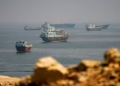
The announcement carries exceptional weight when read against the backdrop of the Strait of Hormuz a waterway through which roughly one-fifth of global oil and LNG trade flows.
The United States froze Iranian crude oil payments held in accounts belonging to its ally Qatar and other countries, a move seen as groundwork for drawing on those funds to pay compensation. Earlier, Washington and Tehran reached a ceasefire understanding brokered by Pakistan in April, after which the United States imposed a naval blockade on Iranian ports along the Strait of Hormuz.
Tehran rejected this framing outright. Iranian Foreign Ministry spokesman Ismail Baghaei stated: “The Strait of Hormuz is none of America’s business it is a matter between us and the states that border it.”
Frozen Assets: Massive Numbers, Murky Legal Waters
Tens of billions of dollars in Iranian assets sit frozen around the world, yet converting them into compensation is far from straightforward, facing significant legal and diplomatic obstacles. Analysts view the assets strategy as aimed at increasing economic pressure on Iran, which is currently demanding the release of its frozen funds as part of ongoing peace negotiations with the United States.
The diplomatic framework circulating in backchannels reveals the trade-off clearly: draft terms include reopening the Strait of Hormuz to commercial navigation, lifting the American blockade on Iranian ports, and granting Tehran access to approximately $12 billion of its frozen assets. The frozen funds have effectively become a negotiating currency released as a reward for good behavior, docked as a penalty for aggression.
Between Threat and Diplomacy: Where Does Trump Stand?
Trump’s position has oscillated noticeably between escalation and engagement. After threatening military action and seizure of Iranian oil infrastructure, he expressed optimism about reaching a peace deal soon, declaring that the economic blockade on Iran was “far better” than the military option.
In a striking development today, Friday, June 12, Trump announced from the White House what he called a “wonderful deal” to resolve the conflict with Iran, confirming that the Strait of Hormuz would formally reopen upon signing the anticipated agreement, which he suggested could happen within days possibly early next week in Europe. Yet Iranian authorities insist that negotiations have not yet reached a final resolution.
A Precedent That Redraws the Map of International Sanctions
What is unfolding today goes beyond a regional crisis. It is a genuine test of whether a major power can effectively weaponize financial tools in armed conflicts. If Washington succeeds in cementing this precedent, it will redefine the logic of deterrence for the 21st century — where an aggressor fears not only the missile fired back, but the prospect of paying for their aggression out of their own treasury.