By Joseph Hammond
President Trump’s decision to admit 10,000 more Afrikaner refugees comes as Washington and Pretoria launch a strategic reset on critical minerals and mining.
At the same time, the United States continues to accept Afrikaner refugees under a controversial humanitarian pathway that has angered parts of South Africa’s political establishment.
South Africa is also continuing to build relationships with countries opposed to U.S. interests, like Russia
“South Africa sits at the fulcrum of global mineral interest,” said Veronica Bolton Smith, CEO of Critical Minerals Africa Group. “Aligning with partners from the U.S., Russia, and elsewhere, South Africa can secure capital, technology, and market access.”
South Africa is a mining leader and remains a top source of minerals vital to U.S. security, including vanadium and platinum group metals. Rare minerals such as these have a number of national security applications.
The Trump administration and South Africa have differed on several issues in recent months. Notably, the United States has repeatedly criticized South Africa for its case against Israel at the International Court of Justice and for aspects of its foreign policy a
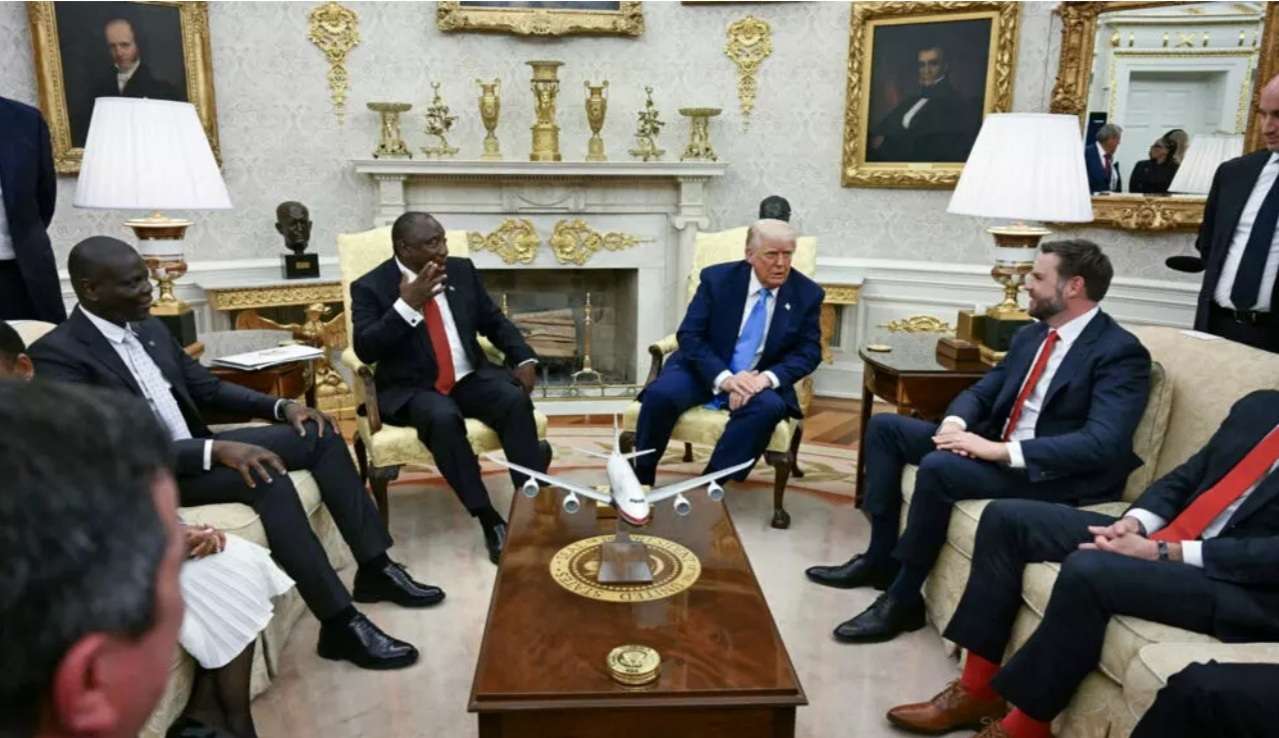
“People are fleeing South Africa for safety. Their land is being taken, and many are being killed,” President Trump said after meeting South African President Cyril Ramaphosa on May 22, 2025. He called the Afrikaners’ situation “genocide.”
During the aforementioned Oval Office discussion, a video showed South African political figures singing “Kill the Boer,” a song from the anti-Apartheid era. Most African National Congress members have abandoned it, but it’s still favored by many in the left-wing Economic Freedom Fighters party.
Last month, the Trump administration told Congress it would raise refugee admissions and reserve additional slots for Afrikaners.
“We are proving we can walk and chew gum at the same time,” said Raheem Nkumane, special envoy for South Africa’s Department of Trade, Industry and Competition. “Working together works on critical minerals.” minerals.”
Taken together, the result is a strange dual-track relationship: growing strategic cooperation alongside unresolved political friction.
In the run-up to that Oval Office encounter last year, South Africa’s Minister of Mines had blocked efforts for closer mineral cooperation between the United States and South Africa. However, the country is now undertaking a new approach prioritizing U.S. engagement in a clear win for the Trump administration.
President Ramaphosa has sought to prevent political disagreements about the fate of white Afrikaners from overshadowing economic cooperation on strategic On April 6, Ramaphosa told the American Chamber of Commerce in Johannesburg that South Africa should develop a critical minerals framework “to ensure we remain a strategic supplier to the U.S.”
The Phalaborwa Rare Earths Project could rebuild strained relations. In April, the U.S. announced a $50 million investment to recover rare earths from the project’s waste tailings, which also helps clean industrial waste near Mozambique.
At the same time, China dominates much of the global processing and manufacturing capacity for many critical minerals, while Russia and China together exert substantial influence over key vanadium supply chains.
Consequently, Africa’s critical mineral resources have become an increasingly important arena of great-power competition. On May 15, representatives of the Russian Federation pledged to invest $4 billion in South Africa’s mining sector during a meeting of the Pan-African Middle East Chamber of Commerce in Johannesburg, according to information obtained by the author.
The Lobito Corridor, an initiative to build an 800-mile railway linking Congo and Zambia to Africa’s Atlantic coast, was first launched under President Biden. Under President Trump, there has been renewed emphasis on using the corridor to increase access to critical minerals. Similar infrastructure projects could benefit South Africa.
As Washington and Pretoria move toward greater cooperation around critical minerals, an Afrikaner stands.
Roelf Meyer, an apartheid-era minister who helped negotiate South Africa’s transition, has become an important interlocutor. Recently named South Africa’s ambassador to Washington, Meyer met senior Trump associates as he prepared for his role last year. He served as the chief negotiator for the apartheid-era National Party opposite Cyril Ramaphosa with the ANC. Talks which eventually led to the end of the racist Apartheid system. Ramaphosa was then chief negotiator for the African National Congress (ANC). Meyer has reportedly met senior Trump associates in preparation for his role.
Meyer’s predecessor, former ambassador Ebrahim Rasool, was expelled after Breitbart reported that he accused Trump of mobilizing a “supremacist instinct” and promoting “white victimhood” during the 2024 campaign. After returning to South Africa, Rasool criticized Breitbart’s reporting and said later events proved him right.
For Washington and Pretoria, the question is no longer whether politics will intrude on mineral diplomacy, but whether this dual-track—simultaneous cooperation and political friction—can endure. For now, the fragile, transactional reset highlights how economic and political interests can collide, yet coexist, in the age of great-power competition.