By Lawson Kasshanna
I write to my fellow Lebanese, especially to members of our Jewish, Muslim and Christian communities. I believe a Christian state centered on Mount Lebanon could give Lebanon’s Christians a political future and give Israel a neighbor with a lasting interest in peace. I know how differently that proposition will be heard by a Christian whose children have emigrated and by a Shiite family in Beirut’s southern suburbs whose home figures in someone else’s plan for a new border. Both have every reason to read the fine print.
My starting point is the experience of the past fifty years. We have watched young Lebanese leave because a job depends on a political connection, a lifetime’s savings can disappear, and an honest citizen who turns to the courts may find that the man he is challenging has more influence over the proceedings than the judge. When parents urge their children to build a life abroad, it is often because they know exactly how things work at home.
The average Lebanese politician learns to live with this reality. Some even come to regard the “white lies,” the corruption and the broken promises as foundations of political stability. A cabinet can emerge bearing little resemblance to the one agreed upon the previous evening, and scarcely anyone is surprised. What we call a shadow state survives because it can reproduce itself through appointments, patronage and, when persuasion fails, the intimidation of arms.
It is unfair to take this political class as the measure of the Lebanese people. I remember a Lebanon whose economic and cultural life gave its citizens reason for confidence. Christians played a substantial role in building its institutions and shaping its public life. Lebanese of every community have since distinguished themselves abroad in fields where advancement at home would have required the blessing of a party leader. The question that troubles me is how much longer we can afford to educate our children for the benefit of other countries.
This is the context in which I consider a future relationship with Israel. Israel pursues its national interests, as any state does. Lebanese Christians should understand that better than most. In my judgment, the Gemayel family placed too much confidence in what Israel would do for its Lebanese partners. The fate of the South Lebanon Army when Israel withdrew left a particularly bitter lesson. An Israeli government could reverse its policy. A Lebanese family identified with that policy could not reverse its history.
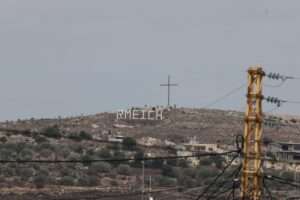
Yet that experience does not exhaust the possibilities of the relationship. Consider the frontier from Israel’s perspective. A village can be emptied, its buildings demolished and its vegetation cleared. Beyond it there will still be another village, another population and another line to defend. A neighboring government capable of keeping an agreement would offer Israel something that another stretch of cleared ground cannot. For Lebanese Christians, the corresponding interest would be a secure frontier and the freedom to develop political and economic ties openly.
The territorial model I favor takes the historical Mount Lebanon Mutasarrifate as its starting point. I can envisage a state extending toward the outskirts of Tripoli, or a different arrangement linking Mount Lebanon with the South. In the configuration I have considered, Syria would incorporate Akkar, Tripoli and part of the Bekaa Valley. Christians in peripheral areas such as Akkar could hold citizenship in the new Lebanese state and retain the freedom to decide where to live.
The hardest part of my proposal concerns the residents of Beirut’s southern suburbs. I have envisaged a territorial settlement in which those displaced from the suburbs would be directed toward the Bekaa, barred from settling in Mount Lebanon and eventually placed under Syrian responsibility. Such a policy would also put pressure on people willing to give them shelter. Its implications should be stated plainly. A Christian family from Akkar would retain a choice of residence that a Shiite family displaced from Beirut would be denied. For the family losing its home, that is the most consequential provision in the entire proposal. Anyone arguing for this map, myself included, must answer for that distinction.
Federalism also deserves serious consideration. I find it difficult, on the evidence of my own lifetime, to imagine Christians, Sunnis and Shiites recovering confidence in a centralized state whose institutions have so often been captured by those with weapons or political patrons. A federal arrangement would allow communities to exercise greater authority over their affairs while preserving a common country. Its credibility would depend on whether an elected regional government could actually govern when an armed faction rejected its decisions.
I continue to favor a state centered on Mount Lebanon. I see possibilities for cooperation with Israel in agriculture, water management, education, technology, culture and security. But the first institution I would want to see in such a state is a court in which an ordinary citizen could win a case against someone in power and expect the judgment to be enforced. After fifty years of watching influence determine whose rights count, that would give a young Lebanese family a concrete reason to stay.