Nabimara Benson
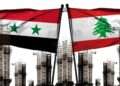
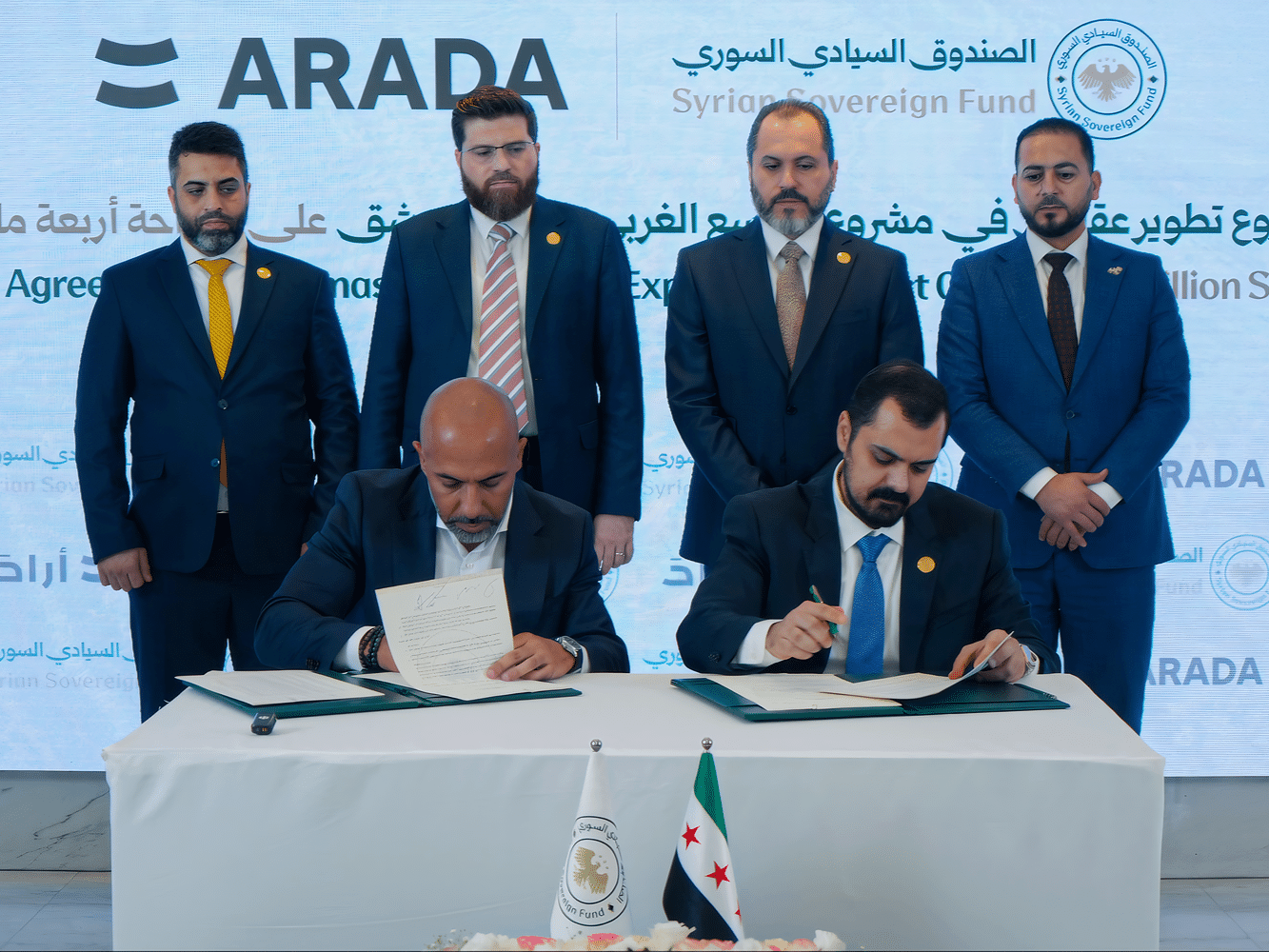
Sharjah-based developer Arada has signed a joint venture with Syria’s recently created sovereign wealth fund to build a $7 billion mixed-use district west of Damascus one of the largest foreign real-estate commitments announced since the fall of Bashar al-Assad.
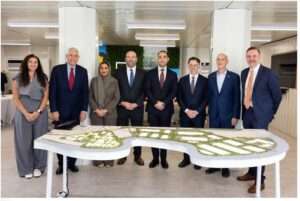
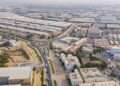
The project, branded New Damascus, is planned on a four-million-square-metre plateau near the Mezzeh district, about 10 minutes from the city centre and 25 minutes from Damascus International Airport. Arada says the site is roughly twice the size of Monaco and will be developed in phases over a decade, with homes and infrastructure slated to start next year.
The scale is designed to look less like a gated enclave and more like a self-contained city. Plans call for 11,000 homes apartments, villas, townhouses and branded residences plus 500 hotel rooms, 1,000 serviced apartments, schools for 5,000 students, a 300-bed hospital, offices, retail, government service buildings and a 700,000-square-metre public park. Officials on the Syrian side have described the layout as a “15-minute city,” with daily needs clustered close to housing. The agreement was signed in Damascus by Arada Group CEO Ahmed Alkhoshaibi and Mohammed al-Khayyat, who leads the sovereign fund’s real-estate arm, in the presence of fund chairman Mazen al-Salhani. The Syrian Sovereign Fund itself is new: it was established by presidential decree in June 2025 to manage state assets and court foreign capital after more than a decade of war and sanctions. Both sides say they are already scanning additional sites across the country.
For Arada, Syria is a fourth market after the UAE, the United Kingdom and Australia. The company now puts its pipeline at about $42 billion and more than 66,000 homes. Its ownership mix is itself a Gulf calling card: co-owners include Sheikh Sultan bin Ahmed Al Qasimi, deputy ruler of Sharjah, and Prince Khaled bin Alwaleed bin Talal, a Saudi royal and Arada’s executive vice chairman. Khaled framed the deal as arriving at “a pivotal moment” in Syria’s history. There is a personal echo in that family name. Prince Khaled’s father, billionaire Prince Alwaleed bin Talal, once owned a stake in the Four Seasons hotel in Damascus and sold it in 2018 to Samer Foz, a businessman widely described at the time as close to the Assad inner circle. The new project is not a hotel repurchase. It is a much larger urban wager under a different government, and it is being sold as reconstruction rather than as a return to the old Damascus luxury circuit.
Syrian officials have also attached a social-housing pitch to the commercial plan. Al-Salhani said the partnership includes a humanitarian track: parallel, sustainable communities for people still in camps and for owners of destroyed homes. Arada has pointed to its existing “Home for a Home” housing work and said it wants to expand that idea in Syria under the banner “City for a City.” Whether those parallel communities are funded and built at the same pace as the branded residences will be one of the project’s real tests.
The deal sits inside a broader Gulf rush into post-Assad Syria. World Bank estimates put reconstruction needs at about $216 billion, and possibly far higher. Damascus has spent the past year courting Saudi, Qatari, Emirati and U.S. capital after most Western sanctions were lifted and Syria was removed from Washington’s state-sponsor-of-terrorism list. Qatar-linked groups have moved into power generation. Saudi firms have signed airport, fibre-optic and energy memorandums. DP World and Chevron have appeared in the same reconstruction conversation.
The most visible Emirati counterpart is Mohamed Alabbar, founder of Emaar and Eagle Hills. In May and July he talked up housing and tourism schemes in Damascus and on the Latakia coast worth roughly $18 billion to $20 billion, arguing that Damascus would be “the city to watch for the next decade.” Those plans remain earlier-stage than Arada’s signed joint venture, but they underline the same thesis: Gulf developers, facing a cooler home market, see Syria as an export market for master-planned cities.
Reuters noted that the UAE has moved more slowly than some Gulf peers in warming to President Ahmed al-Sharaa’s government. A $7 billion district next to the capital is a conspicuous way to close that gap. It also fits a geopolitical story that Gulf and Western officials have been telling since Assad’s fall: reconstruct Syria fast enough, and with enough Arab capital, that Tehran does not reclaim economic ground. That is strategy. Delivery is something else.
New Damascus will succeed or stall on unglamorous questions: land title, utilities, currency convertibility, who actually pays for the infrastructure, and whether middle-class Syrians not only diaspora buyers and hotel guests can afford the homes. Arada says demand for “good quality homes” is already there, from residents and from citizens abroad. A decade-long build on a plateau west of the capital will show whether that demand can be converted into a functioning city, or whether $7 billion remains another reconstruction headline waiting for concrete.