By Rick Clay
The defeat of the Islamic Republic in the 2026 Gulf conflict marks a structural turning point in the global system. Iran’s collapse dismantled the world’s most advanced sanctions evasion architecture, fractured the networks that sustained the multipolar challenge to the United States, and forced a global repricing of energy, fertilizers, petrochemicals, and helium. The reopening of the Strait of Hormuz reversed the largest supply shock in modern history, yet the deeper transformation lies in the destruction of the maritime and financial infrastructure that allowed Iran, Russia, and China to operate outside the Western order. The fall of Tehran triggered a global reset in commodity flows, maritime insurance, and illicit finance, while exposing the vulnerabilities of Beijing’s asymmetric dependence on sanctioned hydrocarbons. The collapse of the Caribbean axis, the implosion of Cuba’s energy system, and the strategic isolation of Venezuela complete a global realignment in which the deep plumbing of global liquidity has been rewired in favor of the United States. Iran’s defeat is not merely a military outcome. It is a systemic reordering of the global economy.
The Destruction of Iran’s Shadow Fleet and Shadow Banking
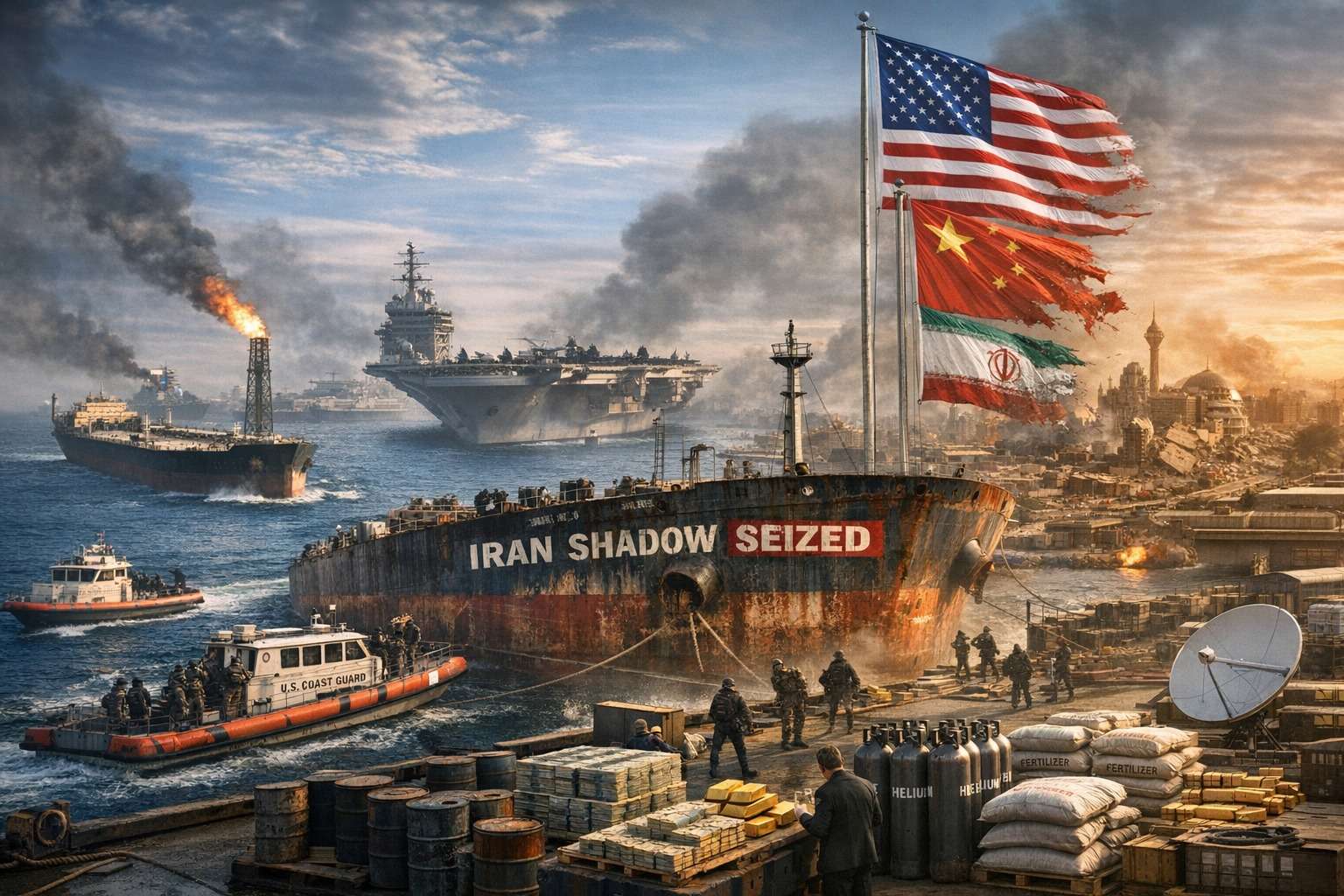
For more than a decade, Iran operated a clandestine maritime system that allowed it to export oil despite sanctions. This shadow fleet relied on aging tankers, falsified documentation, and ship to ship transfers that concealed the origin of crude. The defeat of the Islamic Republic eliminated the political protection that sustained these operations. Vessels were seized, registries revoked, and intermediaries detained or forced into cooperation with Western authorities. The maritime architecture that once moved millions of barrels of illicit crude each month has been dismantled.
The financial networks that supported these flows collapsed alongside the fleet. Iran’s shadow banking system depended on front companies, offshore accounts, and commodity backed transactions that bypassed the formal financial sector. With the fall of Tehran, these entities lost access to state resources, intelligence protection, and the liquidity pipelines that kept them operational. The alternative financial ecosystem that Iran attempted to build with Russia and China has been rendered inert. Without territorial sovereignty and maritime access, no parallel liquidity system can survive.
The destruction of these networks has global implications. For years, Iran’s shadow economy served as the connective tissue linking sanctioned actors across continents. Its collapse has severed the arteries through which illicit capital, crude, and dual use goods once flowed. The deep plumbing of global sanctions evasion has been permanently altered.
The Reopening of Hormuz and the Repricing of Global Energy
The reopening of the Strait of Hormuz following Iran’s defeat reversed the most severe energy disruption in half a century. With the removal of missile threats, drone swarms, and naval mines, the twenty million barrels per day that normally transit the Strait resumed their flow. The global energy market responded immediately. Prices stabilized, shipping insurance normalized, and supply chains that had been forced to reroute around Africa returned to their traditional routes.
Yet the more profound change lies in the elimination of the geopolitical risk premium that Iran imposed on global markets for decades. The Gulf states, long vulnerable to Iranian coercion, have begun constructing hardened export corridors, integrated air and missile defense systems, and diversified energy routes under U.S. leadership. The region is no longer held hostage by asymmetric threats from a hostile neighbor.
Liquefied natural gas markets have also stabilized. The restoration of Gulf LNG flows has reduced pressure on European and Asian electricity systems, preventing winter shortages and easing inflationary pressures. The defeat of Iran has therefore produced a structural recalibration of global energy security that extends far beyond the immediate conflict.
Fertilizers, Helium, and the Industrial Reset
The 2026 conflict revealed the extent to which global industry depends on Middle Eastern commodities that rarely appear in public discourse. The closure of Hormuz disrupted one third to one half of global urea and sulfur exports, threatening agricultural cycles across multiple continents. The defeat of Iran restored these flows, but the shock forced governments to diversify fertilizer supply chains and invest in domestic production. The world is now less vulnerable to disruptions in the Gulf.
Helium markets experienced an even more severe shock. Drone strikes on critical Gulf infrastructure temporarily halted production of one third of the world’s helium supply, threatening the operation of MRI machines and semiconductor fabrication plants. The elimination of Iranian strike capabilities has removed this threat, yet the crisis accelerated global efforts to develop alternative helium sources in North America and Central Asia.
Petrochemical markets have undergone a similar transformation. The conflict temporarily shut down a significant portion of Asian ethylene production due to naphtha shortages. The restoration of Hormuz flows revived these facilities, but the shock accelerated the shift toward diversified feedstocks, including U.S. ethane and bio based alternatives. The industrial reset triggered by Iran’s defeat has therefore reshaped the supply chains that underpin modern agriculture, healthcare, and manufacturing.
The Collapse of the Caribbean Axis
Iran’s defeat severed the strategic axis that once linked Tehran, Caracas, and Havana. For years, Iran used Venezuela as an offshore refinery complex, investing billions to restore facilities in exchange for heavy crude and gold. With the fall of Tehran and the removal of the Maduro regime, these assets were expropriated by a new government aligned with Western energy firms. Iranian influence in the Western Hemisphere has evaporated.
Cuba has suffered an even more catastrophic collapse. The island’s energy system, already fragile, imploded after losing access to Venezuelan crude and facing strict enforcement of fuel interdictions. Nationwide blackouts, water system failures, and agricultural disruptions have pushed the country into a humanitarian crisis. Iran’s defeat eliminated the diplomatic and logistical support that once sustained Havana’s energy lifeline. The Caribbean axis has collapsed, leaving Cuba isolated and strategically irrelevant.
The fall of Iran also disrupted the illicit financial channels that connected Latin American criminal networks to Middle Eastern intermediaries. The deep plumbing of sanctions evasion, gold laundering, and fuel smuggling has been dismantled, reducing the capacity of hostile actors to operate across continents.
China’s Loss of Asymmetric Leverage
China is the greatest strategic loser of Iran’s defeat. For years, Beijing relied on discounted Iranian crude to feed its independent refineries and sustain its industrial base. These barrels were often unreported, allowing China to accumulate strategic reserves at minimal cost. The destruction of Iran’s shadow fleet eliminated this supply, forcing China to compete on the open market for barrels that were previously off book.
China also relied on Iran as a testing ground for military cooperation, satellite navigation support, and dual use technology transfers. The fall of Tehran has exposed Beijing’s involvement in these activities, accelerating the formation of a counter coercive coalition among the United States, Japan, India, and the Gulf states. China’s asymmetric leverage has eroded.
The collapse of the alternative financial architecture that China attempted to build with Iran and Russia further weakens Beijing’s position. Without Iran’s networks, China lacks the maritime and financial infrastructure necessary to sustain a parallel economic order. The defeat of Tehran has fractured the multipolar bloc and restored the primacy of the Western financial system.
Strategic Outlook
The defeat of Iran has created a strategic environment in which the United States holds unprecedented leverage over the global deep plumbing of energy, finance, and industrial supply chains. The destruction of Iran’s shadow networks eliminated the primary mechanism through which adversarial states circumvented sanctions and projected influence across regions. The reopening of Hormuz restored stability to global energy markets, while the industrial reset in fertilizers, helium, and petrochemicals diversified supply chains and reduced systemic vulnerability.
The collapse of the Caribbean axis removed a long standing source of instability in the Western Hemisphere, while China’s loss of asymmetric leverage weakened the multipolar challenge to the United States. The strategic outlook is therefore defined by a reassertion of American influence across the maritime, financial, and industrial domains that constitute the deep plumbing of global power.
The central task for U.S. policymakers is to institutionalize these gains. This requires sustained investment in maritime security, expanded partnerships with Gulf and Indo Pacific states, and the construction of resilient supply chains that prevent the reemergence of shadow networks. The defeat of Iran has created a window of opportunity to reshape the global order. The challenge is to ensure that this moment becomes a durable foundation for long term stability.
Iran’s defeat reversed the global flows of energy, finance, and illicit commerce that once empowered the multipolar challenge to the United States. The destruction of the shadow fleet, the collapse of the shadow banking system, the reopening of Hormuz, and the industrial reset across fertilizers, helium, and petrochemicals have rewired the deep plumbing of the global economy. The fall of the Caribbean axis and China’s loss of asymmetric leverage complete a transformation that extends far beyond the battlefield. The world that emerges from Iran’s defeat is one in which the United States holds renewed strategic advantage, and in which the hidden arteries of global liquidity once controlled by Tehran now flow through channels aligned with Western interests. The task ahead is to consolidate this new order and prevent the reconstitution of the networks that once threatened global stability.