By Michael Arinzati
Al-Qaeda and ISIS didn’t invent their ideology from nothing. They inherited it — from a prisoner in a Cairo jail cell who belonged to the Muslim Brotherhood. Congress is finally asking why that lineage still gets a pass.
In October 1966, the Egyptian state hanged a sickly, bookish literary critic named Sayyid Qutb. He had been a senior ideologue of the Muslim Brotherhood, tortured in Gamal Abdel Nasser’s prisons, and in that captivity he wrote a short, furious book called Milestones. It is arguably the single most consequential text in the modern history of jihadist terrorism, and most Americans have never heard of it.
They’ve heard of what it produced.
The book that built the theology of terror
Milestones made an argument that had no real precedent in mainstream Islamic jurisprudence: that the entire modern world — including nominally Muslim states, including Egypt, including every government that did not rule strictly by Qutb’s reading of sharia — had regressed into jahiliyya, the state of pagan ignorance that supposedly existed before the Prophet Muhammad. Not partially un-Islamic. Not imperfect. Jahiliyya. The same word used for pre-Islamic idol-worshippers.
From that premise, Qutb built the rest of the architecture that every jihadist organization since has run on. If society is jahiliyya, then its rulers are illegitimate, whatever they call themselves. If rulers are illegitimate, they can be declared apostates — the practice known as takfir. If they are apostates, armed jihad against them is not extremism; it’s obligation. And since the corrupted masses cannot be trusted to see this on their own, a disciplined “vanguard” of true believers must seize the moment and drag history forward by force.
Jahiliyya. Takfir. Vanguardism. Offensive jihad against nominally Muslim governments. Read the founding literature of Egyptian Islamic Jihad, al-Qaeda, or the Islamic State, and you are reading footnotes to Qutb.
From a Cairo cell to Kabul
The transmission line isn’t speculative. It’s biographical.
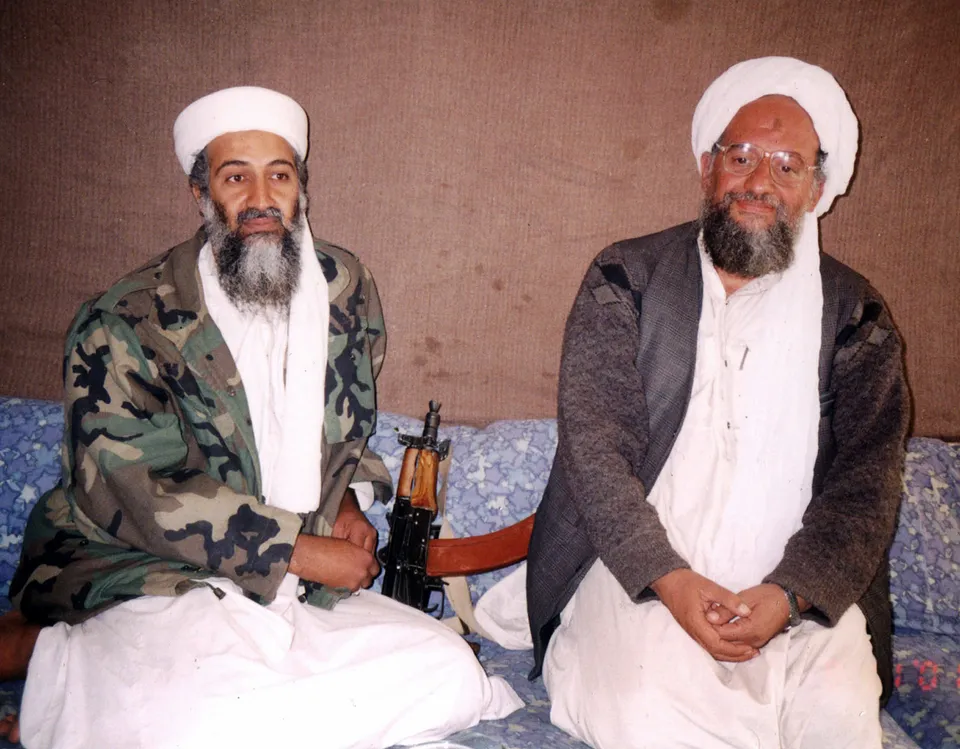
Ayman al-Zawahiri was a teenager in Cairo when Qutb was executed, and by his own later accounts and those of his biographers, the hanging radicalized him. He joined an underground cell built on Qutb’s ideas while still a schoolboy. That cell metastasized into Egyptian Islamic Jihad, the organization that assassinated Anwar Sadat in 1981 and that Zawahiri eventually led. In 1998, Zawahiri folded Egyptian Islamic Jihad into Osama bin Laden’s al-Qaeda, forming the “International Islamic Front for Jihad Against Jews and Crusaders” — the coalition that would plan the embassy bombings, the USS Cole, and September 11. Zawahiri became al-Qaeda’s chief ideologue, then its overall leader after bin Laden’s death in 2011, until a CIA drone strike killed him in Kabul in 2022. The theology he carried the entire way was Qutb’s.
And bin Laden himself did not arrive at this ideology by accident. Sayyid Qutb’s brother, Muhammad Qutb, fled Egypt after the execution and settled in Saudi Arabia, where he taught Islamic studies at King Abdulaziz University in Jeddah — the same university bin Laden attended in the 1970s. Several of bin Laden’s biographers, including Lawrence Wright in The Looming Tower, describe bin Laden absorbing Qutb’s ideology directly through his brother’s teaching circle. The man whose ideas built al-Qaeda’s justification for mass murder was, quite literally, kept alive in the intellectual bloodstream by the family of a Muslim Brotherhood martyr.
ISIS’s lineage runs through a different, overlapping stream — the Jordanian street-jihadism of Abu Musab al-Zarqawi, filtered through thinkers like Abu Muhammad al-Maqdisi. But that stream drank from the same well. Zarqawi’s world was built on the same Qutbist scaffolding — jahiliyya, takfir, vanguard war against apostate rule — fused with Salafi literalism. When the Islamic State declared its caliphate in 2014 and began executing “apostates” on camera, it was applying Qutb’s logic with industrial efficiency: society is jahiliyya, its rulers and dissenters are apostates, and the vanguard has both the right and the duty to kill them.
You cannot understand al-Qaeda or ISIS as ideological phenomena — not just as armed groups, but as belief systems that convinced tens of thousands of people to become suicide bombers — without understanding that both were built on a foundation poured by a senior figure of the Muslim Brotherhood.
“We broke with him,” says the Brotherhood. The record says otherwise.
The Brotherhood’s standard defense is that it disowned Qutb’s radicalism decades ago. After his execution, the Brotherhood’s leadership under Hassan al-Hudaybi published Preachers, Not Judges, formally rejecting the takfiri logic of Milestones and recommitting the organization to gradualist political participation rather than open revolution.
Take that at face value for a moment, and a problem remains: the Brotherhood never disowned Qutb the man, only selectively distanced itself from his conclusions while keeping his diagnosis. Brotherhood literature to this day lists Qutb among its most important thinkers. Milestones remains in print, translated, and circulated through Brotherhood-adjacent networks worldwide. The organization renounced the tactic — declaring the near enemy an apostate and shooting him — without renouncing the theology that makes the tactic thinkable. That is not a repudiation. It is a change of tempo.
And the tempo matters less than people think when the destination is the same. This is the same movement whose Palestinian branch is, by its own founding charter, Hamas — an organization the United States has designated a Foreign Terrorist Organization since 1997. It is not an analogy or an accusation to say Hamas is the Muslim Brotherhood’s offspring. It is the Brotherhood’s own claim about itself.
What Washington already knows
This year, the pattern moved from analysis to enforcement. In January 2026, Treasury designated the Egyptian and Jordanian Muslim Brotherhood branches as Specially Designated Global Terrorists for material support to Hamas, and the State Department designated the Lebanese Brotherhood — al-Jamaa al-Islamiyah — as a Foreign Terrorist Organization. In July, Treasury went further up the org chart, sanctioning Mahmoud al-Abyari, the London-based Secretary General of the Egyptian Brotherhood’s own General Secretariat, for helping raise funds that reached Hamas’s military wing through previously sanctioned front organizations. Treasury described a “multi-layered typology” of sham charities, shell companies, and underground banking moving money across the UK, Turkey, Indonesia, and Gaza — the financial skeleton of an organization that has spent decades selling itself to Western governments as a moderate, civic-minded alternative to jihadism.
Congress has noticed the contradiction. The bipartisan Muslim Brotherhood Terrorist Designation Act — introduced by Representatives Mario Díaz-Balart and Jared Moskowitz, with a Senate companion from Ted Cruz — cleared the House Foreign Affairs Committee in December 2025. It would do what no administration has yet done: direct the Secretary of State to catalog and designate the global Muslim Brotherhood as a whole, not just its branches and financiers one indictment at a time. The bill’s own text calls the Brotherhood a transnational organization that provides support to branches “conducting terrorism” and poses a “direct threat to U.S. national security.”
The distinction that no longer holds
For years, the operating assumption in Washington was that the Brotherhood and al-Qaeda-style jihadism were rivals, not relatives — that the Brotherhood’s willingness to run candidates in elections proved it had genuinely broken from the revolutionary current Qutb unleashed. There’s truth in the rivalry: al-Qaeda and ISIS have both denounced the Brotherhood as sellouts for participating in democratic politics, which they consider a form of apostasy in itself.
But a family feud is still a family. Both sides of that argument are working from Qutb’s ledger — they disagree only on the interest rate. The Brotherhood kept the diagnosis and softened the prescription; al-Qaeda and ISIS kept the diagnosis and radicalized the prescription further. Neither faction ever went back to first principles and rejected jahiliyya, takfir, or the idea that the modern Muslim world requires a vanguard to seize it back by force. One just does it with press releases and one does it with car bombs.
That is why “the Brotherhood isn’t al-Qaeda” has always been a weaker argument than it sounds. Nobody serious claims the Brotherhood’s Cairo headquarters is planning the next embassy bombing. The claim is that the Brotherhood is the ideological reservoir the jihadist movement has drawn from for sixty years, and that its financial and organizational infrastructure — the same infrastructure Treasury is now dismantling piece by piece — has repeatedly proven willing to fund the violent wing of the family when the cause is right. Hamas is not a hypothetical. It is the case study.
The argument for outlawing it
A formal U.S. designation of the global Muslim Brotherhood as a terrorist organization would not be a novelty. Egypt, Saudi Arabia, the UAE, Bahrain, Russia, and Syria have already done it, for their own reasons and with their own excesses — but the underlying judgment, that the Brotherhood is a security threat rather than an ordinary civic association, is not a fringe position abroad. It is the American political system that has been the outlier, treating branches and financiers as isolated bad actors while leaving the parent organization’s legal status ambiguous.
That ambiguity has a cost. It lets Brotherhood-linked charities, foundations, and advocacy groups operate in the United States and Europe under a presumption of legitimacy that the organization’s own ideological lineage and its own Palestinian branch’s terrorism record do not support. It lets a UK-based Secretary General fundraise for Hamas-linked institutions for years before Treasury catches up to him one designation at a time. A blanket designation, as the pending legislation proposes, would replace piecemeal enforcement with a standing legal wall — automatic screening, freezing, and prosecution power against the network as a whole, rather than a slow-motion whack-a-mole against whichever affiliate gets caught this year. Qutb has been dead for sixty years. The prison that executed him is long gone. But the doctrine he wrote on scraps of paper still has a live financial network, a seat in European capitals, and — as of this month — a Secretary General with a UK address and a sanctions file. The theology that built al-Qaeda and ISIS did not stay in that Cairo cell. It found an organization willing to keep it in circulation. It’s past time Washington called that organization by its name.