By Maria Maalouf
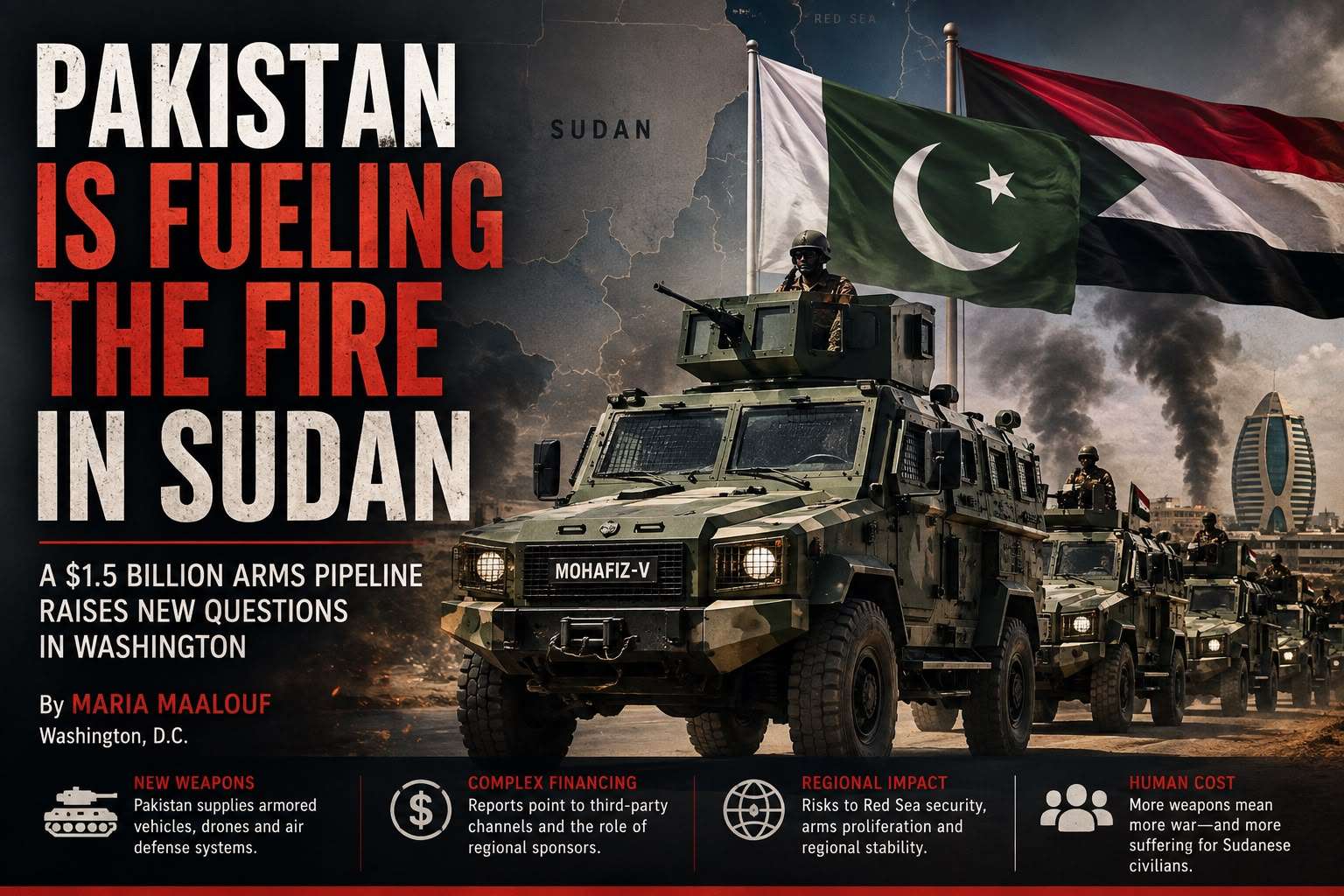
The first public appearance of 100 Pakistani-made Mohafiz-V armored vehicles in a Sudanese Armed Forces military parade in Khartoum is more than another weapons delivery in a distant war. It signals a dangerous new phase in Sudan’s conflict—one in which outside powers are helping rebuild military capabilities while diplomatic efforts struggle to stop the bloodshed. The armored vehicles reportedly represent the visible edge of a much larger defense arrangement between Port Sudan and Islamabad, estimated at approximately $1.5 billion. For Washington, the question should not simply be what Pakistan is selling Sudan. The more important questions are who is financing it, what else is being delivered, and whether foreign military support is making an already catastrophic war even harder to end.
The $1.5 Billion Question
The Mohafiz-V is manufactured by Pakistan’s state-owned defense industry and designed for mobility across difficult and semi-arid terrain—the exact battlefield environment found across Darfur and Kordofan. But the armored vehicles may represent only one component of a much broader military package. Regional reports and intelligence assessments cited by the press indicate that the arrangement could include Shahpar-2 reconnaissance and attack drones, loitering munitions, spare parts for K-8 Karakorum light-attack aircraft and Chinese-origin air-defense platforms. If these systems are delivered and operationalized at scale, they could significantly reinforce the Sudanese Armed Forces’ conventional capabilities and potentially change the military balance in key areas of the country. This is not simply an arms sale. It is potentially an attempt to rebuild the conventional advantage of one of Sudan’s principal warring parties.
Washington Should Be Paying Attention
There is an uncomfortable contradiction at the center of the Sudan file. The international community says it wants negotiations, civilian protection and an end to the war, yet sophisticated military equipment continues to enter the battlefield. The United States has already determined that Sudanese government forces used chemical weapons during the conflict and imposed sanctions in response. That makes the arrival of new military capabilities even more troubling. The appropriate international response to the use of prohibited weapons should be greater accountability and pressure—not an expanding pipeline of armored vehicles, drones, munitions and air-defense technology. Every new shipment can strengthen the belief that victory remains possible through military force, and as long as Sudan’s belligerents believe they can win on the battlefield, the incentive to make meaningful compromises at the negotiating table diminishes.
Follow the Money
The financing of the reported Pakistan-Sudan arrangement may ultimately prove as important as the weapons themselves. Reports have described complicated third-party financial channels and changing calculations among regional actors, including Saudi Arabia and Qatar. Sudanese Armed Forces commander Gen. Abdel Fattah al-Burhan’s diplomatic outreach to Riyadh has consequently attracted attention regarding the political and financial support necessary to sustain the SAF’s war effort. These claims require careful verification, and neither Riyadh nor Doha should be assigned responsibility for financing specific weapons without conclusive evidence. But that does not make the underlying question disappear: Who is financing Sudan’s expanding arsenal? A transaction reportedly worth $1.5 billion in the middle of one of the world’s worst humanitarian crises cannot be treated as an ordinary bilateral defense contract. The financial architecture behind it deserves scrutiny from Washington and other governments concerned with Sudan’s future.
Pakistan Enters the Red Sea Equation
Pakistan’s involvement carries strategic implications extending far beyond Sudan. The Red Sea is one of the world’s most important maritime corridors, connecting Europe, the Middle East, Africa and Asia, and any expansion of foreign military influence around Sudan inevitably becomes part of the broader competition surrounding this strategic waterway. India is watching particularly closely. Indian security analysts have reportedly raised concerns about Pakistan expanding its military footprint near Red Sea and Indian Ocean lines of communication. The possible deployment of Pakistani drones alongside Chinese-origin technologies in an active war could also provide Islamabad with valuable operational experience and battlefield data. Sudan must not become a testing ground for foreign military technology. The combination of Pakistani platforms, Chinese technology and a prolonged African war creates risks that extend beyond the immediate confrontation between the SAF and the Rapid Support Forces.
The Proliferation Danger
Sudan is a fragmented battlefield involving armies, militias, local armed groups and competing external interests. That makes every sophisticated weapons delivery inherently dangerous. Drones, surveillance systems, ammunition and other military technologies introduced today can eventually move beyond their original recipients. Weapons proliferation rarely respects borders once states descend into prolonged conflict. The danger therefore extends toward the Horn of Africa, the Sahel and the Red Sea. Neighboring countries will ultimately bear part of the price through border insecurity, weapons trafficking, refugee movements and increased instability. Commercial interests will pay as well, as continued militarization around Sudan and the Red Sea increases uncertainty for shipping companies, insurers and investors operating along one of the global economy’s most important corridors.
Pakistan’s Internal Controversy
The reported deal is also generating criticism inside Pakistan. Baloch political groups have questioned whether foreign-currency revenues from major defense exports could strengthen Pakistan’s military establishment and ultimately increase resources available for internal security and counterinsurgency operations in Balochistan and elsewhere. Those allegations should be presented as claims by Pakistani opposition groups rather than established facts, but they highlight a legitimate broader issue: where does the money from a reported $1.5 billion defense transaction ultimately go? When weapons exports become an important source of revenue for military-linked industries, financial incentives can begin competing with diplomatic considerations. Sudan cannot afford to become collateral damage in that equation.
More Weapons, Less Diplomacy
The emerging pattern is dangerous but simple: foreign weapons increase expectations of battlefield victory; expectations of victory reduce incentives for compromise; failed negotiations then create demand for additional weapons. Sudan becomes trapped in a self-perpetuating cycle. Pakistan may view the arrangement primarily through the lens of defense exports and strategic influence, while other regional powers may see Sudan through their own security or geopolitical interests. But Sudanese civilians experience the consequences differently—through displacement, destroyed communities, hunger and another year without peace.
Washington Must Follow the Weapons—and the Money
The United States and its partners should demand greater transparency surrounding major weapons transfers into Sudan and the financial networks supporting them. Washington should examine not only who manufactures the weapons but who finances their purchase, who transports them, which intermediaries facilitate the transactions and what political arrangements accompany them. Sudan does not need another international arms race. It needs external powers to stop treating its territory as an arena for geopolitical competition, defense exports and proxy influence. Those who supply the weapons may never pull the trigger themselves. But when foreign governments and military industries knowingly provide the means for an already catastrophic war to continue, they cannot claim to be standing on the sidelines of the fire.