By Maria Maalouf
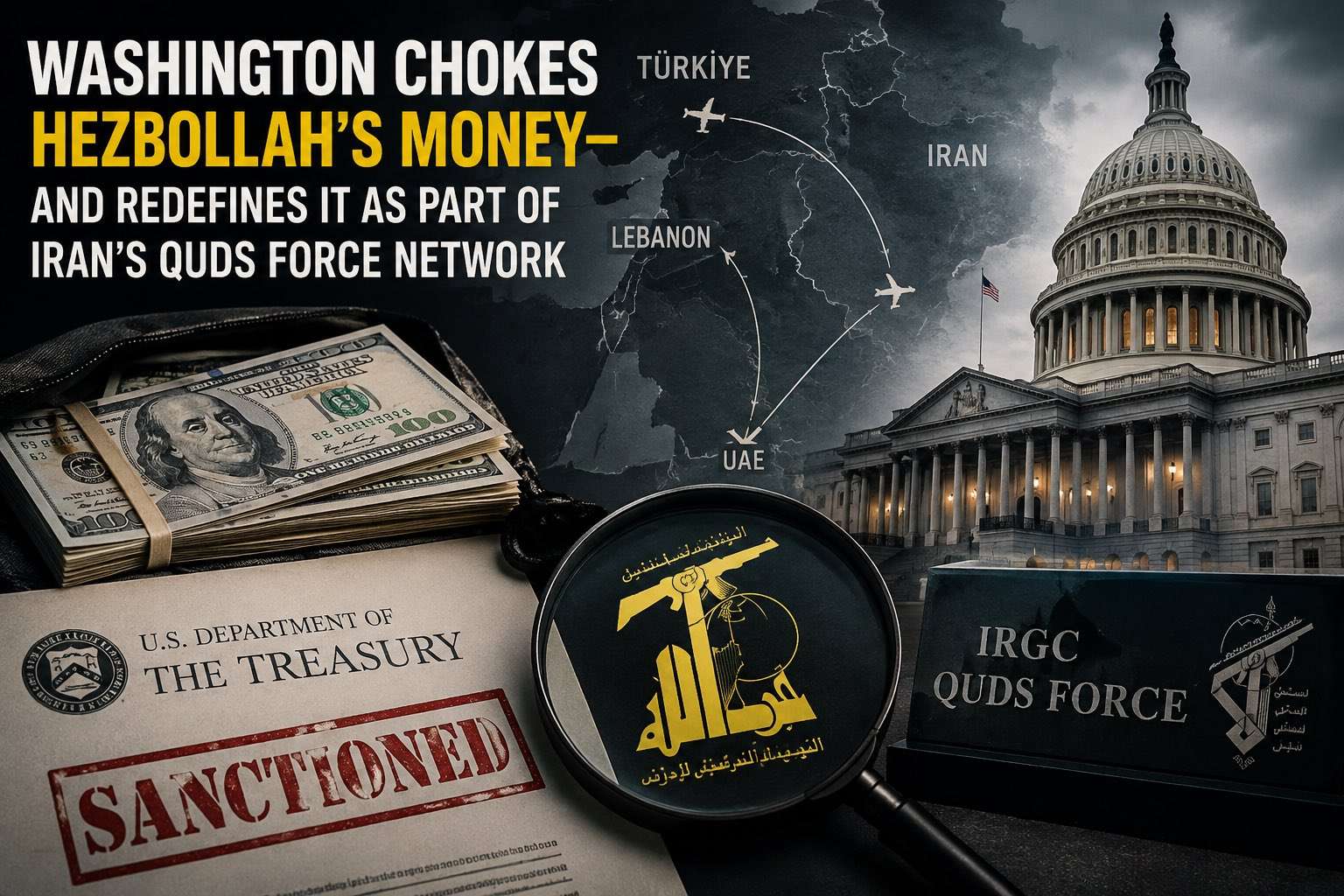
The sanctions announced by the U.S. Treasury Department on August 20, 2026, should not be read as simply another entry in Washington’s long campaign against Hezbollah. They mark something more significant. The United States is no longer concentrating only on Hezbollah’s money. It is targeting the infrastructure that allows that money to move — the couriers, exchange houses, front companies, bank accounts, commercial flights and cross-border corridors that connect Iran’s financial machinery to Hezbollah in Lebanon. Even more consequentially, Washington has formally reinforced its treatment of Hezbollah as part of the operational network of Iran’s Islamic Revolutionary Guard Corps-Quds Force. That may ultimately matter more than the ten individuals sanctioned.
Washington Is Targeting the Route
The Treasury Department’s Office of Foreign Assets Control, OFAC, designated ten individuals it says participated in a sophisticated cash-smuggling network supporting Hezbollah. According to Treasury, couriers traveling on commercial flights between Lebanon, Türkiye, the United Arab Emirates and Iran moved up to hundreds of millions of dollars across jurisdictions, providing Hezbollah access to foreign currency outside the formal financial system and helping it evade sanctions. This tells us something important about the evolution of American strategy. Washington is no longer waiting for Hezbollah’s money to arrive in Lebanon. It is trying to intercept the financial architecture before the money reaches its destination. The target is no longer merely the account. The target is the artery.
Türkiye at the Center of the Route
One of the most important figures identified by Treasury is Turkish businessman Yunus Alper Yilmaz, whom Washington describes as the manager of the courier network. According to OFAC, Yilmaz used certain Türkiye-based exchange houses as fronts and provided front companies and bank accounts for transfers connected to the IRGC-Quds Force. The division of labor described by Treasury is revealing. Halil Ibrahim Kacmaz and Onder Dede allegedly collected cash from exchange houses. Vasfi Akyuz allegedly coordinated the logistics of the couriers and personally participated in moving funds. Mehmet Akyuz, Mehmet Acur, Feyyad Karasalih, Masoud Mousafar, Gulay Kaya Savci and Emrah Ayaz allegedly transported cash intended for Hezbollah aboard commercial flights to Lebanon. In other words: Yilmaz managed. Others collected. Akyuz coordinated. The couriers carried. These are not simply ten names on an American sanctions list. Together, they reveal what Washington describes as a financial supply chain.
Türkiye therefore matters because it appears as an important operational node in that chain. But an essential distinction must be made: Treasury’s findings do not establish Turkish government involvement. On the contrary, the State Department said the United States disrupted the network through close coordination and collaboration with Turkish partners. That creates an interesting strategic reality. Türkiye appears both as territory allegedly exploited by the network and as a partner helping Washington dismantle it. If that cooperation expands, it could become considerably more damaging to Hezbollah than the designation of individual couriers.
From Hezbollah to the Quds Force
The most important development, however, goes beyond money. OFAC re-designated Hezbollah under Executive Order 13224, as amended, citing what Treasury describes as the Quds Force’s coordination of Hezbollah attacks and its deep involvement in directing Hezbollah’s political decision-making. Washington now explicitly describes Hezbollah as being owned, controlled or directed by, or acting for or on behalf of, the IRGC-Quds Force. That language is strategically significant.
Hezbollah has been designated by the United States as a Foreign Terrorist Organization since 1997 and as a Specially Designated Global Terrorist since 2001. The IRGC-Quds Force was designated as a Specially Designated Global Terrorist in 2007, while the IRGC itself was designated as a Foreign Terrorist Organization in 2019. But the August 20 action reconnects these classifications in an important way. Washington is effectively drawing one operational chain: The Quds Force generates and directs influence. Financial networks move resources. Intermediaries conceal transactions. Couriers transport cash. Hezbollah receives the benefit. This is no longer simply a Lebanese sanctions file. It is part of Washington’s confrontation with the architecture of Iranian regional power.
Why Cash Still Matters
For years, American sanctions have made conventional banking increasingly dangerous for Hezbollah and Iranian-linked networks. That makes physical cash more valuable. Banks generate records. Wire transfers leave electronic trails. Correspondent banking creates exposure to American financial institutions. Compliance systems can flag suspicious transactions. Cash can bypass much of that infrastructure. A suitcase does not generate a SWIFT message. That is why the use of commercial aviation is particularly important. In this system, the aircraft is not merely transportation. It becomes part of the financial corridor. The courier becomes part of the payment infrastructure. The airport becomes part of the sanctions battlefield. By naming the couriers themselves, Washington is sending a message that leaving the banking system does not necessarily mean leaving the reach of American sanctions.
The Shadow Economy Behind Hezbollah
Treasury places the courier operation within something much larger. According to the department, Hezbollah and its allies have relied on mechanisms including oil smuggling, illicit shipping, commodity sales and bulk-cash smuggling to generate and move funds. The network targeted on August 20 was also associated with the late Behnam Shahriyari, an IRGC-Quds Force finance official. This reveals the scale of Washington’s challenge. The problem is not ten people. The problem is an adaptable shadow economy.
Close a bank account and transactions move elsewhere. Sanction a company and another front can emerge. Restrict electronic transfers and physical cash becomes more attractive. Expose one courier and another can replace him. Shut down one jurisdiction and the network searches for another. This is why sanctions against Iran and Hezbollah increasingly resemble a war of adaptation. Washington exposes, the network adjusts. Washington blocks, the network reroutes. Washington identifies an intermediary, another intermediary appears. The question is therefore not simply whether the United States possesses enough financial power. It clearly does. The question is whether American pressure can adapt faster than the networks it is attempting to destroy.
The Power of the American Financial System
The August 20 action demonstrates why the Treasury Department remains one of Washington’s most powerful instruments of national security. The United States possesses not merely sanctions, but an entire financial ecosystem capable of amplifying them. Under OFAC’s 50 Percent Rule, entities owned 50 percent or more, directly or indirectly, by blocked persons can themselves be treated as blocked. The danger also extends to foreign financial institutions facilitating significant transactions involving designated individuals.
This is where American financial power becomes global. Washington does not necessarily have to sanction every institution. It needs financial institutions to understand the consequences of crossing the line. A bank must calculate the risk. An exchange house must calculate the risk. A shipping company must calculate the risk. A front company’s business partners must calculate the risk. And foreign institutions must consider whether one profitable transaction is worth jeopardizing access to the American financial system. This is how Washington attempts to construct a financial wall around its targets.
Hezbollah Is Part of a Larger Iran Strategy
The timing is equally important. The Hezbollah action comes as the Trump administration signals a major escalation of economic pressure against Tehran. Treasury Secretary Scott Bessent has said Washington is preparing what he described as the “toughest sanctions in history” against Iran. That places the Hezbollah decision inside a much larger strategic picture.
Washington is attempting to attack Iranian power at several levels simultaneously: Iran’s ability to generate revenue, its ability to move money internationally, the intermediaries that facilitate those transactions, the networks that convert formal financial flows into clandestine ones, and the regional organizations supported by those networks. Hezbollah therefore cannot be viewed separately from the broader American campaign against the Quds Force. That is precisely what the August 20 action makes clear. The battlefield is financial, but the objective is geopolitical.
Sanctions Are Not Yet Strategy
There is nevertheless an important limitation. Sanctions can make Hezbollah’s financing more expensive. They can make moving money more dangerous. They can force the organization to use additional intermediaries. They can deter banks and exchange houses. They can disrupt access to foreign currency. But sanctions alone do not guarantee a change in political or military behavior. That distinction matters.
Treasury itself emphasizes that the ultimate objective of sanctions is not punishment for its own sake, but a positive change in behavior. The question Washington must therefore answer is simple: What behavior does it ultimately want to change? Stopping a particular cash route is achievable. Weakening Hezbollah’s financial capacity is harder. Reducing its military capability is harder still. Changing Hezbollah’s political behavior inside Lebanon requires another level of pressure. And breaking the organization’s strategic relationship with Iran and the Quds Force would represent an entirely different objective. Sanctions attack resources. Strategy converts the loss of resources into a change in decisions. Washington has demonstrated enormous ability to accomplish the first. Whether it can achieve the second remains unresolved.
The Next Battlefield: The Corridors
This is why the August 20 decision should not be reduced to the headline that the United States sanctioned ten individuals. The deeper story is that Washington is attempting to dismantle the infrastructure that gives Hezbollah access to foreign currency outside the formal financial system. It is targeting the money, the intermediary, the exchange house, the front company, the bank account, the courier, the commercial flight and ultimately the corridor itself.
Türkiye is important because Treasury says a major component of the courier network was managed there and used Türkiye-based exchange houses. But Turkish cooperation with Washington points toward something potentially more important. If the United States can persuade governments along Hezbollah and Quds Force financial corridors to cooperate systematically — rather than simply sanctioning individuals after money has already moved — the environment surrounding these networks could change dramatically. A clandestine financial organization can replace a courier. It can replace a shell company. It can replace an exchange house. It is much harder to replace an entire international corridor. That is where Washington may be heading.
Can Washington Choke the Decision?
The United States possesses extraordinary financial power. It has the dollar. It has the American banking system. It has secondary sanctions. It has the SDN List. And it has the ability to make financial institutions around the world reconsider a transaction simply because Washington considers it dangerous. But even this power has limits. America can make the road harder. It cannot guarantee that another road will not be built. It can disrupt a network. It cannot assume disruption equals destruction. It can choke Hezbollah’s money. But choking the money does not automatically choke Hezbollah’s decision-making.
That is the strategic test now facing Washington. The August 20 sanctions demonstrate that the United States can follow the money from exchange houses to front companies, from couriers to commercial aircraft, and across borders before it reaches Lebanon. They also demonstrate something even more important: Washington is increasingly treating Hezbollah not as an isolated Lebanese actor, but as an integral component of the IRGC-Quds Force’s regional network.
That is the real significance of this decision. The next phase will determine whether Washington can transform that legal and financial designation into strategic consequences. Because the ultimate question is no longer whether America can find Hezbollah’s money. It can. The question is whether Washington can make every alternative route so costly, so dangerous and so exposed that the financial pressure eventually reaches the level where decisions are made.
Washington can choke the money. The real test is whether it can choke the decision.