By Maria Maalouf
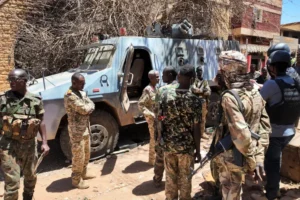
An August 11 editorial in The National forces the international community to confront one of the darkest allegations to emerge from Sudan’s catastrophic war: that the Sudanese Armed Forces used chemical weapons.
If substantiated, this is not simply another violation in a conflict already defined by atrocities, displacement, siege, starvation, and destruction. It would represent the crossing of one of the clearest red lines in modern international law — the prohibition against chemical warfare.
The United States has already taken action against Sudan’s military-led government following its determination that the Sudanese Armed Forces used chemical weapons during the conflict. Reports surrounding the allegations have raised particular concern over the possible use of chlorine.
But sanctions alone cannot be the end of the story.
Sudan became a party to the Chemical Weapons Convention in 1999, accepting an international obligation never to develop, possess, or use chemical weapons. That commitment raises a question extending far beyond Sudan:
What does an international red line mean if crossing it produces little more than financial restrictions and diplomatic expressions of concern?
Sudanese civil society and human rights groups have called for an independent investigation and cooperation with the Organisation for the Prohibition of Chemical Weapons (OPCW). They are right to demand answers.
Allegations of chemical-weapons use must never be reduced to competing political narratives. They require an independent, transparent, technically credible investigation capable of establishing what was used, where it was used, who authorized it, and who carried it out.
If the evidence confirms that chlorine or another toxic chemical was deliberately deployed as a weapon, accountability must follow — regardless of the identity, military rank, or political affiliation of those responsible.
Anything less risks turning one of international law’s strongest prohibitions into an empty declaration.
The international response also exposes a broader problem. Expressions of “deep concern” have become the vocabulary of paralysis. Financial sanctions may impose costs, but they cannot substitute for establishing the truth or pursuing accountability where the evidence warrants it.
When an alleged chemical attack is answered principally with economic restrictions rather than a determined international effort to establish responsibility, the consequences reach beyond Sudan. Every failure to enforce a prohibition weakens that prohibition for the next conflict.
There must also be no selective justice.
Sudan cannot become another battlefield where atrocities are condemned or ignored depending on which side commits them. Crimes against civilians must be investigated whether the alleged perpetrator is the Sudanese Armed Forces, the Rapid Support Forces, or any other armed actor.
No faction should receive immunity from scrutiny. No uniform should provide immunity from accountability. And no geopolitical interest should determine whose victims deserve justice.
Sudanese civilians have already paid an unbearable price for a war over power. They should not also be asked to accept a world in which allegations of chemical warfare become merely another item on the diplomatic agenda.
The international community can investigate, document, sanction, and support accountability. It can help protect civilians and reinforce the rules designed to prevent humanity from returning to the darkest forms of warfare.
But it cannot manufacture Sudan’s political future.
A durable peace will ultimately have to be built by Sudanese themselves — through legitimate institutions, national reconciliation, civilian participation, and a political order in which weapons no longer determine who governs.
Yet peace without accountability is fragile, and international law without enforcement eventually becomes rhetoric.
The Sudan case therefore presents a test far larger than Sudan itself.
Is the global prohibition against chemical weapons still an enforceable red line?
Or has the world reached a point where governments can cross even humanity’s most sacred boundaries and expect little more than sanctions, statements, and concern?
If the Chemical Weapons Convention is to mean anything, credible allegations must be investigated, facts must be established, and those responsible must face consequences.
Otherwise, the danger is not merely that chemical weapons were allegedly used in Sudan. The greater danger is that the world is learning to live with the possibility that they were.