By Dr. Abdel Aziz Tarekji
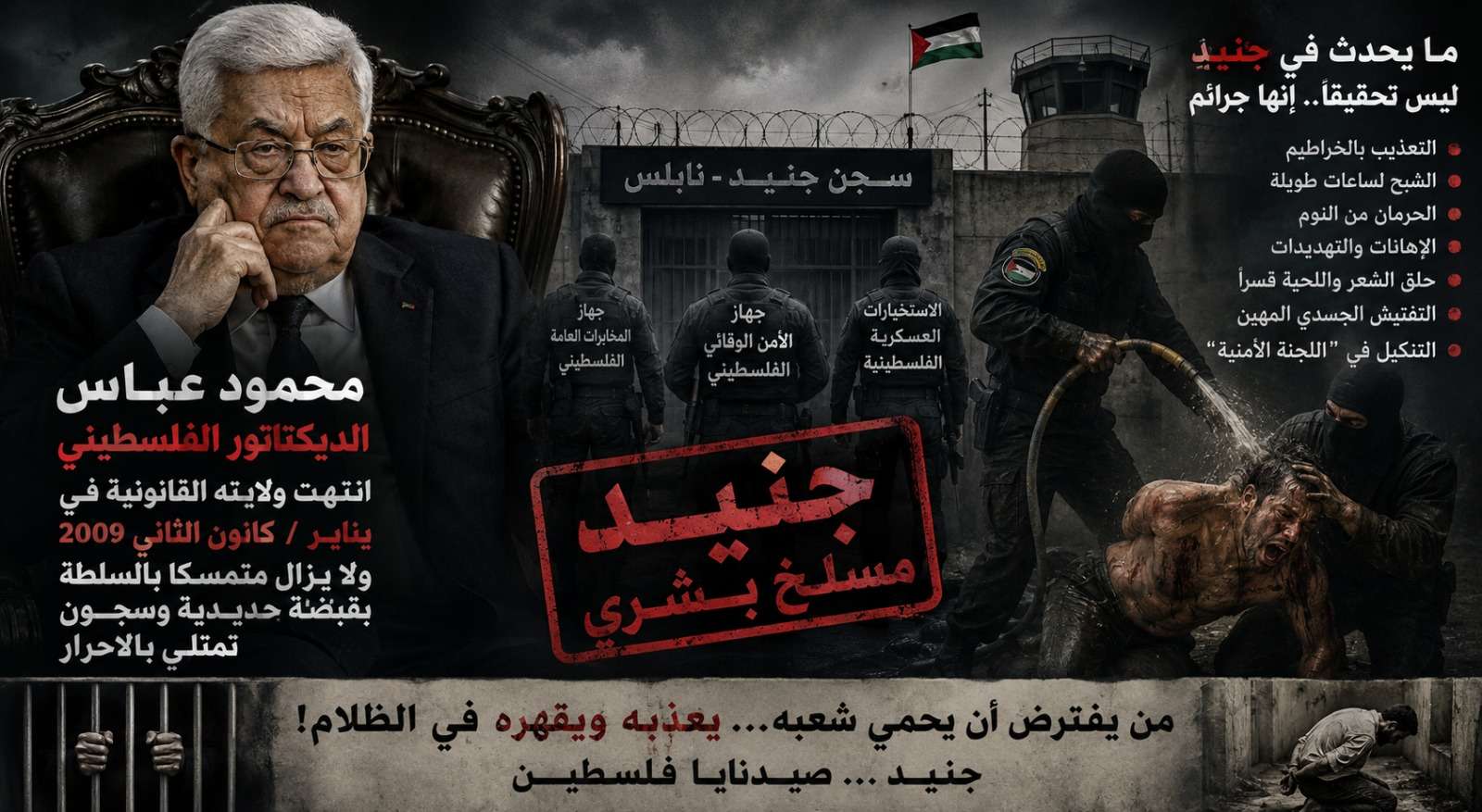
Not every human slaughterhouse is called Saydnaya. In the heart of Nablus stands Junaid Prison, a name that, for many of those who have passed behind its walls, no longer signifies merely a prison or detention center. It has become associated with horrifying testimonies of suspension and stress positions, beatings with hoses, sleep deprivation, insults and threats, humiliating body searches, the forced shaving of hair and beards, and the abuse and mistreatment of detainees.
What makes these testimonies even more disturbing is that they do not concern abuses committed by a foreign occupation. They concern Palestinians being humiliated at the hands of security agencies that operate in the name of Palestine.
Inside Junaid, the name of the so-called Security Committee repeatedly emerges. The term sounds innocuously administrative, yet published testimonies describe it as one of the most terrifying places inside the prison. According to those accounts, detainees who object to abuses may be sent there and subjected to suspension, beatings, mistreatment and sleep deprivation.
In a recent account concerning detainee Amin al-Qouqa, the Committee of Families of Political Detainees stated in July 2026 that he had been subjected daily to suspension, torture and mistreatment, while masked guards allegedly stormed his cell at night and deprived him of sleep.
If established by an independent investigation, these practices are not mere excesses or mistakes committed during interrogation. They are acts that may constitute torture and cruel, inhuman or degrading treatment under international law. A hose is not an interrogation instrument. Suspension and stress positions are not lawful means of extracting information. Deliberate sleep deprivation is not a security measure. And humiliating a detainees body is not within the lawful authority of any officer, regardless of rank or the accusation facing the person standing before them.
The institutions involved must be named rather than concealed behind the convenient phrase security services. We are speaking about a system in which the Palestinian General Intelligence Service, the Palestinian Preventive Security Service, and Palestinian Military Intelligence appear, alongside other competent agencies depending on which authority carried out the arrest and interrogation.
These institutions have commanders, department heads, officers, interrogators and a chain of command. Any investigation into torture therefore cannot end with the guard or interrogator who physically carried out the act. It must ask: Who ordered it? Who supervised it? Who knew? Who covered it up? And who had the power to prevent the abuse but failed to do so?
More disturbing still, recent allegations go beyond torture itself and raise the possibility of concealing evidence of abuse from oversight bodies. In May 2026, the Committee of Families of Political Detainees accused Palestinian Authority security agencies at Junaid of transferring detainees out of the Security Committee section to coincide with visits by the Red Cross and human rights organizations, allegedly to prevent monitors from hearing their accounts of what they had endured. According to these reports and other documentation, we are therefore not speaking only about abuses behind cell doors, but about a potential attempt to conceal those abuses from oversight bodies.
It is here that the comparison with Saydnaya becomes morally legitimatenot as a comparison of the number of victims, but as a comparison of the logic of the human slaughterhouse. Saydnaya did not become a global symbol of horror because of the prisons name. It became one because Assads security apparatus treated the human being behind its walls as a body that could be broken and humiliated at will.
And when testimonies from Junaid speak of suspension, hoses, sleep deprivation, humiliation, masked men, rooms of abuse and, at times, deaths under torture, the question is no longer: Is Junaid another Saydnaya? The question is: How did we ever allow a Palestinian prison to exist whose alleged practices could evoke the name of Saydnaya?
Junaid also embodies an even more bitter moral paradox: a Palestinian who has spent decades demanding that the world protect him from torture should not today find himself at the mercy of a Palestinian interrogator employing against him the very methods we condemned when others used them.
A torturer does not become less despicable because he speaks the victims language. A hose does not become legitimate because it is held in Palestinian hands. And torture does not acquire legitimacy because the Palestinian flag flies above the building.
This is why the institutions must be named: the General Intelligence Service, Preventive Security and Military Intelligence are not above the law. The State of Palestine is a party to the United Nations Convention against Torture, and the prohibition of torture is absolute. Neither national security, nor the dangerousness of the accused, nor political affiliation, nor orders from a superior can justify torturing a human being. Even a person accused of the gravest crimes retains a right that the state cannot take away: the right not to be tortured.
This issue has nothing to do with the Fatah-Hamas conflict, nor should it be allowed to become a political bazaar. Whether a detainee belongs to Fatah, Hamas, the political left, is an independent, a journalist, an opposition figure, or even someone accused of a serious crime, that detainee remains a human being protected by law.
Human rights that change according to the identity of the victim are not human rights at all; they are a political position disguised in the language of human rights.
And if the Palestinian Authority and its security agencies believe these testimonies are false or exaggerated, the solution is simple: open Junaid completely to independent, unannounced human rights inspections. Open the Security Committee. Allow monitors to select the detainees they wish to interview without security personnel present, and disclose camera records, injury records, complaints, investigations, and disciplinary measures imposed on officers and interrogators.
Those who are not hiding a slaughterhouse behind their walls should have nothing to fear from opening its doors.
Junaid is not merely a prison with a sinister reputation; it is a moral and legal test for the entire Palestinian Authority. Either the allegations of torture are transparently investigated and everyone whose responsibility is established is held accountablefrom the lowest-ranking guard to the highest officialor the name Junaid will remain a stain haunting everyone who knew and remained silent.
The world came to know Syrias Saydnaya after its secrets emerged from behind its walls. Do not wait for the day when Junaids doors are opened and its detainees walk out carrying their testimonies and the marks of what they endured, only for everyone to begin asking, too late:
How did we allow a human slaughterhouse bearing the name of a Palestinian institution to exist in the heart of Nablus?
A Final Message to Mahmoud Abbas
I conclude with a message to Mahmoud Abbas: You were elected president on January 9, 2005, for a term that the law set at four years. That original electoral mandate ended in January 2009, yet you have remained in power throughout all these years without new presidential elections granting you a renewed popular mandate.
My advice to you, now that you are in the final stage of your life, is to think carefully about the legacy you will leave behind before you stand before God. Do not allow your name to be written into Palestinian memory alongside those rulers who governed their peoples through an iron security grip and left behind prisons, fear and victims.
Open Junaid Prison to an independent investigation. Stop the torture. Hold accountable those who have violated the dignity of Palestinians before history holds you accountable for knowing what was happening and remaining silent. Power fades, and no seat of authority lasts foreverbut the cry of the oppressed outlives every dictator.