A White Paper Chapter, Strategic Assessment Series.
Prepared for Senior Policy Review
Date of Issue: July 2026
Classification: For Policy Review
This chapter argues that the Islamic Republic of Iran has entered a condition of terminal structural collapse — not a managed or reversible decline, but a cascading, multi-domain rupture that is irreversible within the current institutional framework of the theocratic state. The collapse is being driven simultaneously by two mutually reinforcing dynamics: an internal security breakdown of historic proportion and a comprehensive failure of the regime’s external deterrent architecture.
Internally, the coercive apparatus upon which the Islamic Republic has depended for forty-five years is disintegrating. Police precincts have defected or stood down en masse. The Islamic Revolutionary Guard Corps — long understood as the ideological steel spine of the state — has experienced fracturing along generational, ethnic, and regional fault lines that the Supreme Leader’s office can no longer contain. Territorial control has been effectively ceded in multiple peripheral provinces, where Kurdish, Baloch, Arab Ahvazi, and Azerbaijani forces have assumed administrative and military authority. Externally, the regime’s deterrent toolkit has been systematically dismantled: U.S. naval operations have neutralized the Strait of Hormuz threat; Ukrainian strikes have severed the Russian resupply vector through the Caspian; and Israeli strikes have reduced Iran’s nuclear infrastructure to a single contested redoubt at PicAx Mountain.
This chapter examines each of these dimensions in sequence: internal security fragmentation, territorial seizure, political succession dynamics centered on Crown Prince Reza Pahlavi, Iran’s strategy of selective external aggression against Arab neighbors while avoiding Israel, U.S. maritime protection operations through Hormuz, Ukraine’s Caspian strike campaign, and the nuclear endgame at PicAx Mountain. The chapter concludes with a strategic imperative: the window for managed transition is narrow, and the decisions made by the international community in the next 90 to 180 days will prove determinative for the region’s stability and global proliferation calculus.
Introduction: A Cascading Collapse, Not a Managed Decline.
The analytical tendency in Western policy circles has been to frame the Islamic Republic’s mounting crises as episodes within a long continuum of managed authoritarian stress — periodic convulsions that the regime absorbs, adapts to, and ultimately survives through a combination of coercion, economic patronage, and ideological cohesion. That framework is no longer adequate. What we are observing in Iran in the summer of 2026 is not a regime under pressure; it is a regime in the process of institutional dissolution. The distinction carries profound strategic weight, and the failure to make it clearly has already cost the international community critical reaction time.
The Islamic Republic is not declining toward a new equilibrium. It is collapsing toward an interregnum — a period of indeterminate duration in which the formal structures of the state will persist in name while ceasing to function in practice across wide swaths of territory, security architecture, and governmental administration. This assessment is not predicated on any single indicator but on the convergence of multiple, independently catastrophic trends that have achieved a compounding effect: internal coercive fragmentation, territorial loss, nuclear encirclement, external deterrent failure, and the emergence of a credible alternative political pole in the form of Crown Prince Reza Pahlavi and the transitional coalition forming around him.
The geopolitical stakes of Iran’s collapse are not limited to the region. Iran sits at the intersection of three of the world’s most consequential strategic theaters: the Persian Gulf hydrocarbon corridor, the nuclear proliferation frontier, and the Russia-China axis of influence projection. A disorderly collapse — one not guided by coherent Western policy, regional coordination, and a viable transitional political framework — risks producing outcomes of catastrophic scope: a nuclear-armed fragmented state, a proliferation marketplace accessible to non-state actors, a humanitarian catastrophe of regional magnitude, and an uncontrolled power vacuum into which Russia, China, and Turkey will move with alacrity. This chapter is written against that background, and with the conviction that clarity of analysis is itself a precondition for effective policy response.
I. The Fracture from Within: Police Defections and IRGC Fragmentation
The most consequential development in Iran’s internal collapse has not been the scale of popular protest — which has been evident and well-documented since 2022 — but rather the systematic defection and stand-down of the security forces tasked with suppressing it. Throughout the spring and summer of 2026, law enforcement units across multiple provincial centers have refused direct orders from Interior Ministry command structures, with entire precincts laying down arms, removing insignia, and in several documented instances openly joining protest formations or providing crowd protection against plainclothes Basij elements. This is not the behavior of a security apparatus under strain; it is the behavior of one experiencing institutional collapse at the operational level.
The Islamic Revolutionary Guard Corps presents a more complex picture, and it is essential that policy analysts resist the temptation toward oversimplification in either direction. The IRGC is not dissolving as a unified institution, but it has fractured in ways that have materially degraded its coercive coherence. The fractures run along three primary axes: generational, ethnic, and regional. Junior officers and rank-and-file conscripts — many of whom belong to the same demographic cohorts as the protest movements — have demonstrated a sustained unwillingness to conduct lethal suppression operations against civilian populations in anything approaching the consistency required for effective counterinsurgency. Ethnic minority soldiers, drawn disproportionately from Kurdish, Baloch, and Arab Ahvazi communities, have exhibited the highest rates of defection and operational non-compliance. Regional commands in Khuzestan, Kurdistan, and Sistan-Baluchestan have in several cases ceased to take direction from Tehran entirely.
We must be precise about what this fragmentation does and does not mean. It does not mean that the regime’s coercive capacity has been eliminated. The Supreme Leader’s personal protection apparatus — the units drawn from the Ansar-ul-Mahdi corps and the hardened Basij Special Units, concentrated principally in Tehran and Qom — has remained largely loyal. These forces represent a residual capacity for localized, targeted violence that should not be underestimated. Pockets of IRGC hardliners, particularly in the capital and in the holy city of Qom, remain operationally active and have demonstrated both the will and the capability to conduct lethal operations against specific targets, including protest leaders, defected officers, and foreign journalists. The regime retains the capacity to kill; it has lost the capacity to govern. That distinction — between residual coercive reach and functional political authority — defines the character of the current collapse phase.
II. Territorial Seizures and the Geography of Collapse
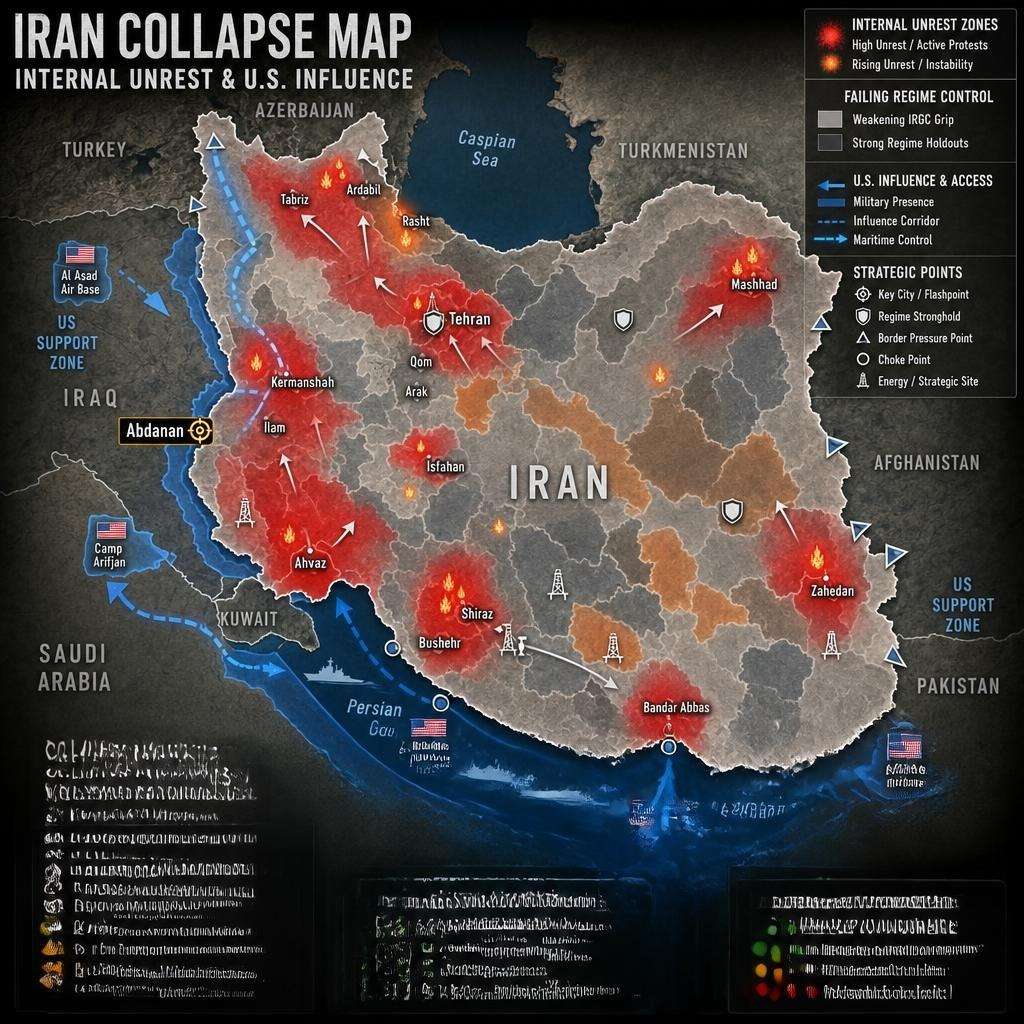
The collapse of the Islamic Republic’s internal security architecture has produced its most visible and strategically significant expression in the geography of territorial control. Across Iran’s peripheral provinces — the arc of territory stretching from Kurdistan in the northwest through Azerbaijan, across the eastern expanse of Sistan-Baluchestan, and south into Khuzestan’s Arab Ahvazi communities — opposition forces, tribal militias, and ethnic separatist movements have established meaningful and in several cases durable administrative control over population centers, border crossings, and critical infrastructure nodes. These are not symbolic occupations, flag-raising exercises, or temporary tactical gains. They represent the functional displacement of central government authority in territories that collectively encompass a substantial proportion of Iran’s border perimeter and a significant share of its hydrocarbon production and transit infrastructure.
In Khuzestan province, Arab Ahvazi forces have established security perimeters around oil field infrastructure that the National Iranian Oil Company can no longer access or protect. In Kurdistan, Peshmerga-aligned and indigenous Kurdish political-military formations have consolidated control over multiple provincial capitals and border crossings into Iraqi Kurdistan, effectively creating a cross-border administrative and logistics corridor that Tehran cannot interdict. In Sistan-Baluchestan, Baloch nationalist forces — organized under several competing but loosely coordinating command structures — have seized customs posts and communications infrastructure along the Pakistani border. In the northwest, Azerbaijani political movements, emboldened by the deterioration of central authority, have pressed territorial claims and established parallel governance structures in communities where state institutions have ceased to function.
The strategic implication of this territorial map is direct and severe: the Islamic Republic of Iran no longer exercises sovereign control over its own borders in any conventional operational sense. The government in Tehran cannot move military forces reliably through multiple transit corridors within its own territory. It cannot collect customs revenue, enforce conscription, deliver judicial authority, or provide basic administrative services across wide swaths of the country. The connection between this territorial fragmentation and the regime’s inability to project domestic authority is not merely correlative — it is constitutive. A state that cannot control its periphery cannot govern its center with confidence, and the regime’s decision-makers in Tehran are operating with the acute awareness that the territorial erosion currently visible at the margins is moving, steadily and without reversal, toward the core.
III. The Emergence of Crown Prince Reza Pahlavi and the Question of Political Succession
Into the political vacuum created by institutional collapse, one figure has emerged with a combination of international recognition, symbolic capital, and coalition-building capacity that no other transitional actor currently possesses: Crown Prince Reza Pahlavi, the eldest son of the late Shah Mohammad Reza Pahlavi. His political resurgence — which would have appeared improbable as recently as three years ago — has accelerated in direct proportion to the collapse of the regime’s legitimacy and the absence of any credible reformist alternative within the Islamic Republic’s own institutional framework. It is essential to understand precisely what Pahlavi represents politically, because mischaracterizing his role either inflates or dismisses his strategic importance.
Pahlavi has not claimed the Peacock Throne. He has deliberately and consistently positioned himself not as a pretender to monarchical restoration but as a democratic bridge — a figure of transitional legitimacy whose function is to provide the symbolic and organizational scaffolding for a secular, constitutional Iranian state while that state’s permanent institutions are constructed through a representative process. His public communications, diplomatic engagements in Washington, Paris, and Tel Aviv, and the governance framework documents produced by his advisory council all point consistently toward a post-Islamic Republic order defined by popular sovereignty, civil rights protections, and separation of religion from state authority. This is a politically sophisticated posture, and it has earned him a support base that extends well beyond the nostalgic diaspora communities that once constituted his primary constituency.
Within Iran, Pahlavi’s support has grown most rapidly among secular urban youth — the generation that has led the protest movements since the death of Mahsa Amini — and among former mid-level military officers and civil service professionals who seek an orderly transition framework rather than revolutionary chaos. Outside Iran, his network of diaspora organizational support has been materially upgraded through the involvement of politically experienced Iranian-American and Iranian-European professionals with genuine policy capacity. Nevertheless, the risks attending his candidacy as a transitional figure are real and must be assessed honestly. His monarchist lineage creates genuine division among republican-leaning Iranians who fear that a transition managed under his symbolic authority will slide toward restoration rather than democratization. More operationally significant, he has no ground-force presence inside Iran — no militia, no territorial base, no command authority over any armed formation currently operating within the country. His leverage is political and symbolic, not operational. At this stage of the collapse, however, no other figure commands comparable international recognition or projects comparable internal legitimacy across the diverse coalition of forces working toward the regime’s end. His strategic value lies precisely in his capacity to serve as a point of convergence for actors who would otherwise compete destructively for the post-regime order.
IV. Selective Aggression: Iran’s Strategy of Striking Arab Neighbors While Avoiding Israel
As internal collapse has accelerated through 2025 and into 2026, the Islamic Republic’s external behavior has followed a pattern that is neither erratic nor ideologically driven in its execution — it is strategically calculated. The regime has intensified missile, drone, and proxy-conducted strikes against Arab Gulf neighbors — most significantly Bahrain, Saudi Arabia, the United Arab Emirates, and Iraqi Kurdish territory — while maintaining a conspicuous and deliberate absence of direct kinetic action against Israel. To the superficial observer, this pattern might appear contradictory for a regime whose foundational ideology centers on the destruction of the Zionist entity. To the strategic analyst, it is entirely coherent and reflects a rational deterrence calculus operating under conditions of acute institutional vulnerability.
The regime’s senior leadership — and the intelligence and military advisors who survive within its shrinking decision-making circle — has assessed, correctly, that a direct kinetic strike on Israel at this stage of the collapse would trigger a military response of regime-ending magnitude and timeline. Israel’s demonstrated willingness to conduct preemptive and retaliatory strikes against Iranian nuclear and military infrastructure — already executed across multiple campaigns targeting Fordow surface facilities, Parchin, and a range of missile production sites — leaves no ambiguity about its response calculus. The regime has internalized this assessment. Strikes against Arab neighbors, by contrast, carry manageable escalation risk within a deterrence environment where the Gulf states have consistently preferred diplomatic and defensive responses over offensive military action, and where the United States has historically sought to prevent rather than enable regional military escalation.
There is also a domestic propaganda dimension to this selective aggression posture that deserves analytical weight. External strikes against Arab Gulf monarchies — framed within the regime’s remaining information architecture as resistance to American imperialism and Zionist-allied Arab collaborators — serve the function of nationalist-Islamic narrative reinforcement for the regime’s shrinking but still existent ideological base. They project a image of regime capability and defiance at precisely the moment when internal evidence of collapse is most acute. The cynical internal logic is transparent: aggression against targets that will not trigger existential response maintains the propaganda value of external action without activating the one adversary — Israel — whose military response would materially accelerate the collapse timeline the regime is desperately seeking to slow. Gulf Arab states have not responded passively to this campaign. Saudi Arabia and the UAE have significantly expanded air defense acquisition programs, formalized expanded U.S. basing agreements, and deepened quiet intelligence coordination with Israel through the operational architecture of the Abraham Accords — a development that represents one of the most consequential regional security realignments of the past decade.
V. Maritime Stability Under U.S. Protection: The Strait of Hormuz Operation
Among the Islamic Republic’s most credible and long-standing instruments of external coercion has been the threat to close, or substantially disrupt navigation through, the Strait of Hormuz — the 21-mile-wide chokepoint through which approximately one-fifth of the world’s oil supply transits daily. For decades, this threat functioned as a strategic deterrent of considerable effectiveness, restraining the escalatory ambitions of both regional adversaries and Western powers by placing the global energy economy in the position of a hostage. That deterrent has been rendered operationally moot. The United States has conducted a sustained, large-scale naval escort and surveillance operation through the Strait that has effectively neutralized Iran’s maritime coercion capacity for the duration of the collapse period.
More than 1,000 commercial tankers have operated under active U.S. naval escort or continuous surveillance coverage during the period of Iranian institutional collapse, collectively transiting in excess of 100 million barrels of crude oil and refined petroleum products through the Strait without successful Iranian interdiction. This operation — conducted through a rotating presence of carrier strike groups, surface action groups configured for maritime security operations, and embedded U.S. Coast Guard maritime security units with legal authority to conduct vessel inspections under international law — has maintained the integrity of the global energy corridor at a moment when Iranian collapse might otherwise have provoked a catastrophic disruption of hydrocarbon supply chains. The operational complexity of sustaining this commitment while simultaneously managing intelligence collection on the collapse’s trajectory, supporting regional partner air defense postures, and maintaining the nuclear surveillance mission at PicAx Mountain should not be underestimated. The U.S. military is being asked to perform simultaneously across every dimension of the Iran portfolio, and resourcing constraints are real.
The Hormuz operation has served a second, equally important strategic function beyond the protection of commercial navigation: it has served as a signal of American commitment to regional partners who might otherwise have concluded that Washington’s attention was too fragmented — by Ukraine, by domestic politics, by the Indo-Pacific rebalancing — to hold the line in the Gulf. Had Saudi Arabia or the UAE concluded that the United States would not sustain Hormuz protection through the collapse period, the resulting pressure toward unilateral military action — pre-emptive strikes against Iranian naval assets, covert support for separatist forces inside Iran, or accelerated nuclear hedging programs — would have introduced instability of an order that could have overwhelmed any managed transition framework. The U.S. naval commitment has, in this sense, been as much a diplomatic instrument as a military one: it has bought time, suppressed unilateral escalation, and preserved the space within which a coordinated international approach to the collapse remains possible.
VI. Ukraine’s Caspian Strikes: Destruction of Four Russian Vessels and the Northern Vector
The destruction of four Russian naval vessels in the Caspian Sea by Ukrainian long-range maritime strike assets in the spring of 2026 ranks among the most consequential and least adequately analyzed events of the current collapse period. Its significance is not primarily military — the Caspian fleet is not a force of strategic magnitude — but geopolitical and logistical, and its second-order effects are reshaping the northern dimension of the Iran collapse in ways that Western policy has been slow to incorporate into its operational planning.
Russia had been employing its Caspian naval presence as a vector for projecting influence and material support into Iran’s northern tier throughout the collapse period. The logistical function of this presence was specific and operationally significant: Russian surface vessels had been facilitating the transfer of air defense components — including S-300 system maintenance modules and replacement radar arrays — dual-use electronics critical to the regime’s command and communication infrastructure, and in documented cases, advisory and technical personnel whose function was to assist the IRGC’s most sophisticated units in maintaining operational capability against both domestic and external threats. This northern supply line represented one of the regime’s most resilient external lifelines, precisely because it operated through a geographic vector — the landlocked Caspian basin — that neither Israel nor the United States had historically treated as a primary operational theater.
Ukraine’s strike campaign, adapted directly from the Black Sea operational doctrine that has proved so effective against Russian naval assets in the European theater, delivered a shock that the Kremlin was both militarily and psychologically unprepared to absorb. The adaptation of long-range maritime strike capabilities — storm shadow-derived targeting architectures, naval drone variants modified for Caspian engagement envelopes — to a landlocked sea represents one of the most consequential geographic expansions of the conflict’s operational envelope since the war’s inception. The destruction of the four vessels has materially degraded Russia’s ability to resupply the collapsing Islamic Republic from the north, severing a critical influence vector at precisely the moment when the regime most needed external support to sustain any residual coercive capacity. The second-order effects extend well beyond Iran: Russian deterrence credibility in the Caspian basin has suffered a blow whose reverberations are being felt in Baku, Astana, Ashgabat, and Tashkent, where governments are quietly reassessing the reliability of Russian security guarantees with a seriousness they would not have entertained twelve months ago. The geopolitical irony of this development is stark — Ukraine, fighting a desperate war for its own national survival against Russian aggression, has inadvertently and significantly accelerated the collapse of one of Moscow’s most strategically valuable client states and long-term regional influence assets.
VII. PicAx Mountain: The Last Nuclear Redoubt
The Islamic Republic’s nuclear program — once distributed across a network of enrichment, research, and weaponization-adjacent facilities whose geographic dispersion was itself a strategic hedge against military decapitation — has been reduced, through a combination of Israeli strikes, internal sabotage, opposition seizures, and personnel flight, to a single active site of consequence. PicAx Mountain represents the hardened last line of the regime’s nuclear ambition: a deeply buried, geologically shielded facility whose precise internal configuration, operational status, and enrichment capacity remain subjects of genuine disagreement among Western intelligence services. What is not disputed is its centrality to the entire international dimension of Iran’s collapse. Every other variable in the collapse calculus — transitional legitimacy, Western policy coordination, Israeli military restraint, the pace of regime fragmentation — is ultimately subordinated to the question of what happens at PicAx Mountain.
The regime’s other nuclear infrastructure has been systematically rendered non-operational. The surface infrastructure at Natanz has been struck repeatedly and extensively, with Israeli air operations in 2025 targeting the above-ground administrative, power supply, and ventilation systems that sustain underground operations. Fordow — long considered the most hardened element of the enrichment network — suffered a strike of unprecedented penetration depth whose effects on underground centrifuge arrays have not been fully assessed but are believed by multiple Western services to have been severe. Parchin, the primary suspected weaponization research site, was seized by opposition-aligned forces in late 2025 and its technical personnel have dispersed — a proliferation concern of its own that demands dedicated tracking. What remains is PicAx Mountain: operational, staffed, and believed to contain centrifuge arrays capable of weapons-grade enrichment if the political decision to proceed is made by whatever remnant of the regime’s leadership retains authority over the program.
PicAx Mountain is not merely a military target — it is the axis around which the entire international dimension of Iran’s collapse turns. The site simultaneously represents the regime’s most valuable remaining bargaining chip, its most dangerous legacy risk, and the single trigger condition most likely to force preemptive military action before a managed transition can be achieved.
The strategic dilemma presented by PicAx Mountain is acute precisely because the site occupies multiple roles simultaneously. For the regime’s remnant leadership, it is potentially the most valuable bargaining chip in any negotiated transitional arrangement — a facility whose surrender could be offered in exchange for immunity guarantees, financial arrangements, or safe passage for senior figures. For Israel and the United States, it is simultaneously the object of intense intelligence focus and the trigger condition that, if credible evidence of weapons-grade enrichment activity were to emerge, would compel preemptive military action regardless of the state of collapse dynamics and regardless of the diplomatic disruption such action would cause to the transitional process. For opposition forces and the Pahlavi-aligned transitional framework, it is both an asset to be secured and a liability — a facility whose mere existence invites preemptive strikes that could destabilize any post-regime arrangement before it achieves institutional coherence.
We assess three plausible endgame scenarios for PicAx Mountain, and none of them can be dismissed as improbable. In the first and most desirable scenario, the facility is surrendered as part of a negotiated transitional arrangement brokered through Reza Pahlavi-aligned interlocutors, with IAEA access granted immediately and comprehensively, and with the transitional government securing international recognition and economic support in exchange for full transparency. This scenario requires that the transitional political framework achieve sufficient credibility and ground-level authority to negotiate on behalf of forces controlling or adjacent to the site — a condition that does not yet exist but toward which policy should be actively directed. In the second scenario, credible intelligence of weapons-grade enrichment at the site triggers preemptive Israeli military action, with or without explicit U.S. coordination. The consequences of this scenario for the transitional political environment — the disruption of fragile internal coalitions, the nationalist backlash even among anti-regime Iranians, and the risk of uncontrolled radiological dispersal — are severe. In the third scenario, opposition forces capture the facility intact before any negotiated arrangement is reached, creating an immediate proliferation risk that would demand rapid international response including the deployment of specialized technical teams under international authority. Each of these scenarios demands active, differentiated policy preparation — not sequential planning predicated on one outcome, but simultaneous preparation for all three.
CONCLUSION: THE ARCHITECTURE OF MANAGED TRANSITION
The Islamic Republic of Iran is not approaching collapse — it is inside it. The analytical debate about whether the regime will survive has been overtaken by events; the operative questions now are what follows, at what pace, through what mechanisms, and under what degree of international coordination. This chapter has traced the collapse across seven mutually reinforcing dimensions: the disintegration of the internal security apparatus, the territorial fragmentation of sovereign control, the emergence of a transitional political pole in Reza Pahlavi, the regime’s cynically calculated pattern of selective external aggression, the U.S. naval commitment that has neutralized the Hormuz coercion vector, Ukraine’s elimination of the Russian northern resupply corridor, and the nuclear endgame converging on PicAx Mountain. These are not parallel storylines; they are interlocking components of a single strategic rupture that demands to be addressed as a unified whole.
The central policy conclusion of this assessment is that Western governments — and most urgently Washington — must resist the institutional impulse to manage each dimension of the Iran collapse through separate bureaucratic channels, with separate policy teams, operating on separate timelines, without a unifying strategic framework. Maritime security policy and nuclear containment policy and transitional political support cannot be sequenced or prioritized against one another; they must be prosecuted simultaneously and in deliberate coordination, because each dimension affects the operative environment of every other. A preemptive strike on PicAx Mountain without a functioning transitional political framework produces a nuclear-strike aftermath in a political vacuum. A transitional political framework without nuclear containment produces a new government inheriting an unsecured weapons-grade facility. Maritime protection without nuclear resolution produces an indefinitely sustained military commitment with no terminal condition. Integration is not a preference — it is a strategic requirement.
The window for managed transition is narrow. Historical precedents for state collapse at this speed and scale are not encouraging: they tend to produce either rapid authoritarian reconsolidation or prolonged fragmentation, and Iran’s nuclear dimension forecloses tolerance for the latter. The international community’s posture in the next 90 to 180 days will be decisive. If the transitional political framework can be credibly established, if PicAx Mountain can be secured through negotiated surrender or preemptive agreement, and if the U.S. commitment to regional deterrence holds through the interregnum, Iran may emerge from this collapse as a stabilizing constitutional state — a development that would reshape the Middle East’s strategic landscape more consequentially than any event since the 1979 revolution itself. If it does not — if ungoverned collapse, nuclear ambiguity, and uncoordinated external competition are allowed to fill the void — the consequences will be measured in decades.