By Maria Maalouf
From Military Strategy to Economic Statecraft
For decades, the Middle East has been defined by military conflicts, ideological rivalries, and geopolitical competition. Today, a different strategic vision is emerging in Washington—one that prioritizes trade corridors, energy security, infrastructure, and economic integration over military intervention.
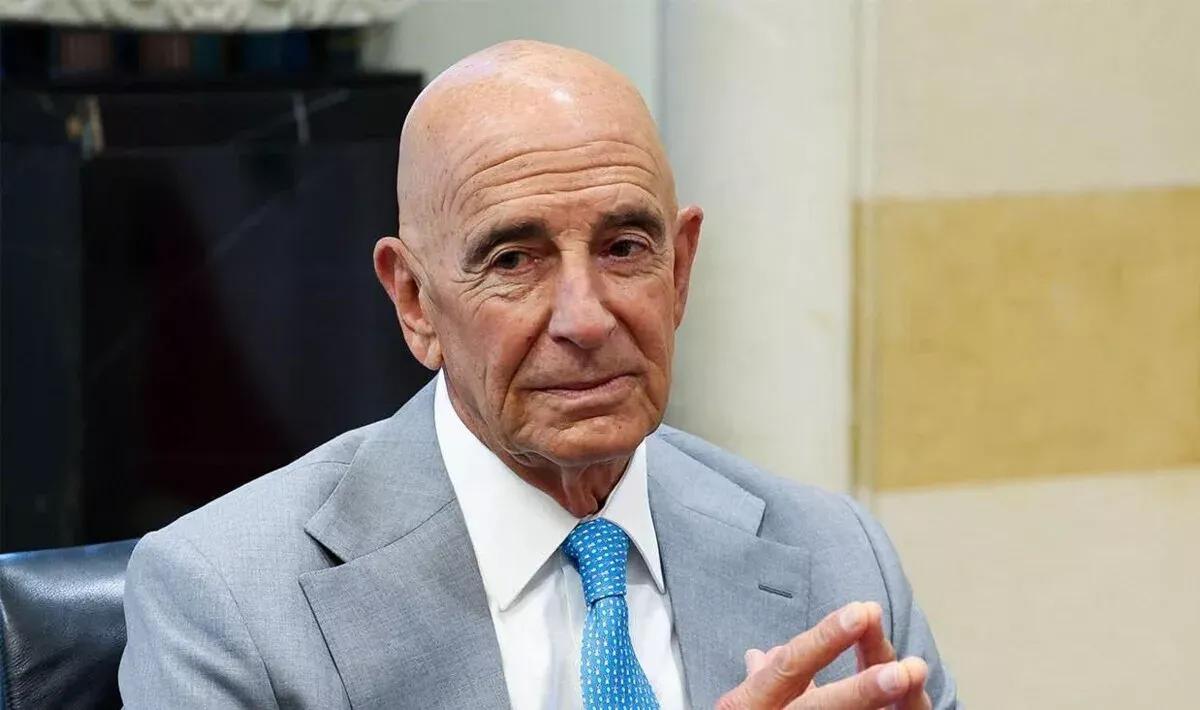
At the center of this vision is what has become known as the Four Seas Project, an ambitious regional concept promoted by U.S. Presidential Envoy Tom Barrack. Although the initiative has not yet been formally introduced as an official U.S. government program, Barrack’s recent speeches outline a framework that could fundamentally reshape the geopolitical architecture of the Middle East.
Rather than viewing Iraq, Syria, Turkey, Jordan, Lebanon, and Egypt as separate policy files, the strategy treats them as interconnected pieces of one regional system.
The Strategic Objectives
The project pursues several interconnected objectives.
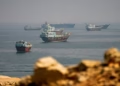
First, it seeks to reduce global dependence on the Strait of Hormuz, one of the world’s most vulnerable energy chokepoints. By establishing alternative overland transportation corridors, the United States hopes to reduce Iran’s ability to use geography as strategic leverage.
Second, it aims to integrate regional infrastructure projects, particularly Iraq’s Development Road, with Turkey’s transportation network and Europe’s commercial markets. This would transform Iraq from a battlefield into a regional logistics hub connecting the Gulf to Europe.
Third, the initiative complements the expanding Middle Corridor, stretching from Turkey through Azerbaijan and Central Asia, providing additional routes for natural gas and commercial trade into Europe.
Finally, the broader objective is political: replacing decades of regional confrontation with economic interdependence that encourages stability through shared prosperity rather than military deterrence alone.
Why Iraq Matters Most
No country occupies a more strategic position within this vision than Iraq.
Located between the Gulf, Turkey, Syria, Jordan, and Iran, Iraq possesses the geographic advantage necessary to become the Middle East’s principal commercial crossroads.
Tom Barrack has repeatedly emphasized Washington’s support for Iraqi Prime Minister Ali Faleh Al-Zaidi, describing his government as a partner capable of transforming Iraq into a center of regional cooperation built on transparency, economic reform, and the rule of law.
If successful, Iraq would no longer be viewed primarily through the lens of conflict but as the engine of regional economic integration.
Reducing Iranian Leverage Without Direct Confrontation
One of the most significant aspects of the Four Seas Project is that it does not rely primarily on military confrontation.
Instead, it seeks to reduce Iran’s strategic influence by reshaping regional economics.
For decades, Tehran has benefited from the world’s dependence on narrow maritime routes, particularly the Strait of Hormuz. Creating alternative transportation and energy corridors weakens that leverage naturally.
This represents an evolution in U.S. strategy: rather than focusing exclusively on sanctions or military pressure, Washington appears increasingly interested in altering the region’s economic geography.
The Biggest Challenges
Despite its strategic appeal, the project faces formidable obstacles.
Political instability
Several participating countries continue to struggle with fragile political institutions, internal divisions, and governance challenges that could delay implementation.
Security concerns
Large portions of Syria remain unstable, while Iraq continues to face security threats from armed groups. Protecting long-distance infrastructure across multiple borders will require unprecedented regional coordination.
Financing
The project will require hundreds of billions of dollars in long-term investments covering railways, highways, ports, energy infrastructure, and digital connectivity.
Private investors will demand political stability and legal certainty before committing capital at that scale.
Regional competition
Iran is unlikely to welcome a regional architecture explicitly designed to reduce its strategic influence.
China may seek to integrate parts of the initiative into its Belt and Road Initiative, while Russia will likely attempt to preserve its influence in Syria and regional energy markets.
Balancing these competing geopolitical interests will be one of Washington’s greatest diplomatic tests.
The American Media’s Response
Coverage of Tom Barrack’s regional vision has remained surprisingly limited within major American media outlets.
Most national coverage continues to focus on Iran’s nuclear program, Gaza, Israel, and immediate security crises rather than long-term infrastructure strategy.
Business publications have generally shown greater interest, recognizing that new transportation corridors, energy routes, and supply chains could significantly reshape global commerce.
Foreign policy analysts increasingly view the proposal as part of a broader transition in U.S. strategy—from managing conflicts to redesigning regional economic systems.
If implemented successfully, the project could eventually become one of the defining geopolitical initiatives of the second Trump administration.
The Timeline
Barrack recently suggested that alternative transportation networks capable of significantly reducing the strategic importance of the Strait of Hormuz could begin taking shape within approximately two years.
That timeline is politically ambitious.
While diplomatic agreements, investment frameworks, and initial construction phases may advance rapidly, full implementation of such a complex multinational network will likely require much longer.
Realistically, the initiative should be viewed as a long-term strategic transformation extending over the next decade, even if measurable progress becomes visible during the next several years.
A New Philosophy for the Middle East
Perhaps the most important feature of the Four Seas Project is not its infrastructure but its philosophy.
For over a century, Middle Eastern politics has been dominated by military alliances, regime change, proxy wars, and ideological competition.
Barrack’s vision suggests a different model—one where pipelines, railways, industrial zones, private investment, technology, and commercial partnerships become the primary instruments of regional stability.
Whether history ultimately remembers it as the Four Seas Project or under another official name, the concept reflects a broader strategic shift inside Washington.
Instead of asking how to contain the Middle East’s crises, policymakers are increasingly asking how to redesign the region’s economic map.
If that transformation succeeds, the next chapter of Middle Eastern history may be written less by armies and militias than by infrastructure, investment, and economic connectivity.