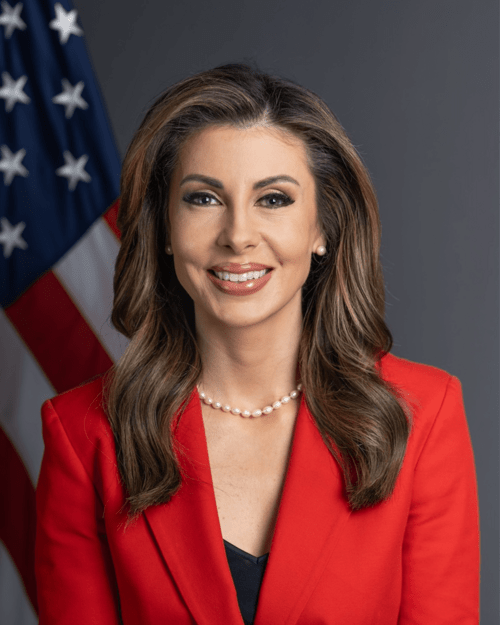
By Tumwesigye Anslem
Former U.S. envoy Morgan Ortagus delivered a pointed assessment of Donald Trump’s Middle East strategy during a lecture at the Middle East Forum, praising it as a transformative success that fundamentally altered the regional balance of power.
Ortagus, who served as a senior State Department official under Trump, argued that the administration replaced a longstanding “culture of fear” in Washington with a bold “policy of courage” in confronting Iran and its network of proxies. This shift, she contended, produced tangible military and diplomatic victories that have reshaped the region.
The envoy highlighted the Trump administration’s success in significantly degrading the military capabilities of both Iran and Hezbollah. She pointed to the elimination of numerous high-ranking military and security leaders during recent confrontations as a key achievement.
“Iran lost a large part of its military power in less than 40 days,” Ortagus stated. This rapid collapse included critical infrastructure such as missile production facilities and drone capabilities. Once viewed as a dominant regional power, Tehran has been reduced to a significantly weaker military actor, according to her analysis.
These setbacks, she argued, have dismantled much of Iran’s ability to project power through its “Axis of Resistance,” delivering a strategic blow to its long-term ambitions in the Middle East.
Ortagus also addressed the dramatic changes in Lebanon, a country long dominated by Hezbollah. She noted that Lebanon had transitioned from serving as a primary launchpad for rocket attacks against Israel to a nation taking tentative but historic steps toward normalization.
The envoy pointed to the “first public diplomatic meetings between Lebanon and Israel” as a landmark development, signaling a potential new direction for the war-weary country and the broader region.
“The region is gradually moving in a different direction,” she observed, suggesting that the combination of military pressure and diplomatic breakthroughs is opening pathways previously thought impossible.
Throughout her lecture, Ortagus framed Trump’s approach as a rejection of previous policies that she implied had emboldened Iran and its allies. By prioritizing strength, deterrence, and direct confrontation of threats, the administration achieved results that have measurably altered the security landscape of the Middle East, she concluded.
Her remarks come as analysts continue to debate the long-term impact of recent conflicts and shifting alliances in the region. Ortagus’s assessment presents a confident vision of a Middle East where American resolve has successfully checked Iranian expansionism and created new opportunities for stability.