By Rick Clay
The international system has entered a period of accelerated fracture driven by the convergence of energy insecurity, maritime chokepoint disruption, and the collapse of long standing geopolitical assumptions. The closure of the Strait of Hormuz, the redirection of global tanker traffic, the emergence of offshore dark fleet networks, and the repositioning of American power across critical sea lanes have combined to reshape the global order in real time. The United States, already the world’s largest producer of oil and natural gas, has become the central stabilizing force in a world suddenly deprived of predictable energy flows. Adversarial states, particularly Iran and China, find themselves structurally disadvantaged as their access to global markets narrows and their leverage over maritime corridors erodes. This white paper examines the strategic realignment now underway and the implications for global power distribution.
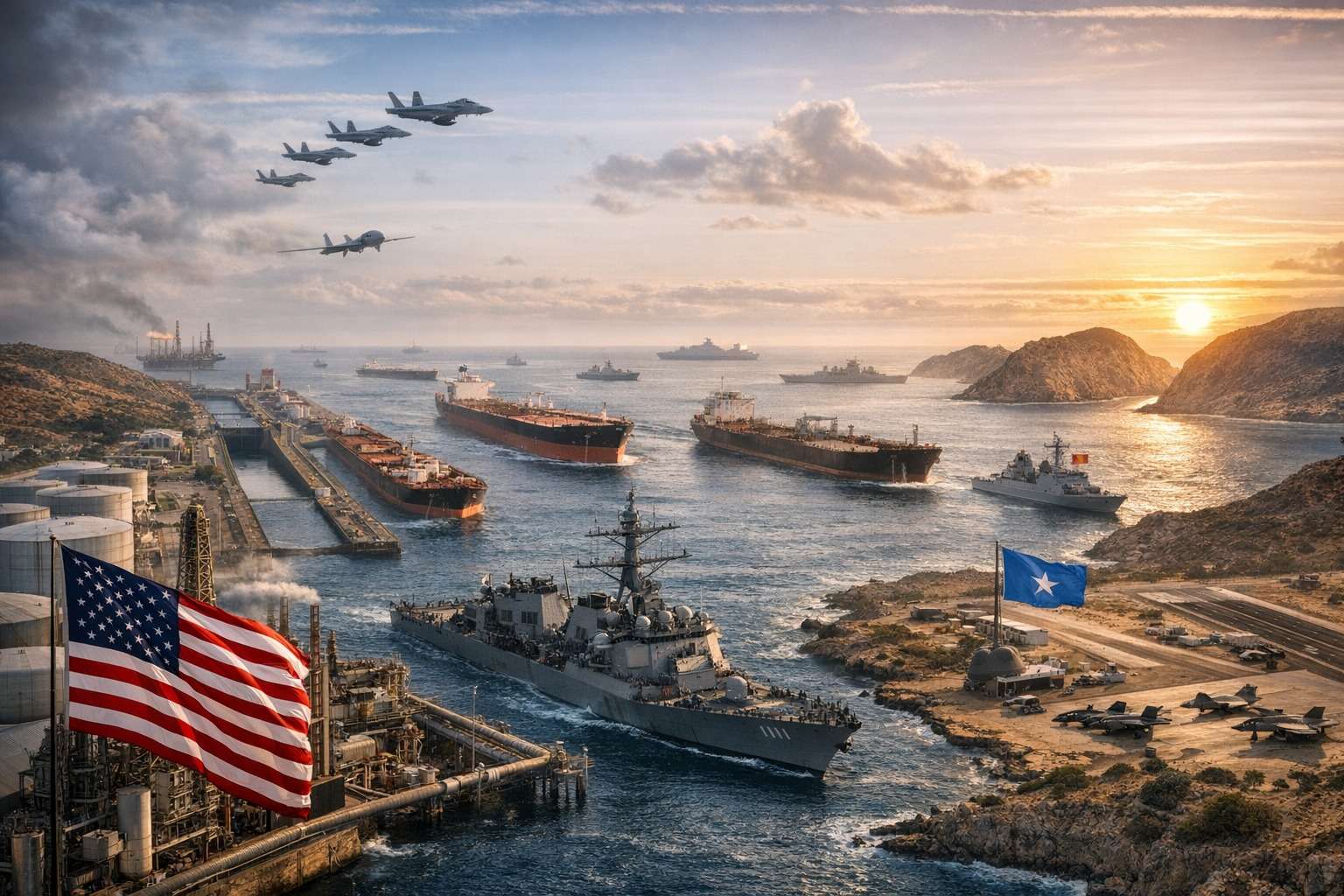
The closure of the Strait of Hormuz triggered the most significant reordering of global energy flows in half a century. With nearly a third of the world’s seaborne oil normally passing through the strait, its sudden shutdown forced tankers to reroute toward the United States, transforming the Gulf of America into the new global loading zone for emergency petroleum and natural gas demand. Analysts observed that the United States, already the world’s largest energy producer, became the only actor capable of supplying the market at scale during a period of explosive price escalation. This shift occurred alongside a broader strategic pattern in which the United States secured control over key maritime corridors, including the Panama Canal and the Red Sea approaches, while adversaries lost access, leverage, and operational freedom.
Iran, facing a comprehensive U.S. blockade of its ports, shifted to offshore dark fleet networks to preserve limited oil flows. Maritime intelligence confirmed that roughly twenty million barrels of Iranian crude accumulated off the coast of Malaysia in ship to ship transfer hubs designed to evade interdiction. These covert networks, while enabling minimal export continuity, underscored Iran’s structural weakness. The global market adapted quickly to the loss of Iranian throughput, while Iran itself was forced into increasingly fragile and inefficient distribution channels.
Simultaneously, Somaliland emerged as a potential host for a U.S. strategic presence at the deep water port of Berbera. Analysts noted that this location sits at the gateway to the Red Sea, adjacent to the maritime corridor where Iranian backed Houthi forces have targeted commercial shipping. A U.S. foothold in Somaliland would provide surveillance, interdiction, and rapid response capabilities across the Red Sea and western Indian Ocean, undermining Iran’s proxy leverage and complicating China’s Belt and Road ambitions in the region.
The convergence of these developments has produced a structural realignment in which the United States has consolidated control over the world’s most critical sea lanes while adversaries face diminishing influence. This white paper analyzes the collapse of Iran’s maritime leverage, the exposure of China’s energy vulnerabilities, and the emergence of a new architecture of American maritime dominance.
The sudden closure of the Strait of Hormuz forced global markets into a crisis of access. Nearly a third of the world’s seaborne oil normally transits the strait, and its shutdown created an immediate scramble for alternative supply. Analysts tracking maritime traffic observed a rapid shift as supertankers diverted toward the United States, treating American ports as the new emergency source of crude and LNG. The Gulf of America became the central loading zone for a world cut off from Gulf exports, and the United States emerged as the only producer capable of rapidly increasing supply into a market experiencing explosive price spikes.
Observers noted that this shift resembled a pre positioned strategic opportunity. The United States had already secured control over the Panama Canal, pushed back against foreign influence in the canal zone, and strengthened its presence across the Western Hemisphere’s energy corridors. When Hormuz closed, these preparations allowed the United States to absorb global demand while adversaries struggled to adapt. The canal became indispensable as Pacific origin tankers rerouted toward American ports, and the strategic value of U.S. control over the canal became immediately apparent.
As the U.S. blockade of Iranian ports took effect, maritime intelligence confirmed that Iran shifted to covert offshore distribution networks to preserve limited oil flows. At least eleven Iranian linked tankers carrying roughly twenty million barrels of crude repositioned themselves off the coast of Malaysia, forming a ship to ship transfer hub designed to bypass U.S. interdiction. Analysts noted that these vessels were likely awaiting counterpart ships for offloading or onward movement, a tactic that allows Iranian oil to continue flowing even when direct port access is blocked.
Windward AI emphasized that dark activity remains the core enabler of Iran’s ongoing operations. This includes falsely flagged vessels, AIS manipulation, and offshore transfer chains that obscure the origin of the crude. These mechanisms allow Iranian oil to persist outside direct Hormuz transit, but they also reveal the extent to which Iran has been forced into increasingly fragile and inefficient distribution channels. The global market adapted quickly to the loss of Iranian throughput, while Iran itself was reduced to floating storage, covert transfers, and diminishing influence.
U.S. Central Command confirmed that during the first forty eight hours of the blockade, no vessels successfully breached enforcement. Nine tankers attempting to exit or enter Iranian ports were intercepted and ordered to turn back, with all nine complying without the need for boarding. This immediate compliance underscored the effectiveness of the blockade and the degree to which Iran’s conventional maritime channels had been neutralized. Analysts estimated that the blockade halted all direct economic trade through Iranian ports, costing Iran hundreds of millions of dollars per day in lost throughput.
The offshore accumulation of twenty million barrels is a visible indicator of systemic failure. Iran can move oil into the shadows, but it cannot move it into the global market at scale. The collapse of Iran’s maritime leverage is observable in satellite imagery, confirmed by maritime intelligence, and reflected in the global redirection of tanker traffic toward the United States.
As global energy flows rerouted toward the United States and Iran’s maritime leverage collapsed, analysts highlighted a parallel development along the western edge of the Indian Ocean. Somaliland, the autonomous region on the Horn of Africa, emerged as a potential host for a U.S. strategic presence at the deep water port and airfield in Berbera. This location sits at the gateway to the Gulf of Aden, adjacent to the Red Sea corridor where Iranian backed Houthi forces have targeted commercial shipping. A U.S. foothold in Somaliland would reshape maritime security from the Bab el Mandeb to the Suez Canal.
The Berbera corridor occupies one of the most strategically consequential positions in the global maritime system. Nearly fifteen percent of world trade and a substantial share of Europe’s energy imports transit the Red Sea. Iranian support to the Houthis has enabled persistent attacks on shipping, forcing vessels to reroute around the Cape of Good Hope and driving up global freight costs. A U.S. presence in Somaliland would provide surveillance, interdiction, and rapid response capabilities across the Red Sea and western Indian Ocean, undermining Iran’s proxy leverage at a moment when Tehran’s own export channels are collapsing.
Somaliland’s leadership has actively sought deeper ties with the United States, positioning itself as a reliable partner in a region dominated by instability. Analysts observed that the United States has historically lacked a permanent presence on the African side of the Bab el Mandeb, relying instead on distant basing and naval patrols. A foothold in Berbera would close this gap, giving the United States a forward operating position capable of monitoring Iranian weapons flows to the Houthis, tracking dark fleet movements, and securing the maritime arteries that now carry rerouted global trade.
This development also intersects with China’s vulnerabilities. China relies heavily on Red Sea shipping for access to European markets and African resources. Analysts noted that China has invested deeply in Djibouti, just miles from Somaliland, establishing its first overseas military base there. A U.S. presence in Berbera would place American forces directly opposite Chinese infrastructure, complicating China’s maritime Belt and Road ambitions at the very moment Beijing faces energy shortages from the Hormuz shutdown and rising global dependence on American petroleum.
Somaliland therefore represents a pivotal node in the new architecture of American maritime dominance. It reinforces the collapse of Iran’s maritime influence, constrains China’s strategic mobility, and secures the Red Sea corridor at a time when global trade is under extraordinary strain.
Analysts examining recent global developments have increasingly argued that the United States has pursued a coordinated national security and energy posture centered on the control of critical maritime chokepoints and the redirection of global energy flows. Observers note that this approach reflects a broader strategic logic in which the United States positions itself as the indispensable hub of global energy supply while adversarial states, particularly China, become increasingly dependent on routes and markets shaped by American influence. Commentators have described this as a structural strategy rather than a tactical one, designed to reshape the geopolitical environment rather than respond to it.
This interpretation emphasizes that control of chokepoints such as the Strait of Hormuz, the Bab el Mandeb, the Panama Canal, and the Red Sea corridor allows the United States to influence the flow of global commerce at a foundational level. Analysts point out that these waterways are not merely transit routes but pressure points that determine the economic stability of major powers. China, whose economy relies heavily on imported energy and uninterrupted maritime trade, is particularly exposed to disruptions in these corridors. Observers argue that by securing influence over these routes, the United States gains leverage over China’s strategic decision making and long term economic trajectory.
Commentators have also highlighted the way global markets have shifted toward the United States as a result of these developments. The closure of the Strait of Hormuz, the activation of alternative pipelines, and the redirection of tanker traffic toward American ports have created a new energy architecture in which the United States functions as the primary supplier during periods of crisis. Analysts note that this shift has placed China in a vulnerable position, as its traditional sources of energy become less reliable and more exposed to geopolitical risk. The United States, by contrast, benefits from increased demand, higher prices, and expanded influence over global supply chains.
Observers further argue that the emerging U.S. presence in Somaliland fits into this broader strategic pattern. A foothold at Berbera would give the United States a forward operating position at the mouth of the Red Sea, directly adjacent to the maritime corridor where Iranian backed Houthi forces have targeted shipping. Analysts contend that this would allow the United States to secure the western Indian Ocean, monitor Iranian proxy activity, and counterbalance China’s military presence in nearby Djibouti. In this view, the Somaliland development is not an isolated event but part of a larger framework aimed at shaping the geopolitical environment in ways that constrain adversaries and reinforce American dominance.
Taken together, these elements form what commentators describe as a comprehensive national security and energy strategy. It is a strategy that leverages chokepoint control, market realignment, and maritime positioning to create systemic advantages for the United States while exposing the vulnerabilities of rival powers. Analysts argue that this approach has already begun to reshape global power dynamics, placing the United States at the center of a new energy and security architecture and positioning China in a more constrained and dependent posture.
The convergence of tanker rerouting, offshore dark fleet accumulation, chokepoint control, and emerging basing opportunities has produced a structural realignment of global power. The United States has emerged as the primary beneficiary of the crisis, with record exports, surging demand, and strengthened control over maritime corridors. Iran’s long term influence over global energy flows has been permanently diminished. China faces a new era of vulnerability as its access to Gulf energy narrows and its maritime Belt and Road infrastructure encounters American counter positioning.
The global system is reorganizing around American energy dominance and maritime control. The collapse of Iran’s leverage, the exposure of China’s dependencies, and the emergence of new U.S. footholds across critical sea lanes signal the beginning of a new geopolitical era.
The closure of the Strait of Hormuz did not merely disrupt a regional waterway. It exposed the fragility of a global system that had long assumed uninterrupted access to Middle Eastern energy and predictable maritime transit. The events that followed revealed a deeper truth about the emerging international order. The United States, through a combination of energy dominance, maritime positioning, and strategic control of chokepoints, has reasserted itself as the central organizing force in global stability. The redirection of tanker traffic toward American ports, the collapse of Iran’s export capacity, the emergence of Somaliland as a potential U.S. foothold, and the growing vulnerability of China’s energy lifelines all point to a world in which American leverage is expanding rather than contracting.
Iran’s maritime influence, once anchored in its ability to threaten or disrupt the Strait of Hormuz, has eroded to the point of structural irrelevance. Forced into offshore dark fleet networks, reliant on covert transfers, and unable to move oil at scale, Iran now operates from a position of weakness rather than strength. Its proxies, including the Houthis, remain capable of disruption, but even these asymmetric tools are increasingly constrained by the prospect of a U.S. presence in Somaliland and the tightening of maritime surveillance across the Red Sea and western Indian Ocean. The strategic geography that once empowered Iran has shifted decisively against it.
China faces a different but equally consequential challenge. Its economic model depends on uninterrupted access to imported energy and global shipping lanes that it does not control. The closure of Hormuz, the rerouting of global energy flows toward the United States, and the growing American presence across the Panama Canal, the Red Sea, and the Indian Ocean have exposed the degree to which China’s rise has been built on assumptions of open seas and predictable supply. Analysts increasingly argue that China is entering a period of structural vulnerability, one in which its access to energy, trade, and maritime mobility is shaped by forces beyond its control. The United States, by contrast, sits at the center of the new energy architecture, supplying the world at a moment of crisis and shaping the conditions under which global commerce can function.
The strategic logic underlying these developments is clear. Control of chokepoints is control of pressure. Control of pressure is control of markets. Control of markets is control of outcomes. The United States has positioned itself at the intersection of these forces, leveraging its energy abundance, maritime reach, and geopolitical partnerships to shape the global environment in ways that reinforce its long term advantage. The result is a world in which adversaries face narrowing options, shrinking leverage, and increasing dependence on systems the United States influences or directly controls.
The realignment now underway is not temporary. It represents a structural shift in the foundations of global power. The United States has demonstrated that energy dominance, combined with maritime control and strategic basing, can reshape the geopolitical landscape more effectively than any single diplomatic or military initiative. Iran’s collapse in maritime relevance, China’s exposure to chokepoint pressure, and the emergence of new American footholds across critical sea lanes all point to a future in which the United States remains the indispensable nation in both energy and security.
The collapse of old assumptions has created a new geopolitical reality. The United States stands at the center of this transformation, not as a passive beneficiary but as the architect of a strategic environment that favors stability, leverage, and long term dominance. The global order that emerges from this moment will be defined by the nations that can shape the flow of energy, secure the arteries of trade, and withstand the pressures of a volatile world. By every measure, the United States is positioned to lead that order for decades to come.