By Michael Arinzati
For years, the strategic map of the Middle East was built around one maritime pressure point: the Strait of Hormuz.
Iran understood the value of that geography better than almost anyone. If Tehran wanted to threaten the global economy without directly attacking the United States or Europe, it did not need to occupy another country. It only needed to threaten one narrow body of water through which an enormous amount of energy normally passes.
But Iran has spent years building something else.
A second pressure point.
More than 1,000 kilometres away, on the other side of the Arabian Peninsula, lies the Bab al-Mandab Strait. It connects the Red Sea with the Gulf of Aden and sits at the entrance to one of the world’s most important maritime corridors.
And Iran does not need to control Bab al-Mandab directly.
It has a proxy for that.
The Houthis.
What is happening in Yemen in September 2026 is therefore bigger than another chapter in Yemen’s civil war. It is the convergence of three conflicts: the Yemeni war, the Saudi-Houthi confrontation and the wider Iranian proxy war.
The Houthis’ advance towards the Red Sea coast has transformed the strategic equation.
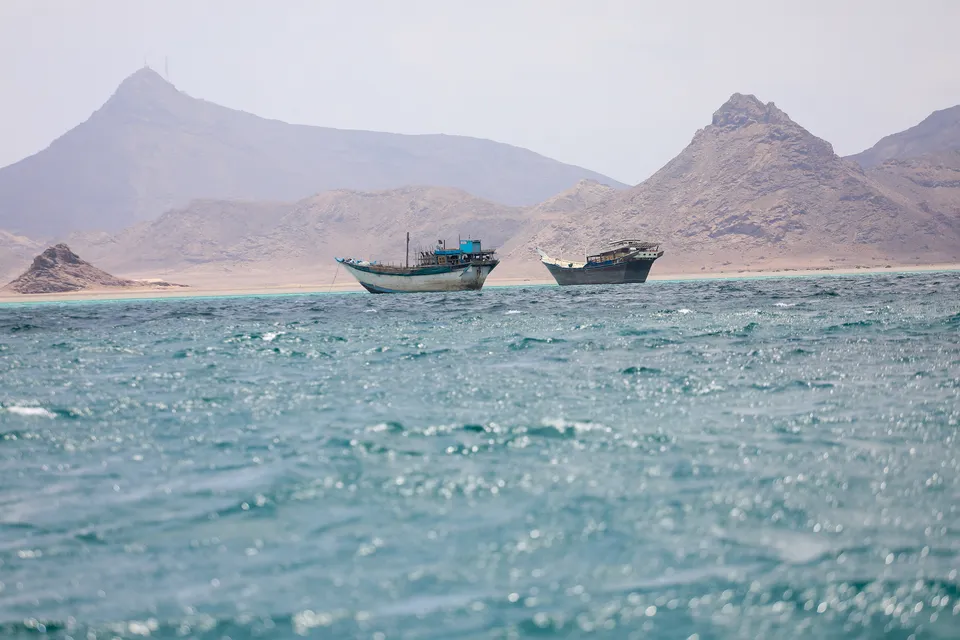
Their capture of Mokha and advance towards the Bab al-Mandab, combined with their seizure of strategic Red Sea islands, has brought an Iranian-aligned armed movement much closer to the ability to threaten a global maritime chokepoint.
That distinction matters.
The Houthis do not need to completely close Bab al-Mandab to win strategically.
They only need to make shipping companies believe that passing through it is too risky.
That is how modern maritime warfare works.
You do not necessarily need to sink every ship.
You need to change the insurance calculation.
From Yemen to Iran’s second front
The chronology of the current escalation tells the story.
After the death of Iran’s Supreme Leader Ali Khamenei and the wider escalation between Iran, Israel and the United States, the Houthi conflict ceased to be geographically contained.
The Houthis returned from Tehran.
The confrontation over the Iranian aircraft attempting to return to Sana’a escalated into Houthi missile and drone attacks against Saudi Arabia.
Then came the Houthi declaration of a maritime blockade against Saudi Arabia.
“A siege for a siege.”
That phrase was more important than it initially appeared.
The Houthis were announcing that Yemen was no longer simply a battlefield inside Yemen.
Saudi Arabia’s infrastructure became a target.
The Red Sea became a battlefield.
Shipping became a weapon.
And then the conflict began crossing borders in the opposite direction as well.
Drones launched from Iraqi territory struck Saudi infrastructure, including the East-West pipeline.
This is what a mature proxy network looks like.
The battlefield no longer has to correspond to the map.
A Houthi-linked threat can originate in Yemen, Iraq or Iran.
The financing can pass through another country.
The components can come through international procurement networks.
And the final target can be Saudi Arabia, a commercial vessel, an airport or a strategic oil facility.
Iran does not need every proxy to be under one centralized command.
It needs them to be capable of creating pressure simultaneously.
That is the real strategic problem.
The Houthis are not simply a Yemeni militia anymore
The Houthis began as a Yemeni movement rooted in northern Yemen.
They are still deeply embedded in Yemen’s local political, tribal and social realities.
But their military transformation is undeniable.
Over the years, their relationship with Iran and Hezbollah helped provide access to training, technology and weapons, while the Houthis themselves developed their own military-industrial and financial capabilities.
US Treasury assessments have repeatedly identified Iranian-linked financial, procurement and smuggling networks supporting Houthi weapons acquisition.
That means the problem cannot be solved by bombing individual launchers.
Destroying a missile launcher matters.
Destroying the network that replaces it matters more.
This is the lesson that has repeatedly been missed in the region.
If you intercept ten missiles but allow the eleventh, twelfth and thirteenth shipments of components to arrive, you are managing the threat.
You are not eliminating it.
The biggest Houthi weapon may be geography
The Houthis understand that they possess something that cannot be destroyed by an airstrike.
Geography.
Northern Yemen gives them strategic depth.
The western coast gives them access to the Red Sea.
Mokha brings them closer to Bab al-Mandab.
The islands provide additional military significance.
And control of territory allows them to combine missiles, drones, naval capabilities, mines, explosive boats and coastal surveillance.
The seizure of Mokha was therefore not simply another territorial gain.
It was a strategic move towards the maritime battlefield.
That is why the West Coast matters so much.
Taiz matters.
Hodeidah matters.
Mokha matters.
The islands matter.
And Bab al-Mandab matters.
The map is telling us where the war is going.
But there is another side to this story
The Houthi advance has not happened in a vacuum.
The anti-Houthi camp has suffered from fragmentation for years.
There is a Yemeni government.
There are different military formations.
There are southern forces.
There are forces associated with Tareq Saleh.
There are tribal forces.
There are competing foreign sponsors.
And historically, these groups have not always shared the same strategic objectives.
That is a fundamental weakness.
You cannot defeat an organization that has a relatively coherent military command with a coalition that has no coherent military strategy.
The Houthis have repeatedly benefited from their opponents’ divisions.
The latest fighting has demonstrated this again.
When Houthi forces advanced down the western coast, government-aligned forces retreated from Mokha.
This is perhaps the single most important military lesson from the current offensive.
The answer is not another collection of militias.
The answer is a Yemeni military structure capable of fighting as one force.
1. Build one Yemeni military command
This is the foundation.
The internationally recognized Yemeni government and the major anti-Houthi military formations need an operational command structure that works.
Not another political committee.
Not another temporary alliance.
Not another arrangement where every faction keeps its own army.
A genuine joint command should coordinate intelligence, logistics, air defence, artillery, special operations and ground offensives.
The different anti-Houthi forces do not need to agree on Yemen’s final political settlement before they can agree on one military objective:
The Houthis cannot be allowed to dominate Yemen’s Red Sea coast or control the approaches to Bab al-Mandab.
Political disagreements can be negotiated later.
Military fragmentation cannot be allowed to continue indefinitely.
2. Make the West Coast the centre of gravity
The strategic priority should be clear.
Bab al-Mandab.
That means the West Coast cannot be treated as just another front.
It is the front.
The objective should be to deny the Houthis the ability to operate freely from Hodeidah southwards towards Mokha and the strait.
This requires control of the coastline, ports, islands and critical high ground.
It also means protecting Mokha, restoring secure access routes towards Taiz and preventing the Houthis from turning the southern Red Sea into a permanent military zone.
The Houthis understand the geography.
The anti-Houthi coalition needs to understand it just as well.
3. Establish a permanent Red Sea security architecture
The international community should stop treating Red Sea security as an emergency that begins whenever another commercial ship is attacked.
There needs to be a permanent regional maritime security system.
Saudi Arabia, Yemen, Egypt, Djibouti, Jordan and other willing regional and international partners should have integrated maritime surveillance, intelligence-sharing, air defence and rapid-response capabilities.
The objective should be simple:
Freedom of navigation cannot depend on whether the Houthis feel restrained this month.
The maritime corridor has to remain open regardless of political developments in Sana’a.
4. Cut the Iranian supply chain
This is where the strategy needs to become much more aggressive and much more intelligent.
Iranian support is not just a box of missiles arriving in Yemen.
It is a network.
Weapons components.
Dual-use technology.
Financial transfers.
Front companies.
Shipping companies.
Smuggling routes.
Procurement agents.
Money laundering.
Cryptocurrency.
And international suppliers.
Treasury has already demonstrated that these networks can be identified and sanctioned. The next step should be systematic.
If a company supplies missile components to a Houthi procurement network, target the company.
If a financial intermediary moves money, target the intermediary.
If a shipping company knowingly facilitates weapons transfers, target the shipping company.
If a port or smuggling route is repeatedly used for military logistics, monitor it.
If an Iranian network finances the operation, attack the network financially.
The objective is not punishment for punishment’s sake.
It is logistics.
No logistics, no missiles.
5. Deal with Iraq as part of the same problem
The attacks launched from Iraq against Saudi infrastructure should not be treated as a completely separate conflict.
They demonstrate how Iran-aligned networks can create overlapping fronts.
If Iraqi territory is used to attack Saudi Arabia, Baghdad has a responsibility to stop it.
The principle should be straightforward:
Sovereignty means controlling your territory.
If Baghdad cannot prevent armed groups from using Iraqi territory to launch attacks against another state, then regional partners will inevitably begin treating those launch sites as part of the wider threat network.
The solution is stronger Iraqi state control over armed groups, better border surveillance and intelligence cooperation — not allowing Iraq to become another launchpad in the regional war.
6. Attack the Houthi war economy
Military capability requires money.
And the Houthis have built substantial revenue streams.
UN documentation has previously described Houthi revenue from customs, taxes, fees and illegal collection points. US Treasury has separately documented extensive illicit fundraising, smuggling and weapons-procurement networks.
This means economic warfare should be a central component of the strategy.
Target the money.
Target the businesses.
Target the smugglers.
Target the procurement agents.
Target the financial intermediaries.
And, critically, replace the economic services that civilians currently depend on.
This last point is essential.
If you remove Houthi taxation but do nothing for ordinary Yemenis, you create another vacuum.
The government has to provide an alternative.
Pay salaries.
Keep electricity functioning.
Keep ports operating.
Protect trade.
Support agriculture and fisheries.
Restore banking services.
Build functioning customs systems.
Give businesses a reason to operate legally.
A functioning Yemeni state is not merely a humanitarian objective.
It is counterterrorism infrastructure.
7. Do not destroy Yemen to save Yemen
This is where strategy and morality meet.
More than 22 million people in Yemen are expected to require humanitarian assistance and protection in 2026.
That number is not an argument for allowing the Houthis to win.
It is an argument for defeating them intelligently.
Humanitarian corridors need to remain open.
Food and medicine must reach civilians.
Ports serving civilian populations must be protected.
Humanitarian organizations must be allowed to operate.
And areas retaken from the Houthis must receive immediate stabilization support.
The alternative is predictable.
Military victory creates another humanitarian disaster, which creates resentment, which creates recruitment opportunities, which creates another insurgency.
That cycle has to end.
8. Offer Yemenis something better than the Houthis
There is a military dimension to this war.
There is also a political one.
The Houthis cannot be defeated permanently by killing fighters.
Their political and social infrastructure must also be replaced.
That does not mean negotiating away Yemen’s sovereignty to the Houthis.
It means giving Yemenis a credible alternative.
Local government.
Security.
Jobs.
Electricity.
Schools.
Healthcare.
Ports.
Trade.
A functioning currency and banking system.
And eventually a political settlement in which armed groups cannot maintain private armies outside the authority of the state.
This is especially important in areas where the Houthis have exploited anger, poverty, tribal grievances and distrust of central government.
The message should be simple:
You do not have to support the Houthis to have a future.
9. Separate the Yemeni people from the Houthi leadership
This distinction is strategically important.
The Houthis are not Yemen.
Yemen is much larger than Ansar Allah.
There are millions of Yemenis who want security, employment, functioning government and an end to war.
A successful campaign therefore needs two completely different messages.
To Houthi commanders and the external networks supporting them:
There is no safe financial, military or logistical future for this war.
To ordinary Yemenis:
The state is coming back, and your future does not depend on the militia.
That distinction can weaken recruitment.
It can also encourage defections.
And it prevents Iran from turning every Yemeni civilian grievance into another argument for permanent war.
10. Stop confusing a ceasefire with peace
The 2022 ceasefire demonstrated something important.
The Houthis could be restrained.
But restraint is not the same thing as disarmament.
And a pause in fighting is not the same thing as a political settlement.
The latest escalation shows what happens when an armed movement retains its military infrastructure while the underlying strategic dispute remains unresolved.
The lesson should not be that diplomacy failed.
The lesson should be that diplomacy needs leverage.
Negotiations work when the parties have a reason to compromise.
They fail when one side believes time is on its side and military escalation will improve its bargaining position.
The Houthis now have an incentive to believe that controlling the Red Sea coast increases their leverage.
That incentive has to be reversed.
The real target is not Sana’a
This may be the most important point.
The objective should not be to capture Sana’a tomorrow.
The objective should be to make the Houthis incapable of using Yemen as an Iranian military platform.
Those are not the same thing.
A successful strategy could eventually require changes in Sana’a.
But the immediate strategic priorities are different:
Control the Red Sea coast.
Secure Bab al-Mandab.
Protect maritime traffic.
Break the missile and drone supply chain.
Stop cross-border attacks.
Cut the financial networks.
Unify the anti-Houthi forces.
Strengthen the Yemeni state.
And create economic and political conditions under which ordinary Yemenis have something better to defend.
That is how the problem becomes manageable.
Iran’s strategy can be turned against it
There is an irony in what has happened.
Iran spent years developing proxies because proxies gave Tehran strategic depth.
They allowed Iran to fight without always fighting directly.
But the same network also creates vulnerabilities.
Iran’s regional strategy depends on logistics.
The Houthis depend on logistics.
Iraqi militias depend on logistics.
Lebanese Hezbollah depends on logistics.
The missiles, drones, money, components and communications systems do not materialize from nowhere.
They move.
And everything that moves leaves a trail.
The answer to Iran’s proxy strategy is therefore not necessarily to fight every proxy simultaneously.
It is to dismantle the network connecting them.
Find the money.
Find the weapons.
Find the suppliers.
Find the launch sites.
Find the commanders.
Find the ships.
Find the financial intermediaries.
Then break the chain.
The Bab al-Mandab cannot become another Hormuz
This is the central strategic issue.
Iran has spent decades turning geography into leverage.
Hormuz is one chokepoint.
Bab al-Mandab is another.
The international community cannot allow the principle of freedom of navigation to become conditional on the military ambitions of an Iranian-backed militia.
The Houthis do not need to formally declare themselves the owners of Bab al-Mandab.
If shipping companies begin avoiding the route, if insurance premiums explode, if tankers divert around Africa, if Saudi oil infrastructure becomes increasingly vulnerable and if international trade becomes hostage to Houthi calculations, the strategic effect is already achieved.
That is why the current fighting matters far beyond Yemen.
The Red Sea is not merely a Yemeni problem.
It is an international security problem.
And Yemen still has a way out
The situation is serious.
The Houthis have demonstrated that they can exploit fragmentation among their enemies, use modern missiles and drones, threaten Saudi infrastructure, attack shipping and take advantage of a regional war to expand their leverage.
Their capture of Mokha and their advance towards Bab al-Mandab are therefore strategically significant.
But significant does not mean irreversible.
The Houthi position is also vulnerable.
They have enemies on multiple fronts.
They depend on external procurement.
They depend on financial networks.
They depend on access to weapons components.
They depend on control of territory.
They depend on the fragmentation of their opponents.
And they depend on the perception that nobody is prepared to challenge them for long.
That last part can change.
The war should therefore be approached as a campaign with clear objectives rather than an endless series of retaliatory strikes.
Deny the chokepoint.
Unify Yemen’s anti-Houthi forces.
Cut the Iranian supply chain.
Destroy the Houthi war economy.
Secure the Red Sea.
Stop the Iraqi spillover.
Protect civilians.
Rebuild the Yemeni state.
And then negotiate from a position in which the Houthis no longer possess the ability to hold Yemen, Saudi Arabia or global shipping hostage.
Because the fundamental mistake would be to think this is only a war over Yemen.
It is not.
It is a contest over whether an Iranian-backed armed network can turn Yemeni territory into a permanent strategic platform — and whether one of the world’s most important maritime chokepoints can become another instrument of Iranian coercion.
The answer cannot be another temporary ceasefire followed by another round of missiles.
The answer has to be a strategy that removes the capability, the financing and the geography that make the threat possible in the first place.
Yemen needs peace.
But peace without security simply gives the next war time to prepare. And the Red Sea cannot afford another decade of preparation.