By Samer Sinijlawi
History is not gentle with Israelis and Palestinians. It records our failures with more clarity than our hopes. And the lesson it repeats, again and again, is brutally simple: every time diplomacy collapses, the next round of violence becomes even more devastating. We saw this in 2000 after Camp David, again in 2008 after Annapolis, and most recently in 2023 after years of paralysis and political decay on both sides. Each time we failed to build a political horizon, the ground beneath us exploded.This is not coincidence. It is cause and effect.
If we do not change course now — both of us — the next explosion will be darker and more destructive than anything either people have ever known. Israelis and Palestinians understand this truth in the depths of their trauma, even as our politics continue to deny it.
Today, a unique moment has emerged. For the first time, the White House is occupied by a man who not only makes promises but appears genuinely determined to act. Two months after the Sharm el-Sheikh plan was announced, it is clear that President Trump intends to implement it — and that the United States, Arab states, and the international community are unusually aligned.
The 20-step plan presented by President Trump is not perfect. No peace plan is. But it is concrete, detailed, implementable, backed by regional powers and the only plan currently on the table. For once, we have a framework rather than a slogan. If Israelis and Palestinians engage with it seriously rather than ideologically, it can mark the beginning of a new chapter and this window will not remain open forever.
There is one assumption that dominates Israeli thinking today: that the disarmament and demilitarization of Hamas is the alpha and omega of peace, the essential condition for any future arrangement. In principle, I agree. In practice, the question is: who can actually achieve this, and how? If Israel, with one of the most advanced militaries in the world, has not been able to dismantle Hamas’s military capabilities after two years of war, then the problem is not military — it is political, social, and structural. Hamas is not just a militia. It is also a governing bureaucracy, a social network, an employer, a provider of basic services and a major component of the local economy
Approximately 60,000 civil and police employees worked under the Hamas government. One-third have been killed, leaving behind tens of thousands of widows, orphans, and dependents. Of the remaining employees, nearly half were not Hamas members; they were simply workers seeking income to feed their families. They currently receive around $300 per month from the remnants of Hamas’s structures — a social and economic lifeline that cannot simply be cut. Demilitarization that ignores these realities is impossible. Demilitarization that embraces them is achievable.
Therefore the new governing system in Gaza must integrate non-affiliated civil employees immediately, create retirement pathways for older or ideologically committed members, offer structured reintegration for those who renounce violence, build transparent social-security mechanisms for families of the dead, launch a massive vocational and administrative training program and replace Hamas’s payroll with a modernized civil service from day one. This is not appeasement. It is state-building, the only path to ending armed factions.
Most Israelis know Hamas. Few know Gaza. Gaza is not just a political landscape but a vast ecosystem of powerful family clans, tribal networks with deep social authority, family-centered business conglomerates, civil society organizations, religious institutions, neighborhood leadership structures, women’s networks, student unions and professional unions and syndicates
These forces often have far greater legitimacy than formal political bodies. They have survived the collapse of the Palestinian Authority, the authoritarianism of Hamas, sixteen years of blockade, and years of repeated war. If Gaza’s reconstruction is to succeed, these forces must be the engine of transformation. They hold the social capital and legitimacy needed to weaken extremism and stabilize governance. What Gaza lacks is not only capacity, it also lacks opportunity.
Some in Israel speak of deradicalization as though it is a matter of rewriting textbooks. But indoctrination is not undone in a classroom alone. Palestinians have lived under conditions that generate radicalization for decades: hopelessness, displacement, unemployment, blockade, political stagnation, internal repression and external violence. Deradicalization requires: rebuilding an educational system based on critical thinking, science, foreign languages, and global engagement, transforming the university sector through cooperation with top global institutions — including Israeli universities if possible, creating public discourse that emphasizes dignity, pluralism, and coexistence, introducing media reforms that reward analytical journalism over populist rhetoric, and promoting cultural and historical literacy that acknowledges Jewish and Israeli narratives.
But deradicalization is not a Palestinian challenge alone. Israeli society, too, has undergone a deep radicalization since October 7. The media, public discourse, and political class remain frozen in trauma. No society can live indefinitely inside a psychological emergency. If we want different results, both sides must undergo a profound narrative shift — one that acknowledges a simple truth: Jews and Palestinians belong equally to this land. Neither people are going anywhere. Both have the right to live here — not as privilege, but as entitlement. This recognition is the foundation of any future peace.
No amount of demilitarization or deradicalization will succeed without the most difficult transformation of all: political reform. Gaza and the West Bank need a system that resembles a social-democratic framework: transparent, accountable, pluralistic, participatory, grounded in rule of law, and equipped with functioning institutions.
The Palestinian public is currently trapped between two disasters: Hamas’s violence, which has brought destruction, isolation, and catastrophe and Mahmoud Abbas’s corruption and authoritarian stagnation, which has suffocated political life and prevented generational change. This dual crisis has devastated Palestinian society and destroyed public trust in political elites.
Electing new leadership is not only a Palestinian need — it is a strategic necessity for Israelis as well. Palestinians need to demonstrate starting now from Gaza, they are capable of building functioning civilian ministries, transparent budgeting, independent courts, professional police, an accountable security sector, a modern civil service and a government that can negotiate, implement agreements, and deliver results. Without this, Israelis will not believe that peace is possible — and they will not say yes to any political horizon.
No political or social transformation will survive without economic revival.Gaza’s economy must be rebuilt around a reconstruction authority insulated from corruption, with major Arab and international financing, in partnerships with Israeli private-sector actors, in a long-term vision that integrates Gaza with the global economy, with energy, water, and transportation infrastructure, a modern port and logistics systems, industrial zones and vocational training for tens of thousands of young people. The old economic dependency breeder radicalism while the new economic dignity should breed stability.
For too long, Palestinians have spoken to Israelis in the language of human rights and international law. These concepts matter — both morally and legally — but they do not resonate in Israel’s current emotional and political landscape. We need a new language, one that acknowledges Israeli trauma, one that understands Israeli fears, one that recognizes Jewish history, one that speaks to Israelis as human beings, not legal subjects, one that appeals to shared interests and shared futures. I know Israelis well. I spent years engaging with their civil society, journalists, intellectuals, commanders, and businesspeople. Beneath the politics, there is a reservoir of shared humanity waiting to be tapped.
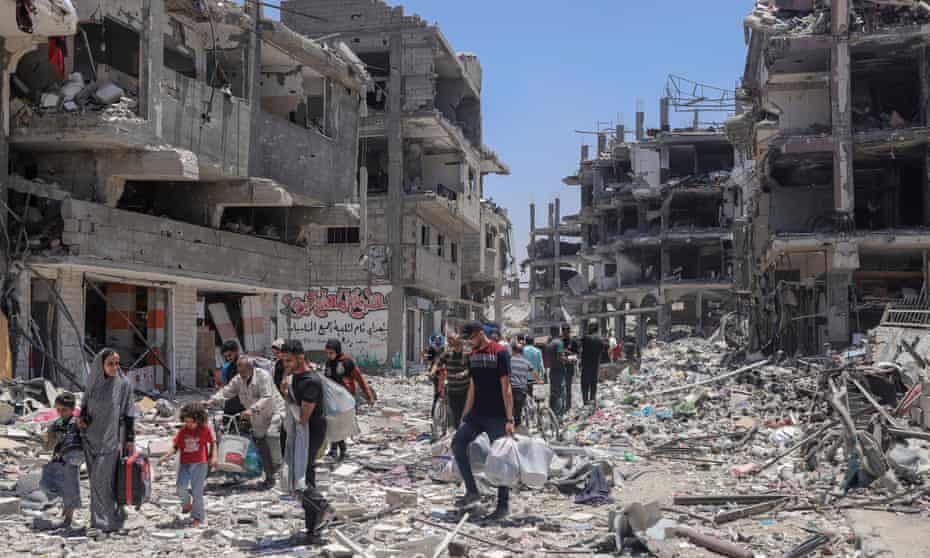
When one side changes deeply and sincerely, the other side eventually responds. This is not a theory. It is human nature. And we Palestinians must take the first step — not because Israel is right, and not because Palestinians are guilty, but because for Palestinians the situation is urgent with two million people in Gaza living in plastic shelters. Israelis, despite fear and trauma, can survive another decade like this, but Palestinians cannot. This moment will not return soon, if we miss it, we will pay the price for another generation.
Gaza is often described in Israel as a jungle — chaotic, violent, ungovernable.
I reject this deeply. Gaza is a wounded society, not a wild one. It is a place full of talent, energy, resilience, family loyalty, and human dignity and it can become a model of reconstruction, a laboratory for new governance, a zone of stability, and bridge between Israelis and Palestinians if we choose to make it so.
The future is not waiting in Washington, Cairo, or Doha, it is waiting in Gaza, Jerusalem, Tel Aviv, and Ramallah and it will begin the moment we dare to imagine something different — and take the first step toward it.
Samer Sinijlawi is a veteran Palestinian political activist, considered part of the opposition within Fatah, a promoter of Israeli-Palestinian dialogue, and lives in Jerusalem.