By Maria Maalouf
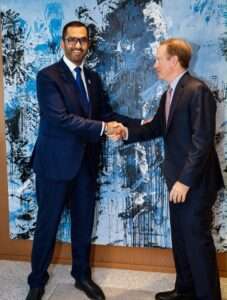
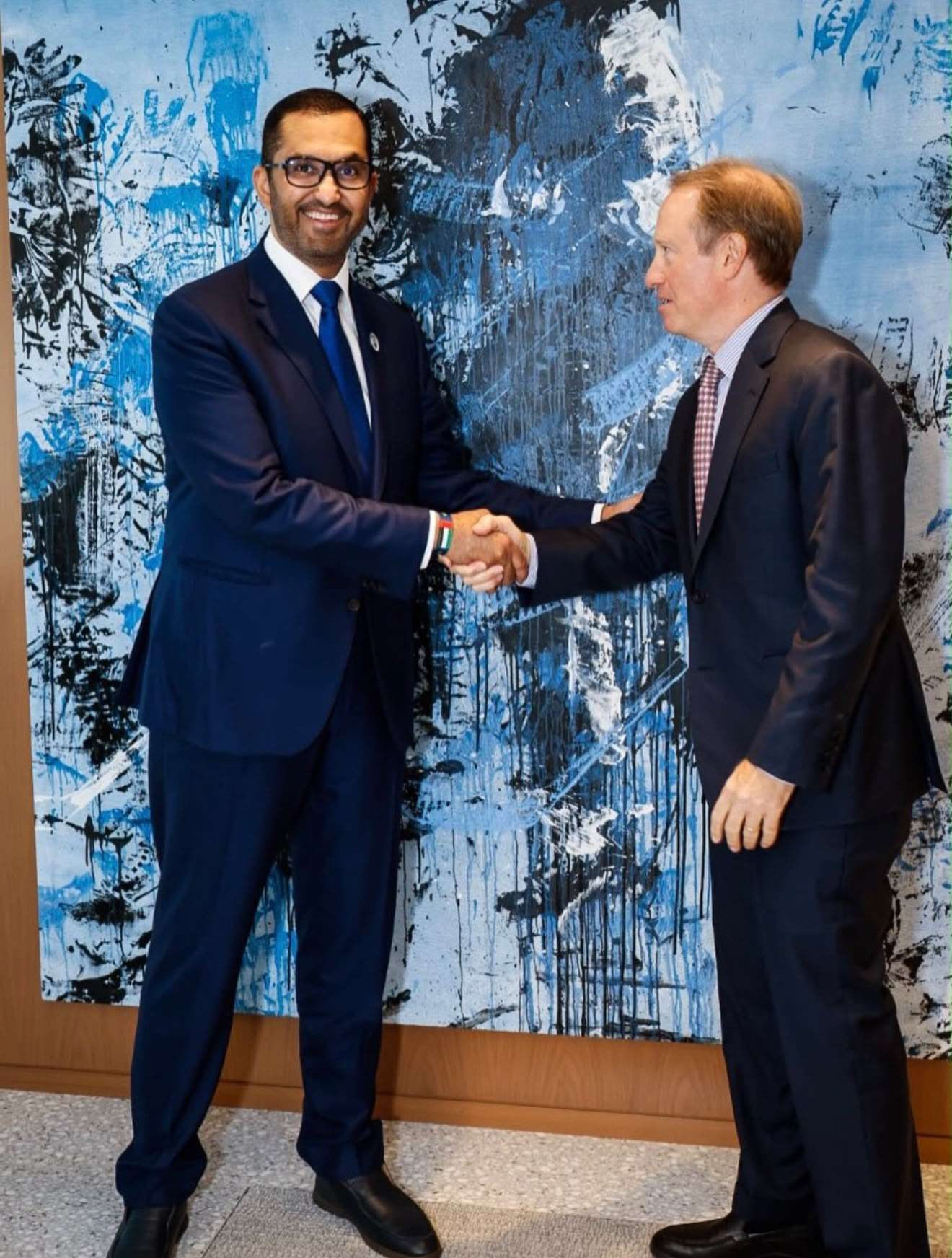
In New York this week, Dr. Sultan Ahmed Al Jaber sat down with Morgan Stanley Chairman and CEO Ted Pick as XRG, the international investment arm of Abu Dhabi National Oil Company, pressed its case for patient capital in the real economy. The message from the UAE energy chief was short and strategic: the next era of growth will be capital-intensive, energy-intensive and intelligence-intensive. The meeting took place as world leaders assembled for the 81st United Nations General Assembly, and it formed part of a wider round of talks that also included Brookfield CEO Bruce Flatt, Occidental Petroleum President and CEO Richard Jackson, and African investor Tony Elumelu.
Al Jaber arrived in the city wearing several hats at once. He is UAE Minister of Industry and Advanced Technology, Managing Director and Group CEO of ADNOC, Executive Chairman of XRG, and a member of the official UAE delegation to UNGA81. That combination of roles is the point. High-level week at the United Nations runs from 22 to 28 September 2026, with Abu Dhabi emphasizing conflict resolution, UN reform, AI governance, climate action and sustainable development. Al Jaber’s itinerary treated energy finance as part of the same conversation rather than a side meeting on the margins.
XRG is the vehicle built to carry that argument into markets. ADNOC launched it in November 2024 with an enterprise value of more than $80 billion and a mandate to take Abu Dhabi’s energy capital global. The company now puts its valuation above $150 billion and organizes itself around three connected platforms: international gas and LNG, chemicals, and scalable energy solutions. The design is deliberate. Gas supplies power and feedstock. Chemicals produce the materials that industry and data centers require, including coolants and advanced polymers. Infrastructure ties the chain together. The strategic claim is that AI and digitalization are creating electricity demand on a scale that yesterday’s grids cannot meet, and that reliable energy, especially gas in the near to medium term, will have to sit alongside renewables if the system is to hold.
That thesis is already visible in the portfolio. XRG has built positions across all five trains of NextDecade’s Rio Grande LNG project in Texas and holds a 35 percent interest in ExxonMobil’s planned low-carbon hydrogen and ammonia facility at Baytown. It has completed an equity stake in Azerbaijan’s Southern Gas Corridor, adding midstream access to existing Caspian upstream holdings in Absheron and Turkmenistan’s Block I. It has taken a 32 percent stake in Argentine gas blocks linked to a potential 12-million-tonne-per-year LNG project in Vaca Muerta. On the chemicals side it helped form Borouge Group International with OMV and completed the takeover of Germany’s Covestro. The company is targeting 20 to 25 million tonnes a year of gas and LNG capacity by 2035 and wants to more than double its asset value over the next decade.
The conversation with Ted Pick sits inside a longer relationship with Morgan Stanley. The bank has advised ADNOC on major listings and energy transactions for years. In August 2026 ADNOC hired Michael O’Dwyer, Morgan Stanley’s global co-head of energy, as chief investment officer, the second consecutive CIO drawn from the firm. Pick, who became CEO in 2024 and chairman in 2025, leads an institution whose franchise is built to raise and allocate the long-duration capital that pipelines, liquefaction trains and power infrastructure actually require. ADNOC framed the New York meeting as an effort to deepen relationships with global capital partners around long-term investment in the real economy, a phrase meant to distinguish this kind of money from shorter-cycle financial flows.
The “three intensives” formulation is more than a slogan. It argues that future growth cannot be financed on quarterly horizons or powered by analog systems. Gas is presented as a lower-carbon transition fuel that can firm renewables and feed chemicals. Chemicals become an AI-enabling industry. Capital has to arrive early enough to build capacity before demand is fully visible. That view also has a geopolitical edge. XRG’s United States push sits inside a broader UAE-U.S. energy and technology partnership, with executives speaking of dozens of potential American transactions across the gas value chain and of deploying tens of billions of dollars under the right return conditions. Energy security and abundance have been framed as shared interests, especially after regional disruptions that again highlighted chokepoints such as the Strait of Hormuz.
Al Jaber’s own career is the personal version of the same synthesis. He is a chemical engineer by training, the founding chief executive of Masdar, the executive who modernized ADNOC and took several of its businesses to market, the president of COP28, and now the public face of a $150 billion-plus international investment vehicle. Critics have long questioned whether rapid fossil-fuel expansion can sit beside climate leadership. His consistent answer has been that energy security, economic development and emissions reduction have to be pursued together rather than in sequence.
No transaction was announced after the meeting with Pick. The significance lies in the alignment of narratives and networks. XRG needs deep-pocketed partners who understand infrastructure cycles. Global banks and asset managers need origination in the energy and materials businesses that will actually power the next wave of growth. In a week when diplomats at the United Nations talk about restoring trust and managing transformation, Al Jaber’s New York schedule was a reminder that the decisions made in boardrooms and trading floors will determine whether the energy system can keep pace with the intelligence system it is now expected to fuel. The next era, as ADNOC and XRG describe it, will not be cheap, low-energy or analog. The open question is whether the capital, the molecules and the megawatts will arrive in time.