By Prof Bill Mikhail
On the morning of Saturday, February 28, 2026, the Gulf region entered one of the most dangerous and transformative moments in its modern history. What had long been anticipated as a potential confrontation between Iran and the United States, alongside Israel and its allies, rapidly evolved into a direct regional war that reshaped the security architecture of the Middle East.
For the United Arab Emirates, however, the conflict was not merely another geopolitical escalation unfolding from a distance. Within hours, the UAE found itself facing one of the largest and most coordinated attacks ever launched against a Gulf state.
Iran initiated an unprecedented campaign of ballistic missile and drone strikes targeting strategic Emirati infrastructure, economic facilities, maritime routes, and critical national assets. The scale of the assault exceeded what many analysts had expected and, in several respects, surpassed the intensity of attacks previously directed at Israel and other regional actors.
Yet while the attack shocked much of the world, it did not shock Emiratis.
The people of the UAE had long understood the extent of the military transformation their country had undergone over the past two decades. Behind the image of a modern economic and financial hub stood a highly sophisticated defense structure built through years of strategic investment, operational experience, intelligence modernization, and regional security engagement.
This was not a military institution built for ceremonial purposes. It was a force designed for deterrence, rapid response, and strategic warfare.
The UAE had already demonstrated its military capabilities in Yemen, where Emirati forces played a decisive role in liberating vast territories from Iranian-backed militias, securing maritime corridors, and confronting networks that threatened the stability of the Gulf and international trade routes.
When the 2026 war began, those years of preparation were put to the ultimate test.
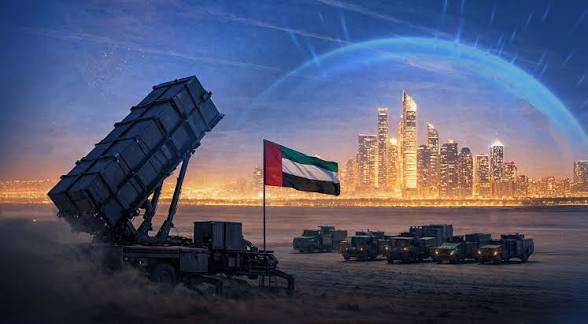
Within days, the UAE launched one of the most advanced air defense operations in the modern history of the Middle East. Emirati defense systems intercepted massive waves of ballistic missiles, cruise missiles, and armed drones with remarkable precision and effectiveness.
According to official defense assessments, thousands of aerial threats were neutralized during the first phase of the conflict while maintaining civilian and infrastructure protection rates estimated at approximately 96 percent. Airports continued functioning. Ports remained operational. Financial institutions stayed active. Daily life, despite the tension, never descended into chaos.
This level of resilience did not occur by accident. It reflected years of investment in integrated defense technologies, intelligence coordination, cybersecurity, command-and-control systems, and strategic partnerships with Western allies.
But the military confrontation was only one dimension of the war.
At the same time Iran launched missiles toward Emirati territory, another coordinated assault emerged across television networks, digital platforms, and social media ecosystems throughout the region.
A systematic disinformation campaign attempted to portray the UAE as a collapsing state. Fabricated videos showing explosions and fires from unrelated incidents around the world were circulated online and falsely presented as scenes from Dubai and Abu Dhabi. Rumors spread claiming that ports had shut down, investors were fleeing, financial markets were crashing, and social order was deteriorating.
What made this campaign particularly striking was that parts of it originated not only from Iranian propaganda networks, but also from regional actors who publicly claimed solidarity and brotherhood with the Gulf.
The objective was psychological warfare: to undermine confidence in the Emirati model itself.
Yet the campaign largely failed.
The Emirati public remained unified behind its leadership. State institutions operated with discipline and transparency. Local media outlets, journalists, digital creators, and residents rapidly exposed misinformation campaigns in real time. Instead of panic, the crisis generated a stronger sense of national cohesion and civic confidence.
Economically, the UAE demonstrated exceptional resilience under wartime pressure. Despite the regional escalation, ports continued to operate efficiently, aviation networks remained functional, supply chains adapted rapidly, and international investors largely maintained confidence in the country’s long-term stability.
This resilience reinforced an increasingly important reality in global politics: modern wars are no longer measured solely by battlefield outcomes, but by a state’s ability to preserve institutional continuity, economic functionality, public confidence, and strategic credibility under extreme pressure.
As the conflict evolved, international reports began revealing another critical dimension of the UAE’s role in the war.
The country was not merely defending itself. It had become an active and highly capable deterrent force.
In a major report published on May 29, 2026, The Wall Street Journal revealed that Emirati air and drone forces had conducted dozens of precision operations targeting strategic Iranian military, oil, and petrochemical infrastructure. According to the report, Emirati strikes targeted sensitive locations including Qeshm Island, Abu Musa, Bandar Abbas, the Lavan refinery, and facilities connected to the Isfahan petrochemical complex.
The report suggested that these operations significantly disrupted Iranian logistical and missile capabilities while exposing vulnerabilities in Tehran’s defensive architecture.
Even more striking was the technological sophistication displayed by the UAE throughout the conflict. Analysts noted the effectiveness of Emirati intelligence integration, electronic warfare systems, drone operations, and precision targeting capabilities, which surprised many international observers who had underestimated the country’s military evolution.
Some operations reportedly continued even after the temporary ceasefire announced in April, underscoring the UAE’s determination to maintain strategic pressure and prevent Iran from rapidly rebuilding operational capabilities.
The reaction from Tehran was immediate and furious. Yet the war also generated discomfort among certain regional powers that had not expected the UAE to assume such an assertive military role in shaping the balance of power in the Gulf.
By the end of the conflict’s first phase, one reality had become undeniable:
The UAE had emerged as one of the most capable, disciplined, and strategically decisive powers in the Middle East.
The country did not collapse under pressure. Its economy did not disintegrate. Its institutions did not weaken. Instead, the war accelerated the UAE’s transformation from a successful economic model into a fully mature geopolitical and military actor capable of defending its sovereignty and influencing regional security outcomes.
The 2026 Gulf War may ultimately be remembered not only as a confrontation with Iran, but as the moment the UAE fundamentally redefined its role in the region and demonstrated that modern power is measured not simply by wealth, but by resilience, strategic clarity, technological superiority, and national unity under fire.
In the midst of missiles, disinformation, and regional uncertainty, the UAE delivered a message that resonated far beyond the Gulf:
Strength is not declared during times of peace.
It is revealed during moments of existential challenge.
And in 2026, the UAE emerged stronger.