By MariaMaalouf
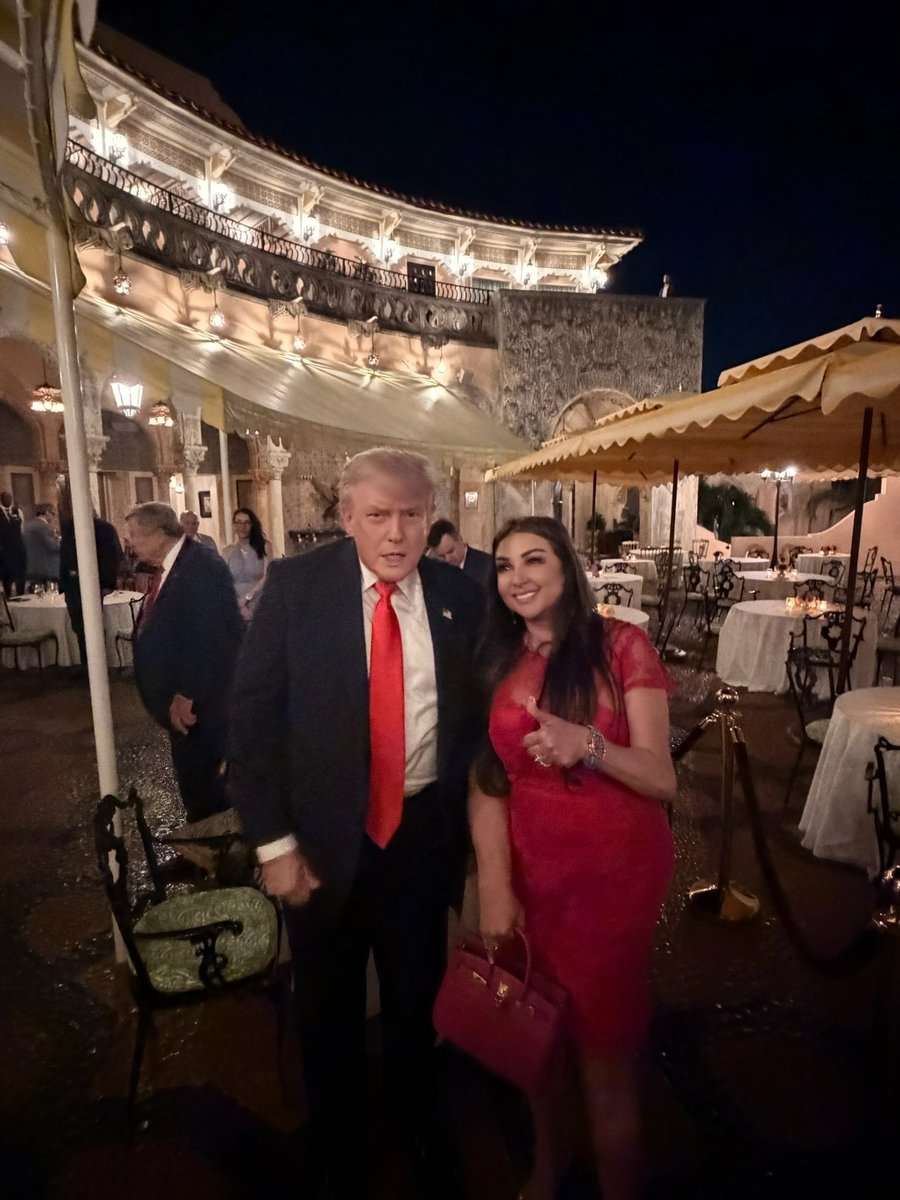
I met with Donald Trump last night at Mar-a-Lago, his residence in Florida. It was not a ceremonial exchange. It was a strategic conversation — direct, unscripted and unmistakably focused on outcomes.
The takeaway is clear: Washington is moving away from managing crises in the Middle East and toward forcing decisions.
President Trump’s recent statements — including his early-morning warning that the era of being “nice” is over — are not rhetorical. They are calibrated signals, timed to shape both geopolitical behavior and market expectations.
Lebanon: appreciation, but no illusions
On Lebanon, President Trump struck a tone that was both personal and conditional. He told me he values the support and goodwill he receives from the Lebanese people — a recognition that matters in a country long caught between competing powers.
But he was equally clear about the path forward. In his view, peace between Lebanon and Israel is not only possible — it is achievable within his tenure. That is a bold assertion, but it comes with defined terms: sovereignty cannot coexist with parallel power structures.
This marks a departure from years of strategic ambiguity. The new framework is simple and uncompromising: one state, one army, one decision.
Under this approach, the issue of Hezbollah is no longer treated as a secondary complication. It is the central test of whether Lebanon can re-enter the international system as a fully sovereign actor. The window for gradualism is closing; the expectation now is measurable change.
Iran: compressed timelines, rising pressure
If Lebanon is about conditional opportunity, Iran is about urgency.
President Trump’s posture reflects a shift from open-ended negotiation to compressed timelines. The message to Tehran is direct: move quickly toward an agreement under clear parameters, or face escalating pressure.
What stands out is not only the substance, but the method. Delivering key messages before Asian markets open is a deliberate tactic — linking political signaling to immediate economic impact. It is pressure applied in real time, across multiple fronts.
Iraq: the end of the gray zone
Iraq, often treated as a secondary file, is in fact central to this strategy.
In recent remarks, President Trump offered a measured acknowledgment of Ali al-Zaidi following his political advancement — a signal that Washington is watching closely, but not extending unconditional support.
The direction is clear: Iraq will no longer be managed as a buffer space. It is being reframed as a decision arena. Reducing militia influence, restoring institutional credibility and tying economic engagement to sovereignty are no longer aspirational goals — they are benchmarks.
A region moving from ambiguity to choice
Across Lebanon, Iran and Iraq, a single pattern emerges: ambiguity is being replaced by binary choices.
State or non-state. Alignment or isolation. Decision or consequence.
Critics will warn that such clarity risks escalation. That concern is valid. But the alternative — indefinite ambiguity — has already produced prolonged instability, eroded institutions and strategic drift.
What I heard at Mar-a-Lago, and what recent statements reinforce, is that the next phase will not be about managing that drift. It will be about ending it.
The Middle East is not simply entering another cycle of tension. It is entering a moment of decision.
And this time, the margin for delay is shrinking.