TONI NISSI
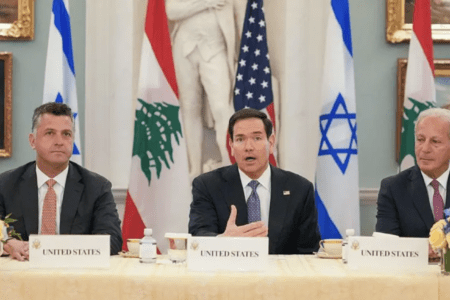
The current negotiations between Lebanon and Israel under the supervision of the United States represent the most consequential diplomatic opening between the two states in decades. These talks emerge after sustained military escalation along the southern Lebanese front, continued cross-border exchanges, and growing international concern over regional spillover.
The historical parallel most frequently invoked is the May 17 Agreement, signed in 1983 and later cancelled. Both episodes followed war, relied heavily on American mediation, and sought to transform battlefield realities into security arrangements. Yet the strategic environment today is fundamentally different: Lebanon is no longer in civil war, Syria no longer dominates Lebanese political life as it did in 1983, and regional normalization trends inaugurated by the Abraham Accords have altered diplomatic calculations.
This paper argues that while a formal peace treaty remains difficult in the short term, a phased sovereignty-and-security framework is plausible. However, any durable settlement requires one central condition that cannot be avoided: the exclusive monopoly of force by the Lebanese state, which necessarily includes the gradual and verified disarmament of Hezbollah and the transfer of all military authority to the Lebanese Armed Forces.
The May 17 Agreement was concluded after Israel’s 1982 invasion of Lebanon. It sought to terminate the state of war, establish security mechanisms, regulate troop withdrawals, and open a path toward normalization. Despite formal signatures, the agreement failed for structural reasons. It lacked broad Lebanese national consensus. It was negotiated while foreign armies occupied Lebanese territory. Syria strongly opposed it and retained decisive leverage inside Lebanon. The Lebanese state lacked the institutional strength to enforce implementation. Large segments of the Arab world viewed it as coerced rather than sovereign. The agreement was effectively voided in 1984 and later formally repealed. No Lebanon–Israel agreement can survive unless it is rooted in sovereign Lebanese consent, internal legitimacy, enforceable security mechanisms, and regional realism.
The current negotiations differ in several decisive ways. Unlike 1983, current talks appear focused first on practical deliverables including ceasefire stabilization, border security arrangements, Israeli withdrawal from disputed or occupied points, implementation of UN Security Council Resolution 1701, prisoner and humanitarian files, and reconstruction and international assistance. The 2022 maritime boundary agreement demonstrated that Lebanon and Israel can conclude U.S.-mediated arrangements without immediate political normalization. The Abraham Accords changed the strategic map. Peace with Israel is no longer an unthinkable taboo in parts of the Arab world, though Lebanon remains a special case due to domestic sectarian balance, Palestinian refugee sensitivities, and Hezbollah’s military role.
Lebanon–Israel negotiations have included the 1949 Armistice Agreement at Ras Naqoura as a direct agreement, the 1983 May 17 Agreement as a direct agreement, the 1991–1993 Madrid Peace Process track as a multilateral effort, the 1996 April Understanding after Operation Grapes of Wrath as an indirect agreement, the 2000 UN Blue Line withdrawal arrangements as an indirect agreement, the 2006 Resolution 1701 ceasefire framework as an indirect agreement, the 2020–2022 Naqoura maritime talks as an indirect agreement, the 2022 maritime boundary agreement as an indirect agreement, and the 2024–2026 border de-escalation and Washington talks as a semi-direct or U.S.-mediated effort.
A viable Lebanon–Israel settlement would require the following minimum conditions. The Lebanese Republic must exercise authority over all national territory, borders, crossings, and military decisions. No sustainable peace is possible while an autonomous armed force operates outside state command. Therefore, a phased, negotiated, internationally supported process must lead to the disarmament of Hezbollah’s independent military infrastructure, the dismantling of rocket and missile arsenals, the transfer of border security functions to the Lebanese Armed Forces, the reintegration of personnel into political or civilian life where appropriate, and guarantees preventing renewed militia rearmament. This would be politically sensitive, but strategically indispensable. Israel would need to withdraw from contested Lebanese points, cease unilateral strikes, and respect internationally supervised arrangements. The Lebanese Armed Forces must become the sole legitimate security actor south of the Litani and across all Lebanese territory. The United States, European Union, Gulf states, and multilateral institutions would likely need to fund reconstruction, energy recovery, and border modernization. Any agreement imposed against a major portion of Lebanese society risks repeating 1983.
In the immediate term, full accession is unlikely. However, a staged pathway is conceivable. The first phase would focus on security stabilization including ceasefire, border demarcation, state authority restoration, and Hezbollah military rollback. A second phase would involve functional normalization including water and energy coordination, trade corridors, civil aviation arrangements, and tourism or religious access frameworks. A third phase would address diplomatic recognition only after domestic consensus and regional backing. Lebanon would likely require a distinct formula rather than simple accession to the existing accords.
Several scenarios could unfold between 2026 and 2030. A limited security deal appears most likely, featuring ceasefire, withdrawals, stronger Lebanese Army deployment, and no immediate normalization. A comprehensive peace settlement would be possible if Hezbollah is disarmed, Lebanon stabilized economically, and external guarantees provided. Abraham Accords entry could occur in later stages if Lebanon reframes peace as sovereignty, recovery, and regional integration. Failure and escalation would follow if disarmament stalls, Israeli strikes continue, or internal Lebanese fragmentation deepens.
Lebanon should negotiate not from ideology but from state interest by working to restore sovereignty, end unauthorized armed structures, secure borders, attract reconstruction capital, preserve internal coexistence, and re-enter regional diplomacy as a functioning state.
The lesson of 1983 is that symbolic peace without sovereign foundations collapses. The opportunity of 2026 is different: it may permit a gradual settlement rooted in state recovery rather than wartime coercion. For Lebanon, peace is not primarily about relations with Israel. It is about whether the Lebanese state can reclaim exclusive authority over war and peace. That necessarily places the disarmament of Hezbollah at the center of any serious diplomatic architecture. If that issue is resolved through a credible national framework, then what was impossible in 1983 may become achievable in the decade ahead.