By Rick Clay
Maritime insurance has become one of the most powerful and least understood instruments available to the United States during the conflict with Iran. Tanker movements, oil price stability, and the viability of Iran’s export channels all depend on a global insurance architecture dominated by Western firms, particularly Lloyd’s of London and the International Group of P and I Clubs. The administration is now evaluating whether targeted insurance restrictions can suppress Iran’s revenue streams, constrain the shadow fleet that enables sanctions evasion, and stabilize global oil prices without escalating direct military confrontation. This approach reframes maritime insurance from a technical financial service into a strategic choke point that shapes the behavior of state and non-state actors across the Gulf.
The central insight is that insurance determines access. A tanker without recognized war risk coverage cannot enter most ports, cannot transit chokepoints without severe penalties, and cannot secure financing or charter contracts. By manipulating this single variable, the United States can influence global oil flows more efficiently than through naval interdiction or sanctions alone. The challenge is balancing pressure on Iran with the need to avoid price spikes that would destabilize global markets and harm American consumers. This white paper examines the structure of maritime insurance, the vulnerabilities of Iran’s export system, the exposure of China and India to insurance based disruption, and the strategic implications of using insurance as a coercive tool during a period of heightened conflict.
I. The Strategic Logic of Maritime Insurance.
Maritime insurance is the invisible architecture that enables global trade. Every tanker requires hull insurance, cargo insurance, and war risk coverage to operate legally and to satisfy port authorities, banks, and charterers. These policies are overwhelmingly underwritten by Western firms. This creates a structural asymmetry. Iran can build a shadow fleet, it can spoof transponders, and it can rely on shell companies, but it cannot replicate the legitimacy that Western insurance provides. Without recognized coverage, a tanker becomes a pariah vessel that cannot dock, cannot refuel, and cannot offload cargo in compliant markets.
This asymmetry gives the United States a coercive advantage. Insurance restrictions can be applied with precision, they can be escalated or relaxed quickly, and they impose financial pressure without requiring kinetic action. They also create uncertainty in freight markets, which raises the cost of doing business with Iran and reduces the profitability of sanctions evasion networks. The strategic logic is simple. If the United States can raise the cost of insuring tankers that carry Iranian crude, it can reduce Iran’s export volume and revenue without firing a shot.
II. The Iran Conflict and the Rising Cost of Risk
The current conflict has already increased war risk premiums across the Gulf. Insurers have raised rates for transits near the Strait of Hormuz, and some underwriters have begun to exclude Iranian territorial waters entirely. This is a predictable response to missile attacks, drone strikes, and the risk of escalation. The administration is now considering whether to formalize and expand these restrictions. The objective is to create a financial environment in which shipping companies and insurers view Iranian crude as an unacceptable liability.
This approach leverages market psychology. Insurers are inherently conservative. They respond to risk signals faster than governments and often more aggressively. By shaping the risk environment through public statements, targeted sanctions, and regulatory guidance, the United States can induce insurers to withdraw coverage voluntarily. This creates a multiplier effect. A single regulatory action can cascade through the insurance ecosystem, raising costs for every tanker that touches Iranian crude.
III. The Shadow Fleet’s Insurance Vulnerability
Iran’s shadow fleet relies on obscure insurers, shell companies, and non compliant registries. These vessels often operate without legitimate coverage, which exposes them to catastrophic financial risk. However, they survive because some ports and buyers, particularly in China, accept substandard documentation. The administration’s emerging strategy appears to focus on tightening the definition of acceptable insurance and pressuring Asian refiners to reject tankers that lack recognized coverage.
This is a critical vulnerability. The shadow fleet is already strained by aging hulls, mechanical failures, and the loss of Russian logistical support. If insurers refuse to cover these vessels, or if ports refuse to accept their policies, the fleet will fragment. This would reduce Iran’s export capacity and force it to rely on a smaller number of legitimate tankers that are easier to track and regulate.
IV. Global Oil Prices and the Risk of Overcorrection
The administration’s challenge is preventing insurance restrictions from triggering a global price spike. Iran exports between one and two million barrels per day, depending on enforcement intensity. Removing this volume from the market would tighten supply and raise prices. The administration is therefore exploring calibrated measures that target the shadow fleet without disrupting legitimate flows from other producers.
This requires a delicate balance. Insurance restrictions must be strong enough to pressure Iran but flexible enough to avoid destabilizing global markets. The administration is reportedly considering temporary waivers, coordinated releases from strategic reserves, and diplomatic engagement with Gulf producers to offset any supply disruptions. The objective is to use insurance as a scalpel rather than a hammer.
V. Strategic Implications for China and India
China is the largest buyer of Iranian crude. It relies heavily on the shadow fleet and on non-compliant insurance providers. Insurance restrictions would therefore hit China directly. They would raise the cost of importing Iranian crude, force Chinese refiners to seek alternative suppliers, and increase China’s dependence on Gulf producers that are aligned with the United States. India, which has reduced its purchases of Iranian crude in recent years, would face less direct pressure but would still be affected by higher freight rates and tighter tanker availability.
This creates leverage. Insurance restrictions can be used to shape the behavior of major Asian importers without imposing direct sanctions. They also expose the fragility of China’s energy security strategy, which depends on opaque networks that cannot withstand sustained regulatory pressure.
VI. The DFC Maritime Reinsurance Facility and the Restoration of Confidence in Gulf Shipping
The announcement by the U.S. International Development Finance Corporation and the U.S. Treasury represents a decisive shift in how the United States intends to stabilize maritime trade during the conflict with Iran. By approving a detailed implementation plan to deploy maritime reinsurance, including war risk coverage, the administration has moved beyond traditional sanctions and naval deterrence and into the realm of direct financial intervention. This approach reframes the United States not only as a regulator of maritime risk but as an active underwriter capable of shaping global confidence in the safety and continuity of trade through the Gulf. The decision to coordinate closely with CENTCOM underscores that this is not a theoretical financial instrument but a strategic tool designed to operate in tandem with military posture and operational realities in the Strait of Hormuz.
The DFC reinsurance facility is structured to insure losses up to approximately twenty billion dollars on a rolling basis, a scale that signals both seriousness and urgency. This revolving capacity ensures that the United States can absorb repeated shocks without requiring new appropriations or emergency authorizations. By focusing initially on Hull and Machinery and Cargo coverage, the facility targets the two categories of insurance most directly affected by Iranian missile attacks, drone strikes, and maritime harassment. These are also the categories that global insurers have been most reluctant to underwrite, creating a vacuum that has paralyzed shipping companies and raised freight rates across the region. The DFC plan fills this vacuum with a credible, government backed guarantee that no private insurer can match.
The administration’s decision to limit eligibility to vessels that meet defined criteria is equally strategic. This ensures that the reinsurance facility does not inadvertently subsidize the shadow fleet or reward non-compliant operators. Instead, it creates a bifurcated market in which legitimate, transparent, and fully documented vessels gain access to American backed coverage while opaque networks face rising costs and shrinking options. This aligns with the broader U.S. objective of isolating Iran’s illicit export channels while preserving the flow of lawful commerce. It also strengthens the position of preferred American insurance partners, who will operate within a framework that rewards compliance and penalizes risk taking behavior.
CENTCOM’s involvement is central to the credibility of the program. Reinsurance alone cannot restore confidence unless shipowners believe that physical security conditions are improving. By integrating CENTCOM’s operational assessments into the underwriting process, the DFC plan creates a unified picture of risk that blends financial guarantees with real time military intelligence. This fusion of capabilities allows the United States to offer a level of security that no private policy can replicate. It also signals to global markets that Washington is prepared to stand behind the uninterrupted flow of oil, gasoline, LNG, jet fuel, and fertilizer through the Strait of Hormuz, even under conditions of sustained conflict.
The broader strategic effect is the restoration of predictability. Markets do not require perfect safety, but they do require clarity. The DFC reinsurance facility provides a transparent, government backed mechanism that reduces uncertainty, stabilizes freight markets, and reassures American and allied businesses operating in the Middle East. It also demonstrates that the administration is willing to use innovative financial tools to protect global commerce, rather than relying solely on sanctions or military force. This marks a significant evolution in U.S. economic statecraft and positions maritime insurance as a central pillar of the broader strategy to contain Iran, support allies, and maintain the integrity of global supply chains.
VII. The Strategic Threat to the United Kingdom’s Maritime Insurance Monopoly
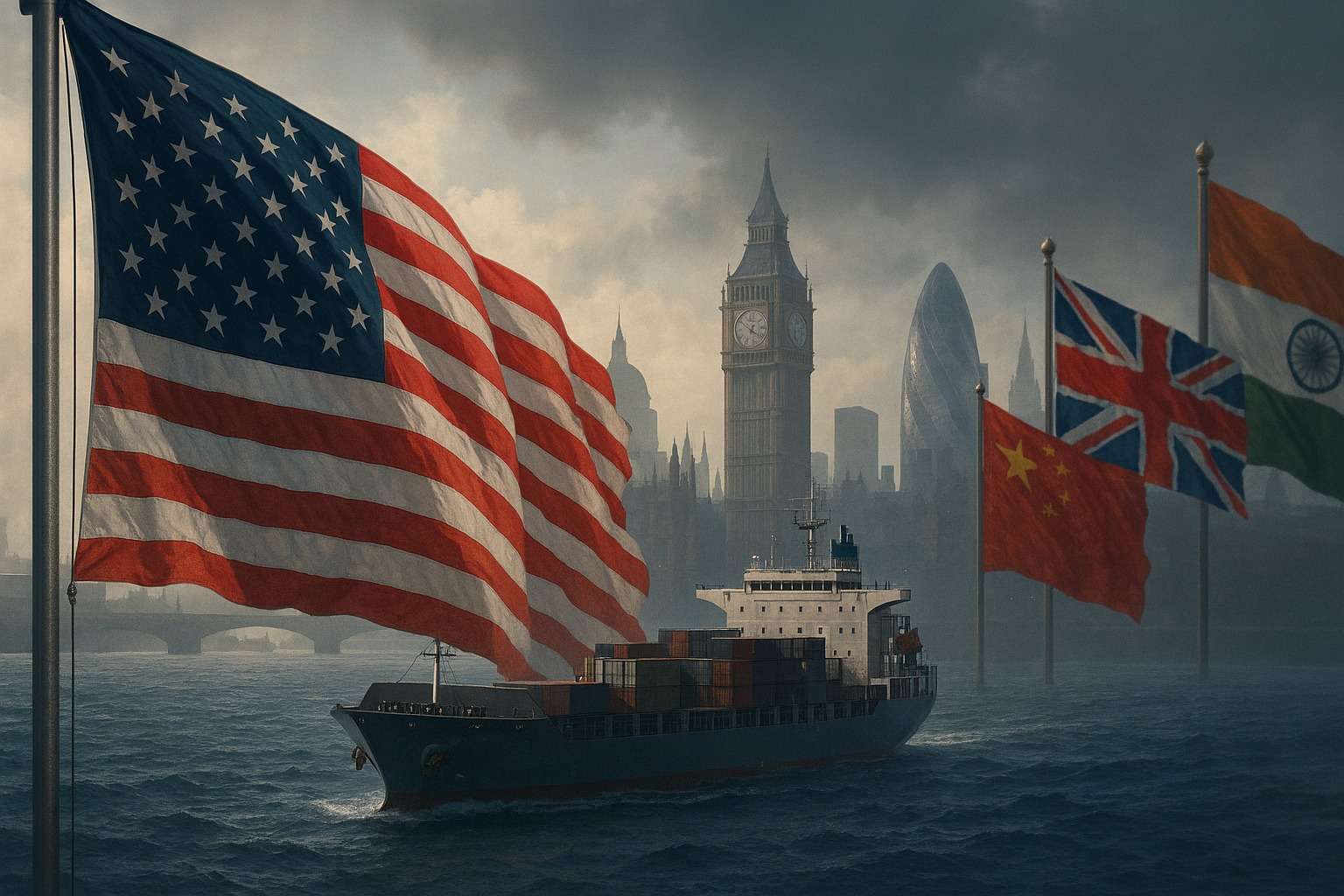
The emergence of U.S. backed maritime underwriting represents the most significant challenge to the United Kingdom’s dominance in global shipping insurance since the nineteenth century. For more than three hundred years, Lloyd’s of London and the International Group of P and I Clubs have controlled the legitimacy, pricing, and risk architecture of global maritime trade. This dominance has given the United Kingdom disproportionate influence over global commerce, naval logistics, and the financial flows that underpin energy markets. The introduction of a large scale American underwriting capability threatens to fracture this monopoly and redistribute power within the maritime ecosystem.
The threat is structural rather than symbolic. The United Kingdom’s dominance rests on historical credibility, regulatory centrality, and market concentration. The DFC program challenges all three pillars simultaneously. It introduces a competing source of credibility backed by the full faith and resources of the United States government. It creates a parallel regulatory environment in which American criteria determine eligibility for coverage. And it begins to shift market concentration by offering a scale of financial backing that private British insurers cannot match.
The geopolitical implications are profound. If the United States becomes a direct underwriter of maritime risk, it gains the ability to shape global shipping behavior in ways that previously required British cooperation. This includes the power to determine which vessels are considered legitimate, which routes are considered insurable, and which states bear the financial consequences of instability. It also allows the United States to use insurance as a tool of economic statecraft without relying on British institutions that may have different strategic priorities. For the United Kingdom, this represents a loss of influence over the global commons and a dilution of one of its last remaining instruments of systemic power.
VIII. The Emergence of a Permanent U.S. Alternative to Lloyd’s
The deployment of U.S. backed maritime underwriting in the Gulf is more than a crisis response. It is the opening move in what could become a structural reordering of the global insurance market. Lloyd’s of London has served as the central node of maritime risk for centuries, but the introduction of a large scale American underwriting capability represents the first credible alternative to this system. If expanded beyond the current conflict, it could evolve into a permanent parallel architecture that competes directly with Lloyd’s for global primacy.
The foundation of this alternative lies in the unique combination of financial capacity, regulatory authority, and military integration that only the United States can provide. A reinsurance facility capable of absorbing twenty billion dollars in rolling losses is not merely a market participant. It is a systemic guarantor. If the United States chooses to institutionalize this capability, it could offer shipowners a level of certainty that private syndicates cannot replicate, particularly during periods of geopolitical instability. This certainty would become a competitive advantage that attracts premium flows away from London and toward American backed insurers.
IX. China and India’s Strategic Response to a Permanent U.S. Underwriting Regime
The emergence of a permanent U.S. backed maritime underwriting system would force China and India to reassess the foundations of their energy security strategies. Both states rely heavily on maritime imports, both depend on predictable insurance markets, and both have built their economic models on the assumption that Lloyd’s of London will remain the neutral arbiter of global shipping risk. A U.S. alternative disrupts this assumption. It introduces a new source of regulatory authority, a new center of financial gravity, and a new mechanism through which Washington can influence the behavior of major importers. China and India would respond in fundamentally different ways, shaped by their geopolitical posture, economic exposure, and strategic ambitions.
China would view a permanent U.S. underwriting regime as a direct challenge to its energy security architecture. China’s dependence on Iranian crude, its reliance on the shadow fleet, and its preference for opaque insurance arrangements reflect a broader strategy of insulating its supply chains from Western pressure. A U.S. dominated insurance system would undermine this strategy by forcing Chinese refiners to choose between compliance with American underwriting standards and continued reliance on high-risk suppliers. China would likely accelerate efforts to build a sovereign insurance ecosystem, expand its state backed reinsurers, and deepen its partnerships with noncompliant registries. This would create a parallel market designed to bypass American influence, but it would also increase China’s exposure to catastrophic losses during periods of conflict.
India would take a more pragmatic approach. A permanent U.S. underwriting regime would offer India a source of stability during periods of regional conflict, particularly in the Strait of Hormuz. American backed coverage, integrated with CENTCOM’s security posture, would provide India with a level of predictability that private insurers cannot match. India would likely adopt a hybrid strategy, using London based coverage for routine trade while relying on American backed underwriting for high-risk routes or periods of instability. Over time, if the U.S. system proves more reliable during crises, India could shift a larger share of its fleet toward American backed coverage, strengthening its alignment with U.S. security frameworks.
Maritime insurance is emerging as a central instrument of American power in the Iran conflict. It offers precision, scalability, and deniability. It exploits structural advantages that Iran cannot counter. It pressures China without requiring direct confrontation. And it stabilizes global markets by targeting the shadow fleet rather than legitimate producers. The integration of DFC reinsurance into this framework marks a turning point, transforming maritime insurance from a passive financial service into an active instrument of national strategy. It also signals the beginning of a deeper shift in global power, as the United States challenges the United Kingdom’s centuries long dominance in maritime underwriting and reshapes the financial architecture that governs global trade. The emergence of a permanent U.S. underwriting regime would redefine global energy security, reshape the behavior of major importers, and establish the United States as the guarantor of global maritime risk.