By Ampamya Ronah
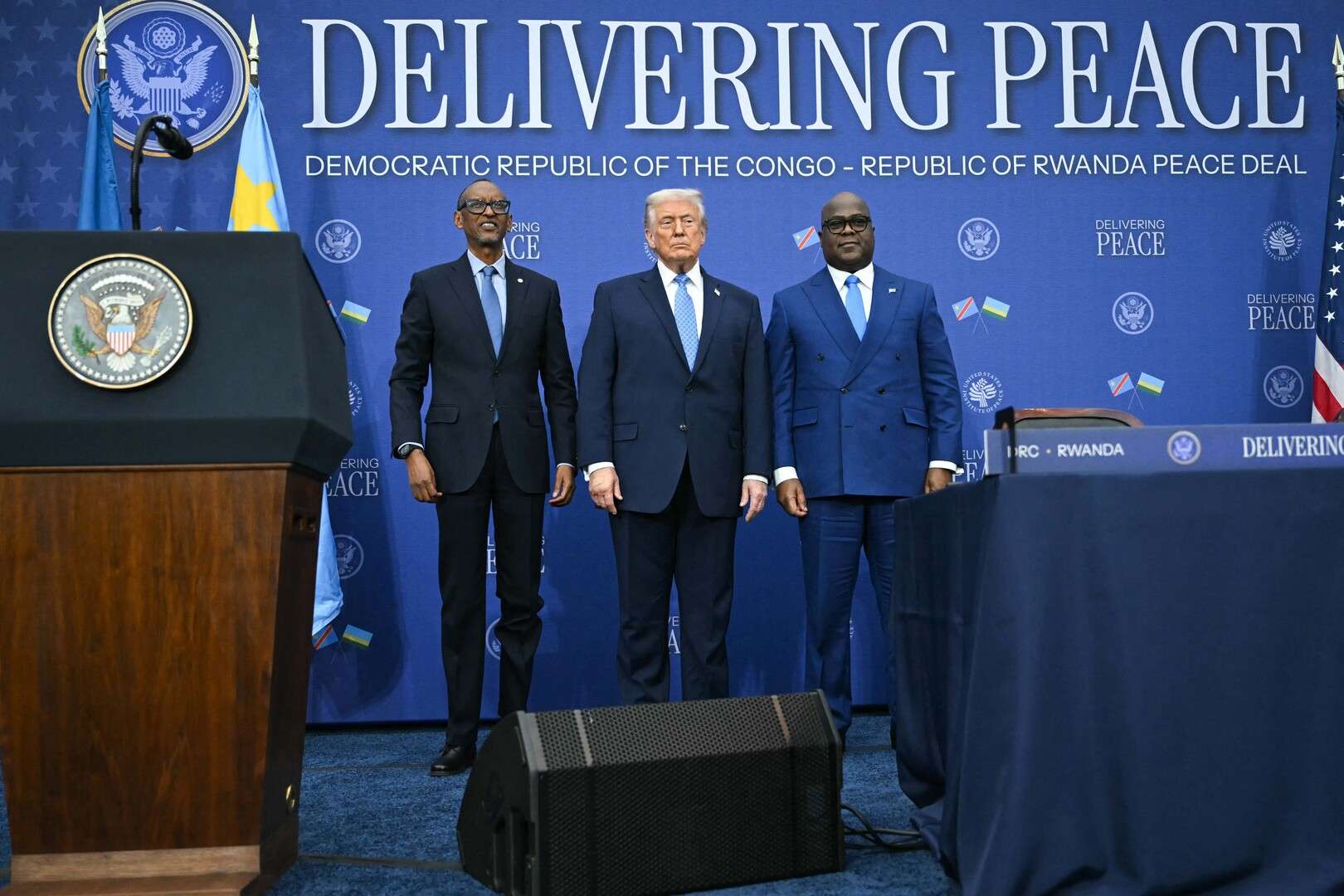
In a ceremony dripping with symbolism at the U.S. Institute of Peace, Presidents Félix Tshisekedi of the Democratic Republic of the Congo (DRC) and Paul Kagame of Rwanda clasped hands yesterday, sealing a long-awaited peace accord under the watchful eye of U.S. President Donald Trump. Trump, beaming with characteristic bravado, declared it a “historic triumph” and a “great day for the world,” crediting his administration’s diplomacy for halting what he called “over 30 years of senseless bloodshed” in Africa’s mineral-rich heartland. Yet, as confetti settled in Washington, the thunder of artillery echoed through the misty hills of eastern DRC, where M23 rebels—long accused of Rwandan backing—clashed with Congolese forces just hours after the ink dried. This stark juxtaposition underscores the chasm between diplomatic fanfare and the gritty reality on the ground.
The DRC-Rwanda rift is no mere border squabble; it’s a toxic brew of ethnic vendettas, colonial ghosts, and glittering stakes in coltan, cobalt, and gold. The seeds were sown in the 1994 Rwandan genocide, when Hutu extremists fled across the porous border into then-Zaire (now DRC), morphing into the Democratic Forces for the Liberation of Rwanda (FDLR)—a militia Kagame’s government views as an existential threat. Rwanda’s subsequent invasions in the late 1990s, under the guise of hunting these génocidaires, plunged the DRC into its deadliest wars, claiming millions of lives and displacing tens of millions more. Enter the M23 movement, a Tutsi-led insurgency that resurfaced in 2021, seizing swaths of North and South Kivu provinces. Kigali has vehemently denied arming the group, but UN reports and Western intelligence paint a picture of Rwandan troops embedded among M23 fighters, drawn by the allure of controlling lucrative mining hubs. By early 2025, M23’s lightning advances had captured Goma and Bukavu, DRC’s eastern economic engines, sending shockwaves through global supply chains for electric vehicle batteries and smartphones. Kinshasa accused Rwanda of “genocidal aggression,” while Kigali countered that Congolese inaction against the FDLR justified its “defensive measures.” The brink of all-out war loomed, until U.S. mediators—bolstered by Qatari and African Union envoys—stepped in.
The deal, formally the “Peace Agreement Between the Democratic Republic of the Congo and the Republic of Rwanda,” traces its origins to a June 27 framework but reached its ceremonial climax on December 4 in the U.S. capital. Building on March talks in Doha and a November framework between Rwanda and M23, the accord outlines a multifaceted roadmap to de-escalation. At its core are robust security measures. Both nations pledge to honor territorial integrity and cease all hostilities, including proxy support for armed groups. Rwanda commits to lifting its “defensive measures”—euphemism for troop incursions—once the FDLR is neutralized under a joint operations plan from October 2024. In tandem, the DRC vows to disarm and integrate non-state actors like M23 through ongoing Doha negotiations and a Disarmament, Demobilization, Community Reintegration, and Stabilization (P-DDRCS) process. Reintegration into national forces requires rigorous vetting to exclude human rights abusers.
A novel Joint Security Coordination Mechanism (JSCM), launching within 30 days, will facilitate intelligence sharing, threat assessments, and civilian protection, with U.S. and Qatari observers ensuring transparency. Monthly meetings, alternating between Kinshasa and Kigali, aim to build trust where suspicion has long reigned.
Economically, the accord is a pragmatic pivot. A Regional Economic Integration Framework, set to roll out in three months, leverages the African Continental Free Trade Area (AfCFTA) to formalize mineral value chains—from mine to processed metal. Joint ventures in hydropower, Lake Kivu gas extraction, and national park management promise shared prosperity, with anti-corruption audits to stem the illicit trade that has fueled the war. A separate minerals pact, signed alongside the peace deal, opens doors for Western investment, potentially derisking billions in cobalt and coltan flows.
Dispute resolution falls to a Joint Oversight Committee (JOC), comprising the parties, AU facilitators, and mediators, empowered to mediate breaches and enforce consensus-based fixes. The agreement endures indefinitely, barring mutual termination.
Global reactions have been cautiously optimistic. France hailed the “Washington Accords” as a “new prospect for peace,” crediting regional stakeholders like Togo. The African Union and East African Community praised the momentum, while Amnesty International urged swift action to curb ongoing atrocities, noting that peace pacts have historically faltered without accountability for rights abuses.
In Kinshasa and Kigali, leaders touted the deal as vindication. Tshisekedi called it a “victory for Congolese sovereignty,” while Kagame emphasized the FDLR’s demobilization as non-negotiable. Trump, eyeing a legacy burnish ahead of his term’s twilight, positioned the summit as proof of his “America First” foreign policy’s global reach—complete with side deals on mineral access for U.S. firms.
Yet skepticism abounds. As the leaders posed for photos, M23 forces repelled a government offensive near Walikale, with both sides trading blame. Analysts warn that the June framework’s unfulfilled pledges—such as full Rwandan withdrawal—augur implementation woes. The FDLR’s entrenched presence and M23’s autonomy complicate neutralization efforts, while ethnic tensions simmer among DRC’s 100 million souls.
The Washington Accord is no panacea, but it represents the most credible blueprint for peace in decades. By entwining security with economic incentives, it addresses the conflict’s twin engines: fear and greed. Success hinges on verifiable troop pullbacks, inclusive reintegration, and ironclad oversight—tasks demanding political will from elites long accustomed to proxy wars.
For the displaced farmers of Kivu and artisanal miners sifting cobalt under gunfire, this deal offers a sliver of hope: schools reopening, markets bustling, children playing without the whine of drones. As Trump quipped, “They have so much to be proud of.” Whether that pride endures may define not just DRC and Rwanda’s future, but Africa’s ability to heal its deepest wounds. The world, invested in stable minerals and stable neighbors, must now ensure words translate to deeds.