By Alain Renault
The ongoing regional war involving Iran has transformed the Strait of Hormuz from a strategic vulnerability into a global economic emergency. For decades, Gulf states understood the risks of depending on a single maritime corridor through which nearly one-fifth of the world’s oil supply once passed daily. But today, those fears are no longer theoretical.
The continued disruption of exports through the Strait of Hormuz has exposed the fragile architecture of global energy security and forced Gulf producers into a race against time to create alternative export routes.
According to recent reports, Iraq and the United Arab Emirates are accelerating massive infrastructure projects designed to bypass Hormuz entirely. The implications are not only economic. They are geopolitical, strategic, and deeply connected to the future balance of power in the Middle East.
No country illustrates this danger more clearly than Iraq.
Nearly all Iraqi oil exports traditionally passed through the Arabian Gulf and the Strait of Hormuz. Once the conflict escalated and maritime traffic became restricted, Iraq’s exports reportedly collapsed dramatically, threatening the backbone of the Iraqi economy itself. In 2025, oil represented more than half of Iraq’s GDP, leaving Baghdad dangerously exposed to any prolonged disruption.
In response, Iraqi authorities approved the rapid expansion of exports through the Kurdistan–Turkey pipeline linking Iraqi oil fields to the Turkish port of Ceyhan on the Mediterranean Sea. The expansion would increase export capacity from approximately 220,000 barrels per day to nearly 770,000 barrels daily.
This is not simply an energy project. It is a national survival strategy.
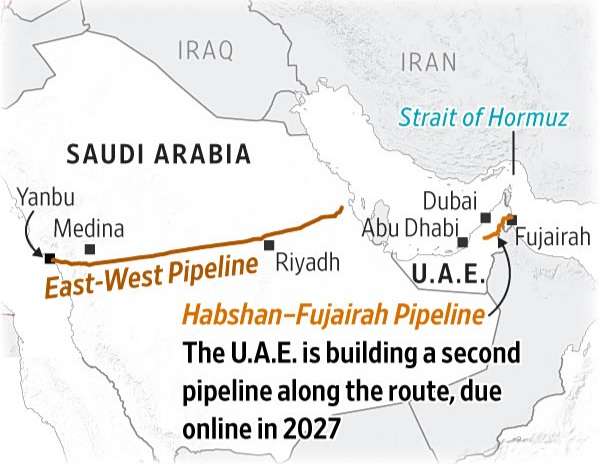
At the same time, the United Arab Emirates appears significantly more prepared than many of its regional neighbors. Abu Dhabi has spent years investing in strategic redundancy and alternative export infrastructure. The UAE is now accelerating construction of a west-to-east pipeline directly connecting oil fields to the port of Fujairah on the Gulf of Oman, bypassing the Strait of Hormuz entirely.
Once completed, the project is expected to substantially increase ADNOC’s export capacity while strengthening the UAE’s ability to maintain energy flows even under regional military pressure.
This reflects a broader Emirati strategic doctrine: economic resilience through infrastructure diversification.
Yet despite these efforts, the region remains highly vulnerable.
Reports of Iranian attacks targeting regional energy infrastructure, including drone strikes near Fujairah and attacks on Saudi oil facilities, demonstrate that no alternative route is entirely immune from escalation. Gulf states may reduce dependence on Hormuz, but they cannot eliminate geopolitical risk overnight.
The challenge is enormous. Building new export corridors requires billions of dollars, years of engineering work, cross-border coordination, and political stability — all while global energy markets remain under pressure.
Meanwhile, international shipping companies face impossible choices. Vessels operating in Gulf waters risk attack if they refuse Iranian transit demands, while any perceived cooperation with Tehran could expose operators to American sanctions and international scrutiny.
The consequences extend far beyond the Middle East.
A prolonged disruption in Gulf energy exports threatens global supply chains, inflation rates, energy prices, and industrial production across Europe and Asia. The Strait of Hormuz is not merely a regional passageway. It is one of the central arteries of the global economy.
What is happening today may permanently reshape the energy geography of the Middle East.
The Gulf states are learning an urgent lesson: true national security in the twenty-first century is no longer defined only by armies and missiles. It is defined by infrastructure, logistics, diversification, and the ability to keep economies functioning during war.
And in this new strategic reality, the countries capable of adapting fastest will shape the future of global energy power.