By Tumwesigye Anslem
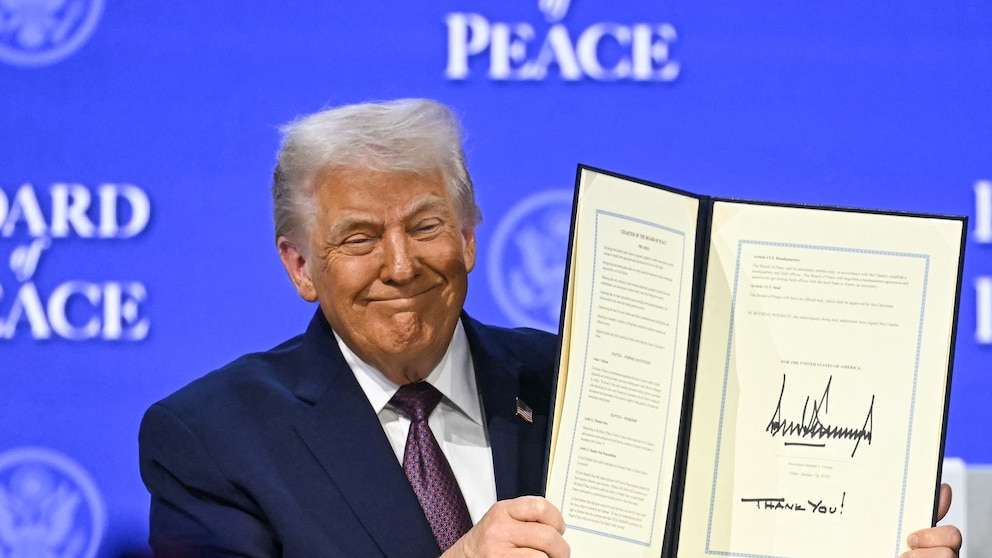
On January 22, 2026, at the World Economic Forum in Davos, Switzerland, President Donald Trump formally signed the founding charter of the Board of Peace, establishing it as an official international organization. The ceremony, attended by representatives from over 20 countries, positioned Trump as chairman and marked a high-profile push to address conflict resolution, starting with Gaza’s reconstruction and potentially expanding to other global challenges.
Trump held up the signed charter amid applause from dignitaries on stage, including officials from the United Arab Emirates, Hungary, Pakistan, Bahrain, Morocco, Egypt, Qatar, Saudi Arabia, Jordan, Turkey, and others. Leaders from nations such as Argentina, Armenia, Azerbaijan, Indonesia, Kazakhstan, Paraguay, and Uzbekistan were among those adding their signatures following the president’s. The event featured a prominent backdrop declaring “Board of Peace,” with Trump describing the moment as the formation of one of the “most consequential bodies ever created.”
The initiative originated as a mechanism to oversee Gaza’s post-ceasefire rebuilding, demilitarization, humanitarian aid delivery, and economic revitalization under free-market principles. Jared Kushner presented conceptual plans during related discussions, including visions for a modernized “New Gaza” and “New Rafah” with new housing and infrastructure. Permanent membership reportedly requires a $1 billion contribution to a dedicated reconstruction fund, primarily focused on Gaza at launch.
Trump emphasized collaboration with the United Nations, stating the board would work alongside it while offering a more action-oriented approach than traditional multilateral frameworks. He highlighted successes in securing ceasefires and stability across regions, including the Middle East, and suggested the board could tackle broader issues once fully operational. “We can do pretty much whatever we want to do,” he remarked, underscoring its flexible mandate.
The coalition includes several Abraham Accords partners and Middle Eastern powers, alongside a mix from Europe, Asia, Latin America, and beyond. Some countries, like Israel, Belarus, Canada, and Vietnam, have indicated intent to join. However, major Western European allies—France, Germany, the United Kingdom, Norway, Sweden, and others—declined participation or remained noncommittal, expressing concerns that the board could rival or undermine the UN’s role in global diplomacy.
Critics have raised alarms over the structure, particularly the chairman’s broad authority and the initiative’s departure from established institutions. Supporters praise it as a pragmatic, results-driven alternative, building on Trump’s prior diplomatic breakthroughs and prioritizing tangible outcomes like infrastructure rebuilding and prosperity.
The Davos signing ceremony, captured in videos and widely shared online—including celebratory posts hailing Trump as the “Peace President”—reflects his distinctive foreign policy style: blending direct leadership, economic incentives, and bilateral deal-making. As the Board of Peace begins its work, its success in delivering stability in Gaza and beyond will test whether this new entity fosters genuine unity or highlights deepening international divisions in an already polarized world.