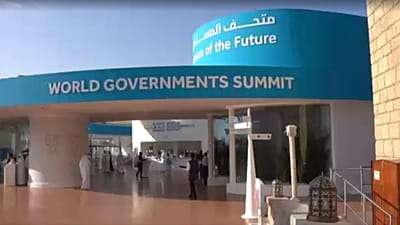
By Maria Maalouf
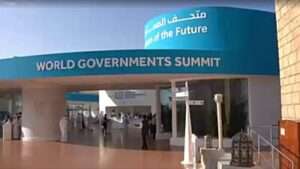
In a world where anxiety often outpaces planning—and where governments struggle to keep pace with accelerating change—the World Governments Summit 2026 in Dubai is not a routine international gathering. It is a political and intellectual statement with a clear message: those who fail to anticipate the future will eventually be governed by it.
This year’s edition—the largest since the summit’s launch in 2013—is not defined merely by scale, but by significance. More than 6,250 participants; over 60 heads of state, government leaders, and their deputies; upwards of 500 ministers; representatives from 150 governments; 87 Nobel laureates; and more than 700 CEOs of the world’s leading companies. This unprecedented convergence does more than signal organizational success—it confirms a deeper reality: Dubai has become an intellectual operations room for a global system searching for direction.
Under the banner “Shaping Future Governments,” the summit poses not a technical question, but a sovereign one: how can the modern state remain effective when technology advances faster than legislation, and societies transform more rapidly than laws? The UAE does not offer ready-made answers. Instead, it compels a necessary debate—one that redefines what governance itself means in the 21st century.
Since its inception by Sheikh Mohammed bin Rashid Al Maktoum, the summit was never designed as a platform for speeches. It was conceived as a long-term project. It began in 2013 with discussions on public-sector innovation, expanded to citizen happiness, then moved decisively toward future foresight. By 2016, it had evolved into a global institution operating year-round to generate knowledge and shape policy. This was not mere accumulation—it was an escalation in ambition and courage.
Over thirteen years, Dubai has transformed into a global laboratory for re-engineering the state. Crises were debated here before they peaked—from COVID-19 to climate change, from the digital economy to artificial intelligence. Notably, the summit has treated these challenges not as existential threats, but as opportunities to rebuild trust between governments and societies—the rarest currency in today’s world.
The 2026 summit convenes at a moment of acute global sensitivity. The international order is being reshaped. The global economy hovers on the edge of uncertainty. Governments face mounting pressure from citizens demanding efficiency, transparency, and tangible outcomes. In this context, the summit delivers a quiet but firm warning: governments that rely solely on reaction will, sooner or later, fall out of history.
With more than 445 sessions, 25 global forums, and over 45 high-level ministerial meetings, the agenda is structured around five core pillars: global governance and effective leadership; societal well-being and human capacity building; economic prosperity and emerging opportunities; the future of cities and demographic shifts; and forward-looking horizons and next-generation opportunities. These pillars are not standalone themes, but an integrated roadmap for the state of the future.
The summit’s impact is further reinforced by the release of 36 strategic reports, produced in partnership with leading international think tanks and research institutions. This is the crucial distinction between a successful conference and an influential platform: the ability to translate ideas into decisions, and visions into execution.
At the center of this landscape stands the UAE. It does not present itself as a flawless model, nor does it trade in idealistic slogans. Instead, it practices what might best be described as institutional intelligence—anticipate, test, correct, and advance. In a world drifting toward fragmentation, Dubai opens spaces for dialogue; it favors partnership over guardianship, and cooperation over polarization.
The World Governments Summit 2026 is not simply a successful annual milestone. It is a calm political declaration that governance can be flexible without being fragile, bold without being reckless, and humane without sliding into populism. From Dubai, once again, the question is not what the future will look like—but who has the courage to help shape it.