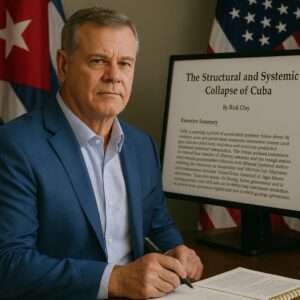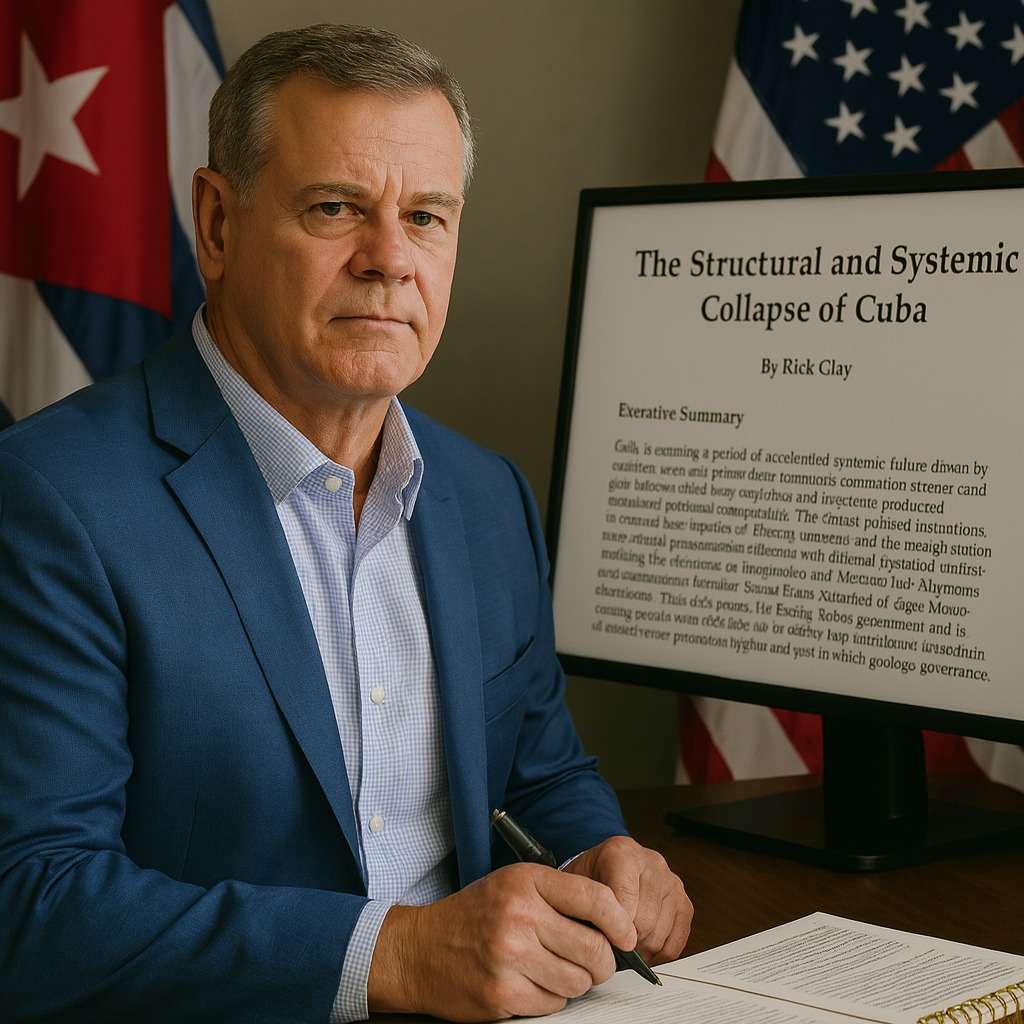
By Rick Clay
Cuba is entering a period of accelerated systemic failure driven by the convergence of governance decay, economic contraction, energy grid collapse, social fragmentation, and structural geological vulnerabilities. The island’s political institutions have lost operational capacity, its economy has contracted beyond recovery, and its energy system is nearing total failure. These internal pressures now intersect with external dynamics, including the cessation of Venezuelan and Mexican fuel shipments and the emergence of secret negotiations between United States Secretary of State Marco Rubio and Raúl Guillermo Rodríguez Castro. These talks bypass the formal Cuban government and signal Washington’s assessment that real authority has consolidated within the GAESA Castro nexus. The cumulative indicators support a high confidence scenario in which Cuba enters acute destabilization within fourteen to thirty days. This white paper presents a hybrid analysis in which geology, governance, economy, energy, society, and global geopolitical linkages are treated as coequal structural forces driving the island toward systemic collapse.
Cuba’s crisis is not the product of a single failure. It is the result of multiple systems collapsing simultaneously under the weight of structural constraints that no government can fully overcome. The island’s fractured political institutions, deteriorating economy, collapsing energy grid, and fragmented society are interacting with geological instability and external pressure to produce a moment of acute national vulnerability. This paper integrates these dimensions into a unified narrative that explains why Cuba’s decline has accelerated and why the island is approaching a point of systemic failure. The goal is to provide a strategic framework for understanding Cuba as a complex system whose collapse is driven by both human decisions and physical realities.
Section One, Structural Geology as a Constraint on National Capacity
Cuba’s geological architecture has always imposed limits on its national development. The island’s hybrid crust, formed through the collision and accretion of Caribbean arc terranes and North American continental fragments, created a fractured lithology and unstable ground conditions. The karstic platforms of western Cuba undermine infrastructure, complicate water retention, and accelerate agricultural degradation. The Oriente Fault system introduces persistent seismic risk that threatens ports, fuel depots, and coastal cities. The surge in seismic activity recorded in 2024 and 2025, including major earthquakes and thousands of aftershocks, has intensified these vulnerabilities. The geology does not cause collapse, but it accelerates it by weakening infrastructure, disrupting services, and magnifying the consequences of political and economic failure.
These geological constraints now intersect with systemic decay. Infrastructure that was already deteriorating has been further compromised by continuous ground motion. Water scarcity, long attributed to mismanagement, is rooted in the island’s porous limestone foundations. The geological instability of the southern margin increases the likelihood of disruptions to critical facilities at a time when the state lacks the capacity to respond. The geology is a structural accelerant that amplifies every dimension of the collapse.
Section Two, Governance Failure and the Erosion of State Authority
Cuba’s governance system has entered a phase of terminal contraction. The formal institutions of the state have lost operational capacity, and real authority has consolidated within the GAESA Castro nexus. The government’s ability to provide basic services has deteriorated, and its administrative reach has shrunk to a narrow set of urban centers. The erosion of legitimacy is evident in the growing disconnect between the population and the state, the inability to maintain public order, and the fragmentation of internal security forces. The leadership is increasingly isolated, reactive, and dependent on a shrinking circle of loyalists.
This governance collapse interacts with geological and economic pressures to accelerate systemic failure. The state lacks the capacity to repair infrastructure damaged by seismic activity, manage water scarcity, or stabilize the energy grid. The administrative apparatus is overwhelmed by shortages, protests, and institutional decay. The erosion of authority creates a vacuum that external actors are now attempting to navigate, as evidenced by the emergence of secret negotiations between the United States and the Castro family.
Section Three, Economic Contraction and Structural Insolvency
Cuba’s economy has moved beyond recession into structural insolvency. The collapse of tourism, the decline of remittances, the failure of state enterprises, and the loss of subsidized fuel from Venezuela and Mexico have eliminated the island’s remaining sources of liquidity. Inflation has eroded purchasing power, supply chains have broken down, and the informal economy has become the primary means of survival for much of the population. The state’s inability to generate revenue has crippled its capacity to import food, medicine, and fuel.
This economic collapse interacts with geological and governance pressures to create a feedback loop of decline. Infrastructure failures disrupt commerce, water scarcity undermines agriculture, and energy shortages cripple industry. The economy no longer functions as a coherent system. It is a patchwork of survival mechanisms operating within a collapsing state framework.
Section Four, Energy Grid Failure and the Approach of Total Blackout
Cuba’s energy system is nearing total collapse. The cessation of Venezuelan and Mexican fuel shipments has left the island with critically low reserves. The aging thermoelectric plants operate at a fraction of their capacity, and the grid experiences daily failures. The refining and pipeline networks, built on unstable ground and lacking modern reinforcement, are vulnerable to seismic disruption. The state has been forced to ration electricity, prioritize limited sectors, and rely on emergency measures that cannot be sustained.
The collapse of the energy grid is the most immediate driver of systemic failure. Without fuel, transportation halts, water pumps fail, hospitals lose power, and food distribution collapses. The geological instability of the island increases the risk of catastrophic failures at critical nodes. The energy system is the point at which all other systems converge, and its collapse accelerates the breakdown of governance, economy, and society.
Section Five, Secret U.S.–Cuba Negotiations as an Indicator of Regime Contraction
The revelation that United States Secretary of State Marco Rubio has been conducting undisclosed talks with Raúl Guillermo Rodríguez Castro marks a pivotal moment in Cuba’s collapse. These conversations bypass the formal Cuban government and target the inner circle of the Castro family, specifically the faction that controls GAESA. This reflects Washington’s assessment that the formal state has lost authority and that real power resides within a narrow military family structure. The United States is preparing for a transition that the Cuban government can no longer manage.
These talks occur against a backdrop of geological instability, economic insolvency, and energy collapse. The state’s administrative capacity has eroded to the point where external actors no longer view it as a viable negotiating partner. The secret negotiations signal that the collapse has moved from a domestic crisis to a regional security concern. The United States is attempting to shape the trajectory of the collapse in a way that minimizes instability and prevents adversarial powers from exploiting the vacuum.
Section Six, High Confidence Assessment of Imminent State Failure
The convergence of governance decay, economic insolvency, energy collapse, social fragmentation, and geological instability supports a high confidence scenario in which Cuba enters acute destabilization within fourteen to thirty days. This assessment is based on observable indicators rather than speculative forecasting. The energy grid is nearing total failure, the economy has lost coherence, the state has lost administrative capacity, and the population faces worsening shortages of food, water, and electricity. The surge in seismic activity has weakened infrastructure and increased the risk of cascading failures. The emergence of secret U.S.–Cuba negotiations indicates that external actors believe the formal government is no longer capable of managing the crisis.
This theory does not assert that the Cuban state will cease to exist within a specific number of days. Rather, it argues that the island has entered a window in which the probability of acute destabilization is significantly elevated. The structural forces driving the collapse are accelerating, and the state lacks the capacity to stabilize any of them. The 14 – 30 DAY window reflects the interaction between these forces and the likelihood that one or more will trigger systemic failure.
Section Seven, The Impact of Cuban Collapse on Russia’s Manpower Crisis in the War in Ukraine
The systemic collapse of Cuba carries implications that extend far beyond the Caribbean Basin. One of the least examined but strategically significant consequences is the effect on Russia’s manpower crisis in the war in Ukraine. Over the past two years, Russia has relied on foreign labor pools and foreign recruits to supplement its depleted domestic manpower. Cuba has been one of the most important of these sources. Thousands of Cuban men, many of them young and economically desperate, were recruited through a mixture of coercion, deception, and financial inducement to serve in Russian construction battalions, logistics units, and in some cases frontline assault formations. These recruits filled critical gaps in Russia’s labor and military pipeline at a time when Moscow was facing severe demographic decline, battlefield attrition, and internal resistance to further mobilization. Cuba’s collapse now threatens to sever this flow.
The Cuban state’s disintegration removes the administrative and coercive mechanisms that enabled Russia to access Cuban manpower. The recruitment networks depended on the cooperation of Cuban security services, the tacit approval of the Castro family’s inner circle, and the ability of the Cuban government to control travel, documentation, and population movement. As the governance system contracts and the state loses operational capacity, these mechanisms break down. The collapse of the energy grid, the erosion of internal security, and the fragmentation of administrative authority make it increasingly difficult for Russia to extract manpower from the island. The Cuban population, facing shortages of food, water, and electricity, is less susceptible to state pressure and more inclined to resist or flee. The loss of Cuban recruits removes a critical supplement to Russia’s strained manpower pool.
This disruption occurs at a moment when Russia’s demographic and military pressures are intensifying. The war in Ukraine has consumed vast numbers of soldiers through high casualty rates in offensive operations that rely on massed infantry assaults. Russia’s domestic population is aging, its birth rate is declining, and its internal mobilization capacity is politically constrained. The Kremlin has turned to foreign labor and foreign recruits to sustain its war effort, drawing from Central Asia, Africa, and Latin America. Cuba’s collapse eliminates one of the few sources of manpower that Russia could access with relative ease and low political cost. The loss of Cuban recruit’s forces Russia to rely more heavily on domestic mobilization or to expand recruitment from regions where political backlash is more likely.
The collapse of Cuba also affects Russia’s logistical and construction capabilities. Cuban labor has been used extensively in rear area construction, fortification building, and logistical support. These roles are essential to sustaining Russia’s defensive lines and enabling offensive operations. The loss of Cuban labor reduces Russia’s ability to maintain and expand its fortifications, complicates its logistics, and increases the burden on an already overstretched domestic workforce. The Kremlin must now divert more Russian manpower to noncombat roles, further straining its ability to generate combat power at the front.
Cuba’s collapse therefore reverberates across continents. It constrains Russia’s ability to sustain its war in Ukraine, accelerates its manpower crisis, and forces the Kremlin to confront the limits of its mobilization strategy. The intersection of Cuban state failure and Russian military exhaustion illustrates the interconnected nature of global instability. A collapsing island in the Caribbean becomes a pressure point in a European war, revealing the extent to which systemic failures in one region can reshape the strategic landscape in another.
Cuba’s collapse is the result of multiple systems failing simultaneously under the weight of structural constraints that no government can overcome. The island’s geological instability, governance decay, economic insolvency, energy grid failure, and social fragmentation have converged into a moment of acute national vulnerability. The emergence of secret U.S.–Cuba negotiations confirms that external actors are preparing for a transition that the Cuban state can no longer manage. The high confidence assessment of imminent destabilization reflects the reality that Cuba has entered a window in which systemic failure is increasingly probable. The island’s collapse now carries global implications, including the acceleration of Russia’s manpower crisis in the war in Ukraine. Cuba’s future will be shaped by the interaction of physical forces, institutional decay, and geopolitical maneuvering. For the United States, understanding these dynamics is essential to preparing for the challenges and opportunities that will emerge as Cuba moves toward systemic collapse