By Dr. Abdelaziz Tarekji
Description:
A legal reading of the pattern of systematic killing carried out by the Khamenei regime against the civilian population, and a documentation of grave violations committed by the Iranian state against protesters and opponents, which rise to the level of crimes against humanity under international law, together with an analysis of the legal and moral responsibility of the international community to prevent the repetition of the impunity scenario that transformed Syria, under the regime of dictator Bashar al-Assad, into an open killing ground devoid of justice or accountability.
When Killing Becomes Policy, Not Deviation
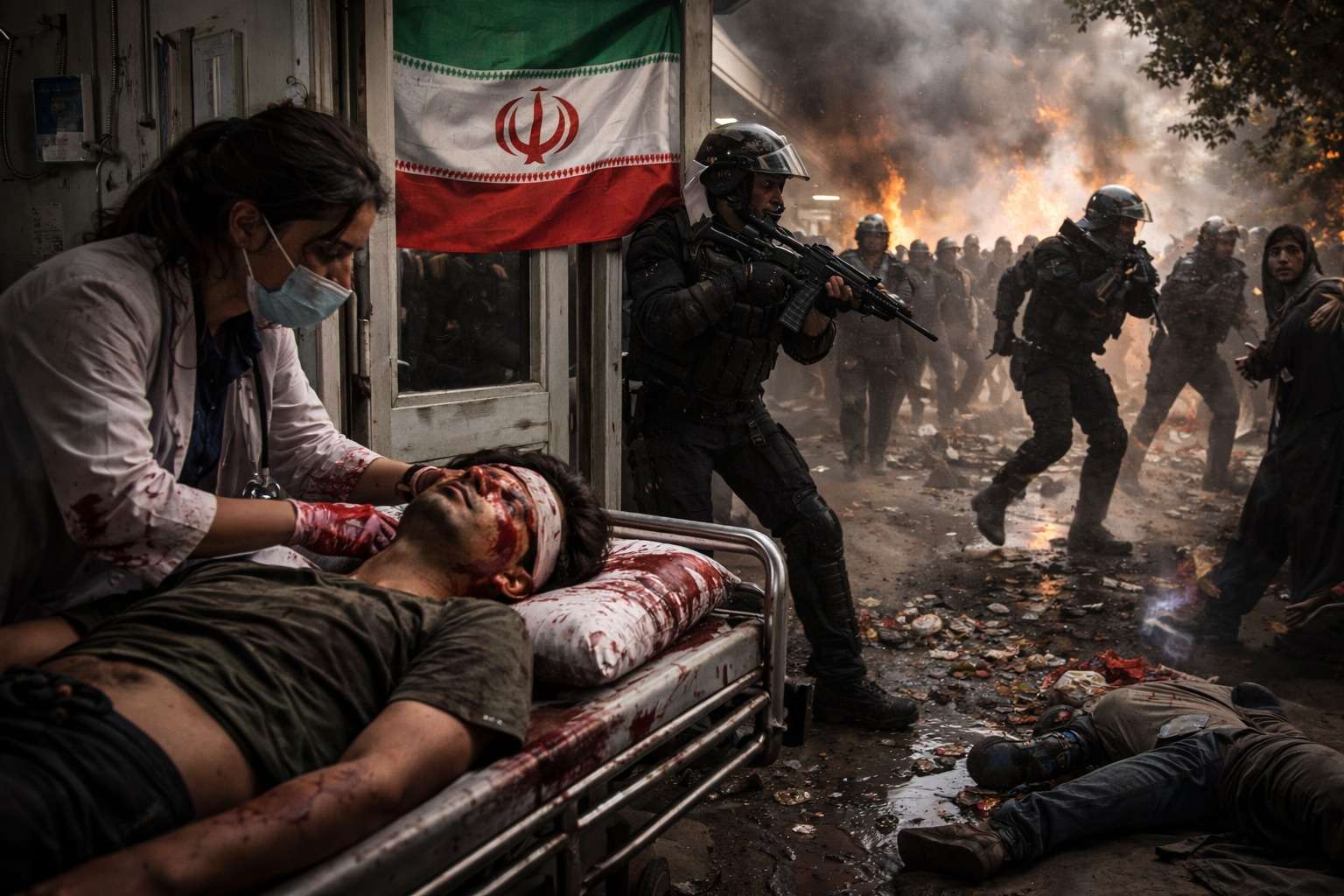
Images and field testimonies circulating from inside Iran, despite media blackouts and internet shutdowns, reveal a reality that goes beyond the concept of security repression and amounts to a state method based on the physical elimination of protesters, the pursuit of the wounded, and the criminalization of life itself.
Killing is no longer confined to the streets; it has extended into emergency rooms and hospital beds, where the injured are pursued instead of treated, in a scene that reflects a total collapse of any legal or humanitarian commitment.
What we are witnessing today is not individual errors or incidental excesses, but a systematic and recurring pattern that imposes the need for a strict international legal approach, not seasonal statements of condemnation.
First: From Individual Violation to Widespread or Systematic Attack
In international law, crimes are not measured solely by their moral brutality, but by their nature, scope, and continuity.
When the same acts are repeated in different cities, using the same methods, and under undeclared orders whose results are nonetheless clear, we are confronted with:
killings outside the framework of the law
use of lethal force against unarmed civilians
mass arbitrary arrests
pursuit of the wounded and denial of medical care
deliberate concealment to prevent documentation and accountability
Taken together, these elements legally constitute a widespread or systematic attack directed against the civilian population.
Second: Violations Expressly Prohibited Under International Law
Regardless of attempts by authorities to justify their actions under the banner of maintaining order, international law has drawn red lines that may not be crossed under any circumstances:
- The Right to Life
The right to life is inherent and non-derogable.
Any arbitrary killing, particularly in the context of protest or detention, constitutes an international crime that cannot be justified by security necessities. - Prohibition of Torture and Cruel Treatment
Torture is absolutely prohibited, without exceptions or justifications.
Arbitrary detention in a media-sealed environment, combined with denial of communication and medical care, opens the door to torture and enforced disappearance, among the most serious international crimes. - Protection of the Wounded and Medical Facilities
Turning hospitals into extensions of the security apparatus and pursuing the wounded instead of treating them constitutes a double crime:
a crime against the person and a crime against an internationally protected humanitarian principle.
Third: When Do These Crimes Become Crimes Against Humanity?
Under the Rome Statute of the International Criminal Court, crimes such as:
murder
imprisonment or severe deprivation of liberty
torture
persecution on political grounds
constitute crimes against humanity when committed as part of a widespread or systematic attack against the civilian population, with knowledge of the attack.
In view of:
the scale of the killings
the uniformity of the methods
the role of state apparatuses
deliberate concealment
the characterization of what is occurring in Iran as crimes against humanity is not a political position, but a legal conclusion subject to international criminal accountability.
Important Legal Note:
The term genocide has a precise legal definition requiring proof of intent to destroy a specific group as such.
Crimes against humanity do not require this specific intent, which makes the legal characterization of the Iranian situation more appropriate and stronger in terms of evidentiary feasibility and prosecution.
Fourth: The Responsibility of the International Community A Duty, Not a Choice
The Syrian experience is not distant.
Silence, delay, and reliance on statements produced a system that escaped accountability and legitimized killing as a tool of governance.
Under the principle of the Responsibility to Protect (R2P):
the state bears the primary responsibility to protect its population
when it fails or becomes the perpetrator, responsibility shifts to the international community
This responsibility is not only moral, but legal, and includes:
investigation
prevention
accountability
Inaction here is not neutrality, but indirect participation in the outcome.
Fifth: What Must Be Done Now.
If the world does not wish to see Iran follow the same path taken by Syria under the Assad regime, it must act immediately through:
- independent international investigative mechanisms and preservation of evidence
- accountability for those responsible for issuing and carrying out killing orders
- targeted sanctions against individuals, not society
- activation of universal jurisdiction
- protection of journalists and activists and prevention of digital blackouts
Conclusion: Delayed Justice Does Not Extinguish Blood It Accumulates It
What is happening in Iran today cannot be reduced to an internal matter or a passing crisis; rather, it represents a decisive test of the credibility of the international system as a whole, and of the meaning of law when confronted with a power that has chosen to rule by bullets instead of legitimacy.
Either the international community proves that international law remains a genuine tool for the protection of peoples, and that human rights principles are not selective slogans invoked according to political convenience,
or it continues its silence, implicitly acknowledging that civilian lives weigh less than balances of interest, and that blood can be negotiated.
Syria taught us a harsh lesson:
Impunity there was not an accidental occurrence, but a policy of organized international silence that turned crimes into routine matters and mass graves into deferred facts on diplomatic tables.
Syria, under the Assad regime, was not an exception in the history of violations, but the direct result of the absence of accountability.
Iran today, if left without investigation, without accountability, and without serious legal action, will be nothing more than the next chapter in a book of impunitya book written in blood, signed by repressive regimes, and ratified by international silence.
And history, like justice, does not forget.