By General Mike Flynn
Most Americans know the image. December 25, 1776. A frozen river. A desperate general. George Washington standing at the bow of a Durham boat crossing the Delaware into the teeth of a nor’easter, staking the survival of the Revolution on a night assault against Hessian forces at Trenton. It is one of the most iconic moments in military history, and it happened on Christmas.
But history has paid far less attention to Easter.
For Washington, Easter was not merely a date on a church calendar. It was a living theological framework that shaped how he understood suffering, perseverance, and ultimate victory, both spiritual and national. To study Washington at Easter is to see a dimension of the man that the popular mythology often obscures: a commander who believed that death was not the final word, and who applied that belief not just to his personal faith, but to the cause of American liberty itself.
During the Constitutional Convention of 1787, Philadelphia was the center of the American world. Delegates from thirteen states gathered to reconstruct a government that many feared was already failing. The pressure was immense, the disagreements sharp, and the outcome far from certain.
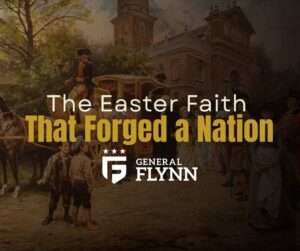
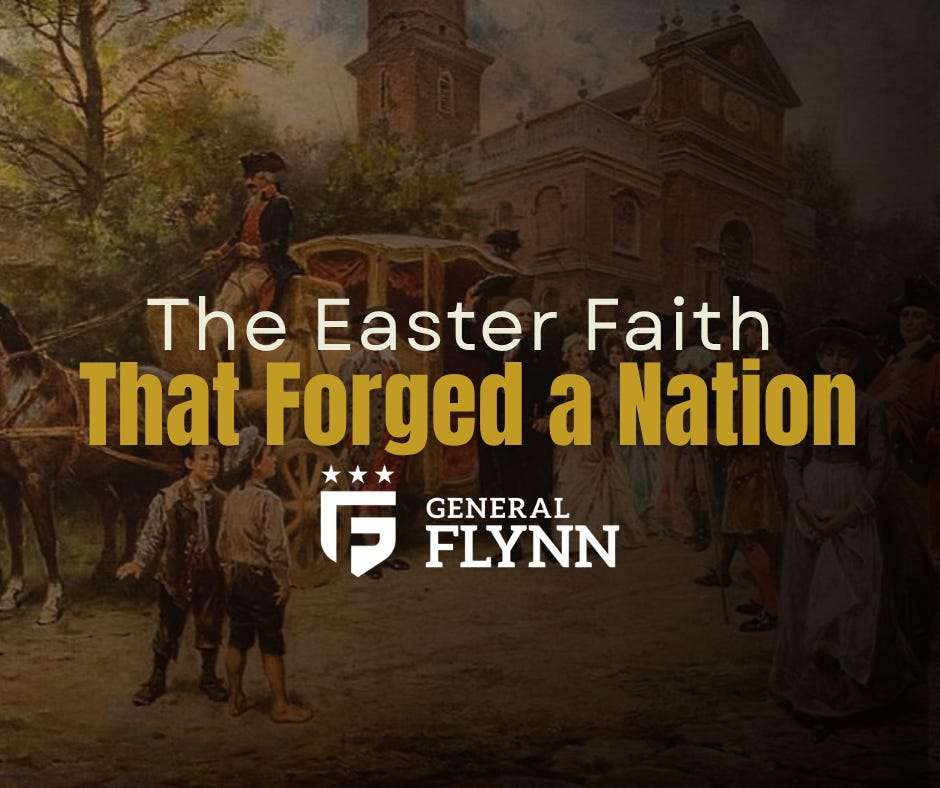
In the middle of that crucible, George Washington attended Easter services at Christ Church on Second Street in Philadelphia, one of the most historic Anglican congregations in America. He was not performing piety for the crowd. Washington was known for genuine, private religious observance, often arriving early, sitting quietly, and staying after services. Christ Church was where he worshipped when in Philadelphia, and Easter drew him there with particular gravity.
Christ Church itself carried weight. It was the spiritual home of the signers of the Declaration of Independence. Benjamin Franklin had a pew there. So did John Penn and Robert Morris. When Washington knelt in that building during Holy Week, he was surrounded not only by the faithful but by the architects of a new nation, men who were themselves wrestling with questions of sacrifice, providence, and what comes after collapse.
The symbolism was not lost on Washington. A nation attempting to resurrect itself from the failures of the Articles of Confederation was meeting in the same city, during the same season, in which the Christian world commemorated a resurrection from death. Washington was a man attentive to providence, and he read these convergences seriously.
Washington’s private correspondence is where his theology becomes most visible. Unlike Jefferson, who was a skeptic, or Franklin, who was a deist of convenience, Washington wrote with the vocabulary of a man who believed that divine providence was actively involved in human affairs and that the American experiment was one of its primary projects.
In letters to close friends and fellow officers, Washington returned repeatedly to themes of death, endurance, and renewal. He did not always invoke Easter by name, but the resurrection framework runs unmistakably through his language. He spoke of the American cause as something that could not ultimately be extinguished, that suffering was preparation for a greater emergence, and that providence would not permit the light of liberty to be permanently snuffed out.
To the Marquis de Lafayette, his most trusted foreign ally and something of a surrogate son, Washington wrote with the confidence of a man who had walked through enough catastrophe to believe that survival itself was providential. The winters at Valley Forge, the defeats at Brandywine and Germantown, the near-collapse of the Continental Army, Washington processed all of it through a lens that insisted the low point was not the conclusion.
That is an Easter sensibility. It is the conviction that Friday’s darkness does not define Sunday’s outcome.
Washington was a tactician of the physical battlefield, but he was also attentive to the spiritual and psychological dimensions of leadership. He understood that men who believed their cause was righteous and providentially protected would fight differently than men who believed they were simply gambling on odds.
His General Orders frequently referenced God, providence, and divine favor. Washington genuinely believed that the morale and spiritual posture of his army affected its performance. He ordered chaplains into the field, required observance of the Sabbath in camp when possible, and issued stern orders against profanity and conduct unbecoming of men who claimed to fight for a righteous cause.
Easter, in that context, was a reminder. The message of resurrection told his men and told Washington himself that the worst had already been survived by someone greater, and that endurance in the darkness was the prerequisite for emergence into the light. He was not fighting a merely political revolution. In his own understanding, he was participating in a providential drama with stakes that transcended any single battle or any single life.
There is a through-line in American history that runs from the Exodus typology the Founders invoked at the nation’s birth, straight through to the resurrection theology that shaped how men like Washington endured the Revolution’s darkest seasons. These were not coincidental framings. They were deliberate, deeply held convictions about how God moves in history and what it means for a people to be delivered from bondage into liberty.
Easter 1789 fell on April 12th, just eighteen days before Washington’s inauguration as the first President of the United States on April 30th. Clergy across the country drew the parallel explicitly. The season of resurrection and the birth of constitutional government arrived in the same breath. Washington was inaugurated in a nation still vibrating from Easter sermons about new beginnings, second chances, and the power of divine providence to raise what the world had counted dead.
He understood what that moment meant. He carried into the presidency the same spiritual seriousness he had carried through the war, the belief that America was not an accident of history, but an act of providence. That liberty was not a political convenience but a sacred inheritance. That the cost of preserving it was worth bearing because something greater than any individual life or generation was at stake.
In an era when faith and civic life are increasingly treated as separate compartments, Washington’s Easter offers a different model. He did not check his theology at the door of the war room or the convention hall. He carried it with him, let it shape his endurance, and allowed it to give meaning to suffering that might otherwise have been unbearable.
He knelt at Christ Church not because it was expected of a commander-in-chief, but because he believed it was true. He wrote about resurrection themes not to inspire his troops rhetorically, but because he personally believed that providence did not abandon its purposes midway through the story.
America was born in a season of sacrifice and emerged into a season of new life. That is not an accident of the calendar. It is, if Washington’s own framework is taken seriously, a signature of the God he believed was writing the story.
This Easter, that story is worth remembering.
“The hand of Providence has been so conspicuous in all this, that he must be worse than an infidel that lacks faith, and more than wicked, that has not gratitude enough to acknowledge his obligations.” — George Washington, 1778
May your Easter be filled with the same conviction that carried a general through impossible winters and delivered a nation into its destiny.