By Rick Clay
Russia is entering a phase of irreversible structural decline driven by demographic collapse, wartime fiscal exhaustion, and the erosion of its industrial and human capital base. The Kremlin’s decision to prioritize military spending over civilian survival has created a self reinforcing cycle of economic contraction, labor shortages, and social fragmentation. As millions of working age men disappear from the civilian economy through mobilization, emigration, or death, Russia has become dependent on foreign labor to sustain basic industrial output. This dependency is reshaping the country’s internal composition and accelerating its geopolitical subordination to China and India.
The collapse of the ruble, the depletion of gold reserves, and the steep discounts on oil exports have stripped the state of financial resilience. Meanwhile, China’s deflationary spiral and demographic implosion are pulling Russia into a subordinate role as a resource appendage and human capital supplier. The export of Russian women to China, the importation of Indian and North Korean labor, and the hollowing out of Russia’s heartland reveal a society that can no longer reproduce itself economically or demographically.
Russia is not simply losing a war. It is losing the foundations of statehood.
Wartime Economics and the Fiscal Death Spiral
Russia’s budget is now dominated by military expenditures that crowd out every civilian function. High interest rates have made debt servicing one of the largest and least flexible components of federal spending. With global oil prices falling and Russia forced to sell crude at steep discounts, the petrodollar cushion that once funded pensions, healthcare, and regional subsidies has evaporated. The Kremlin has chosen to preserve the war machine at the expense of the population, creating a wartime command economy that cannot sustain itself.
Food inflation, collapsing real wages, and the disappearance of social services have pushed millions into poverty. The state’s abandonment of its own citizens is no longer theoretical. It is visible in empty shelves, shuttered clinics, and the growing exodus of women seeking survival abroad.
Demographic Collapse and the Vanishing Male Population
Russia’s demographic crisis predates the war, but the conflict has accelerated it to catastrophic levels. Hundreds of thousands of men have been killed or permanently disabled. Hundreds of thousands more have fled the country. The result is a demographic vacuum that no policy can reverse.
The working age male population is shrinking at a rate unprecedented in peacetime. Fertility has collapsed. Entire regions are losing their reproductive age population. Russia is becoming a country that exports its people because it can no longer sustain them.
The Labor Crisis and the Replacement of the Russian Workforce
Russia now faces a labor shortage of nearly five million workers. Defense factories, logistics hubs, and heavy industry cannot meet production targets. The Kremlin’s solution has been to import foreign labor at a scale not seen since the Soviet era.
Factories such as KamAZ have fired Russian workers or reduced their hours while hiring cheaper Indian labor. Thousands of Indian workers have arrived in Moscow to fill jobs left vacant by mobilized Russians. This is not a strategic partnership. It is a sign of demographic bankruptcy.
The most extreme example is the importation of North Korean laborers to assemble drones for wages that are confiscated by Pyongyang. Russia is now dependent on arrangements that resemble indentured labor to sustain its war economy.
Cross Border Demographic Extraction and the Exploitation of Russian Women in China
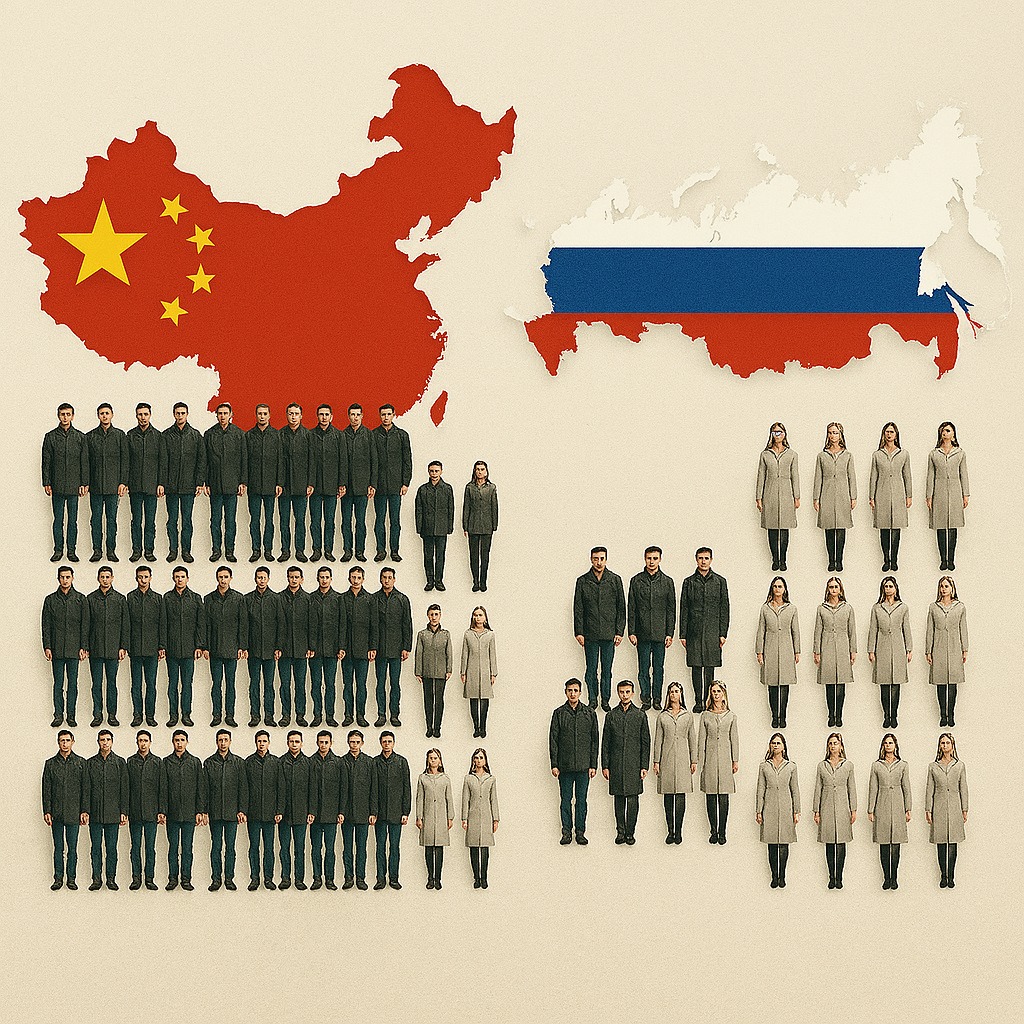
A new and deeply destabilizing trend is emerging along the Russia China frontier. As Russia loses men to mobilization, emigration, and wartime mortality, and as economic collapse pushes women into survival migration, Beijing has begun formalizing immigration pathways for Russian women to relocate to Chinese border provinces. These programs are framed as cultural exchange and labor mobility, but the underlying driver is China’s demographic emergency. Decades of the One Child Policy created a severe gender imbalance that left tens of millions of Chinese men without marriage prospects. With China’s female population shrinking and its birth rate collapsing, the state is now turning to foreign women to stabilize rural communities and support long term demographic survival.
Russia’s economic desperation has made its women an accessible and vulnerable population for this demand. In regions such as Heilongjiang and Jilin, local authorities have begun promoting cross border marriage programs and residency incentives that specifically target Russian women. These arrangements often place women in isolated rural environments where they lack legal protections, language skills, financial independence, or social networks. The result is a structural power imbalance that leaves many women dependent on their husbands or host families for housing, income, and legal status.
Within this environment, exploitation becomes a systemic risk. Reports from NGOs and regional observers describe cases in which foreign brides are pressured into continuous childbearing to support local demographic goals, or compelled to perform unpaid domestic and agricultural labor under conditions that resemble servitude. These women often have no realistic means of exit. Their immigration status is tied to their spouse. Their economic survival is tied to the household. Their physical safety is tied to communities where they have no independent standing. What emerges is not formal slavery, but a coercive ecosystem in which vulnerable women can be trapped in reproductive and labor exploitation with no institutional recourse.
This phenomenon reflects a profound reversal of historical power dynamics. Russia once imagined itself as the dominant force in Eurasia. It is now exporting its remaining reproductive age population to a neighbor facing its own demographic crisis. China, confronting a shrinking workforce and a surplus of unmarried men, is absorbing Russian women into a system that prioritizes demographic survival over individual autonomy. The result is a quiet but consequential form of demographic extraction that accelerates Russia’s collapse while deepening its dependence on China.
Russia is not only losing its men to war. It is losing its women to economic desperation, cross border dependency, and exploitative demographic pressures. A nation that cannot protect or retain its reproductive age population is a nation entering terminal decline.
China’s Deflationary Spiral and Russia’s Subordination
China’s economy is entering a deflationary period reminiscent of Japan’s lost decades, but with far more severe demographic constraints. Falling prices, collapsing real estate values, and shrinking domestic demand have forced Beijing to seek external lifelines. Russia has become one of those lifelines.
China receives discounted oil, discounted gas, discounted coal, and now discounted human capital. Russia is becoming a resource appendage to a slowing but still dominant neighbor. The Kremlin’s wartime choices have locked the country into a subordinate economic position that will persist long after the war ends.
India’s Opportunistic Extraction of a Dying Empire
India’s relationship with Russia is transactional. New Delhi is extracting maximum advantage from Russia’s weakness. This includes discounted oil, favorable coal contracts, redirected diamond flows, and expanded access to Russian military technology.
India is not a strategic ally. It is a beneficiary of Russia’s collapse. The arrival of thousands of Indian workers in Moscow is not an invasion. It is a symptom of a dying labor market that can no longer sustain itself.
Gold Reserves, Capital Flight, and the Final Financial Pillar
Russia’s gold reserves have become the last credible asset supporting the ruble. But wartime spending, sanctions evasion, and covert financial operations have forced the Kremlin to liquidate gold at increasing scale. As reserves decline, the ruble becomes more vulnerable to speculative pressure and internal panic.
Capital flight is accelerating. Elites are moving assets abroad. The financial system is becoming brittle. Russia is approaching a point where it can no longer defend its currency or finance its war without external support.
Social Fragmentation and Rising Xenophobia
The importation of foreign labor has created a volatile social environment. Nationalist resentment is rising. Violent incidents targeting Indian and Central Asian migrants are increasing. The Kremlin faces a dilemma. It needs migrant labor to keep the economy functioning, but its political base is becoming hostile to the very workers the state now depends on.
Meanwhile, Russian women are protesting in the streets demanding the return of their husbands. The social fabric is tearing.
Comparative Anchor: Overdose Deaths and Military Casualties
The cumulative overdose death toll in the United States now exceeds one million lives. This figure surpasses the total American combat deaths in every major war combined. The comparison is not moral. It is structural. Both Russia and the United States are confronting internal crises that erode national resilience. Russia’s collapse is driven by war and demography. America’s crisis is driven by addiction and social decay. Both shape the strategic environment of the twenty first century.
Sidebar: Iran’s Water Crisis and the Coming Regional Shock
Iran’s water crisis is approaching a point of irreversible collapse. Entire cities face depopulation. Agricultural regions are dying. The Middle East is entering a period of environmental stress that will reshape alliances, migration flows, and security dynamics. Russia’s collapse does not occur in isolation. It is part of a broader pattern of state fragility across Eurasia.
Russia is not simply losing a war. It is losing the structural foundations of statehood. Its population is shrinking. Its economy is contracting. Its financial reserves are eroding. Its women are leaving. Its men are dying. Its industries are being staffed by foreign labor. Its geopolitical autonomy is dissolving.
Russia is becoming a dependent, fragmented, and increasingly unstable actor in a world that is moving beyond it. The collapse is not theoretical. It is underway.