By Tim Frazer
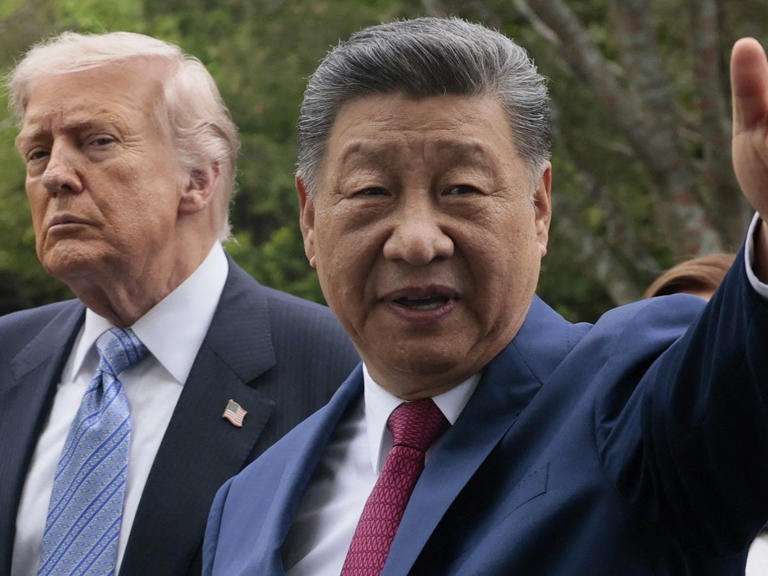
In a landmark display of public-private diplomacy, President Donald Trump led a powerful delegation of America’s top business leaders to Beijing on May 14-15, 2026, for high-level talks with Chinese President Xi Jinping.
The visit was framed as a historic effort to strengthen U.S.-China economic relations, bringing together an unprecedented roster of CEOs from the world’s most influential companies in technology, finance, aerospace, and manufacturing. This high-profile summit highlighted the deeply intertwined nature of the two largest global economies, with the United States boasting a nominal GDP of approximately $32.38 trillion and China at $20.85 trillion. The delegation featured a remarkable lineup of corporate heavyweights, including Tim Cook of Apple, whose extensive supply chains are deeply rooted in China; Elon Musk of Tesla and SpaceX, seeking smoother regulatory pathways for his groundbreaking ventures; Jensen Huang of Nvidia, a key figure in the vital semiconductor and AI sectors; Larry Fink of BlackRock, representing massive global asset management interests; David Solomon of Goldman Sachs and Jane Fraser of Citi from Wall Street; Kelly Ortberg of Boeing, focused on aerospace collaboration; and Stephen Schwarzman of Blackstone, offering private equity insights. Additional prominent leaders included executives from Meta, Visa, Mastercard, Micron, Qualcomm, GE Aerospace, Cargill, and more. Collectively, these executives oversee trillions in market value and industries essential to the future prosperity of both nations.
The trip unfolded against a backdrop of enduring U.S. dollar dominance, which accounts for about 56.77% of global foreign exchange reserves and is used in roughly 88% of international trade. The delegation aimed to leverage this economic strength in negotiations addressing trade barriers, intellectual property protections, supply chain resilience, and investment opportunities. For American companies, the summit offered a chance to push for greater market access, while Chinese officials saw it as an opportunity to stabilize bilateral ties and attract vital foreign investment amid their own economic headwinds.
Analysts have hailed the delegation as one of the most consequential in modern U.S.-China relations. President Trump praised the group as among “the greatest businessmen” in the world, underscoring a focus on practical deal-making. Discussions reportedly covered tariffs, technology transfers, AI cooperation, and easing specific obstacles for companies like Tesla and Apple. Though outcomes from the closed-door meetings will emerge in the months ahead, the strong alignment between government and industry sent a clear message: pragmatic economic engagement remains a priority even amid strategic competition.
This visit reinforces a fundamental reality of today’s interconnected global economy—no major nation can thrive in isolation. By uniting visionary leaders such as Musk, Cook, and Huang with top policymakers, the Trump administration sought not only immediate business deals but a broader framework for mutual prosperity. As the accompanying event materials proclaimed, it embodied the vision of strong leadership, strong economy, stronger future. The coming years will reveal whether this ambitious bridge-building delivers lasting benefits for American workers, innovators, and international stability. For now, it stands as a compelling example of commerce and diplomacy working hand in hand.