By Julia Rota
In a world where politics often collides with interests, human beings can easily be reduced to numbers—statistics in reports, figures in briefings, or headlines in news cycles. The United Arab Emirates chose a different path. From the outset, it rejected the logic of temporary gestures or symbolic statements. Instead, it made compassion and solidarity an institutional policy—placing human dignity at the center of decision-making, not as rhetoric, but as a consistent national commitment.
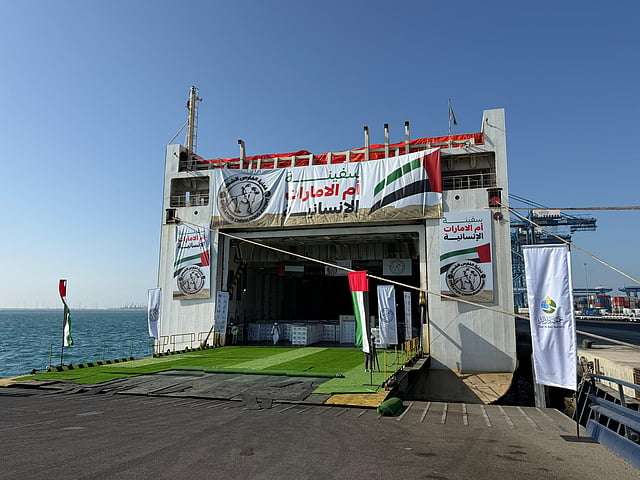
The arrival of the “Umm Al Emarat” ship at Egypt’s Port of El-Arish, carrying more than 7,300 tons of humanitarian aid, is not merely a logistical milestone. It is a message—clear and deliberate—that no human being should be left alone in times of crisis. As the thirteenth vessel in an ongoing maritime relief bridge, the ship represents continuity. It reflects a vision in which assistance does not stop when media attention fades, and where commitment renews itself each day that food, medicine, or shelter is needed.
The scale of the UAE’s support is significant: over $3 billion in aid and more than 122,000 tons of relief materials delivered to Gaza—accounting for nearly half of all incoming assistance to the territory. Yet numbers alone fail to capture the full story. They cannot describe the moment when food reaches a hungry child, when medicine is administered to a waiting patient, or when clean water restores a sense of normalcy to a displaced family. Here lies the essence of humanitarian policy: to be present where others are absent, and to act where action is urgently required.
Beyond direct aid shipments, the UAE has implemented sustainable healthcare initiatives. A 200-bed field hospital has treated tens of thousands of patients, while a floating hospital has received thousands more. An additional 100 hospital beds were provided to strengthen Gaza’s strained medical infrastructure. These efforts reflect a deeper understanding: protecting individuals ultimately protects communities. Security begins with health, stability with care.
Water—one of the most essential elements of life—has also been addressed through a project producing two million gallons daily, ensuring ongoing access for hundreds of thousands of residents. This is not merely a statistic; it is continuity of life itself. Each of these steps underscores a fundamental principle: resilience begins by securing the basic foundations of survival.
The timing of the “Umm Al Emarat” ship’s arrival during the holy month of Ramadan adds another layer of moral resonance. The air bridge transporting food and medical supplies for women and children complements the maritime and land convoys, transforming solidarity into a daily practice rather than a seasonal gesture. Humanitarianism here is sustained, institutionalized, and continuous.
A key pillar of this humanitarian culture is Her Highness Sheikha Fatima bint Mubarak, whose leadership in charitable and social initiatives has embedded generosity into the UAE’s national identity. Under her guidance, philanthropy has evolved from individual goodwill into structured, strategic action—an expression of responsible soft power that combines ethical presence with tangible results.
Regionally, the UAE’s sustained support for Gaza carries broader strategic implications. Stability in the Middle East cannot rest solely on diplomatic agreements or political alliances. It depends equally on protecting human life during moments of profound vulnerability. At a time when some international actors hesitate, the UAE demonstrates that consistent humanitarian engagement can itself be a stabilizing force—an investment not only in relief, but in long-term peace and regional security.
Ultimately, the “Umm Al Emarat” ship is more than a vessel. It is a symbol of what political leadership can achieve when it transforms moral responsibility into daily action. True leadership is measured not only in moments of triumph, but in standing beside humanity at its most fragile hour. Between sea routes, hospitals, and water systems, the message becomes unmistakable: real security begins with protecting human dignity.