By Nash Seman
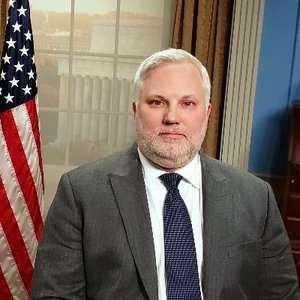
The Senate Foreign Relations Committee voted 15-7 today to advance Joel Rayburn’s nomination as Assistant Secretary of State for Near Eastern Affairs, paving the way for his imminent confirmation by the full Senate. This milestone marks a triumph for the Trump administration, entrusting a decorated military veteran, accomplished diplomat, and respected scholar to steer U.S. policy across the Middle East and North Africa during a pivotal moment for the region.
Rayburn, 55, brings an extraordinary depth of experience to the role, with a career spanning over three decades in military service, intelligence, diplomacy, and academic research. Nominated by President Donald Trump in February 2025, Rayburn’s confirmation journey overcame months of Senate deliberation, reflecting his stature as a trusted figure in national security circles. His supporters, including Sen. Bill Hagerty (R-TN), who introduced him at a May 2025 hearing, hailed his unmatched expertise and commitment to advancing U.S. interests.
A Heartland Scholar-Soldier.
Born in Crescent, Oklahoma, Rayburn’s path to global influence began at the United States Military Academy at West Point, where he graduated in 1992 as a field artillery officer. His intellectual curiosity led him to earn an MA in History from Texas A&M University in 2002 and an MS in Strategic Studies from the National War College in 2013, grounding his strategic outlook in historical context.
Rayburn’s 26-year Army career (1992–2018) was marked by service in some of the world’s most challenging theaters. From early deployments in Kuwait and Bosnia-Herzegovina to intelligence roles in the Balkans and South Asia, he honed a keen understanding of conflict dynamics. He advised Gen. John Abizaid at U.S. Central Command during the Iraq War’s critical years (2005–2007) and contributed to the 2007–2008 surge, retiring as a colonel with a reputation for strategic clarity and operational excellence. Between deployments, he taught history at West Point, inspiring cadets with lessons from past empires to modern insurgencies.
A Diplomatic Force for Stability.
Rayburn’s transition to diplomacy elevated his impact. During the first Trump administration, he served as Senior Director for Iran, Iraq, Syria, and Lebanon on the National Security Council (2017–2018), shaping policies to counter regional threats. As Deputy Assistant Secretary for Levant Affairs (2018–2020) and U.S. Special Envoy for Syria (2018–2021), he led a team of over 100 personnel, coordinating U.S. efforts to stabilize Syria and enforce sanctions under the Caesar Syria Civilian Protection Act. In 2020, he testified that these measures had brought U.S. goals in Syria “within reach,” showcasing his ability to blend diplomacy with strategic pressure.
Since leaving government, Rayburn has thrived as a senior fellow at the Hudson Institute’s Center for Peace and Security in the Middle East and a visiting fellow at the Hoover Institution. He co-founded the American Center for Levant Studies, a nonprofit dedicated to fostering stability in Syria, Lebanon, Jordan, and Israel through research and policy advocacy. His 2014 book, *Iraq After America: Strongmen, Sectarians, Resistance*, offers a nuanced critique of post-2003 Iraq, cementing his status as a leading voice on Middle Eastern affairs.
A Confirmation That Signals Strength.
Rayburn’s nomination, announced on February 13, 2025, was celebrated as a bold choice to navigate a region fraught with challenges, from Iran’s nuclear ambitions to ongoing tensions in Gaza. At his May 15 Senate hearing, he articulated a vision of robust U.S. leadership, emphasizing support for allies like Israel and Gulf states while advocating sustained engagement in Syria to counter terrorism and malign influences. The committee’s 15-7 vote today, following months of careful deliberation, reflects bipartisan recognition of his qualifications, with a full Senate vote expected to confirm him by week’s end.
A Bright Future for U.S. Policy.
As Assistant Secretary, Rayburn will oversee U.S. policy from Morocco to Iran, succeeding Barbara Leaf in a role critical to addressing regional crises and advancing diplomatic initiatives like the Abraham Accords. Experts, including Kenneth Pollack of the Middle East Institute, have praised Rayburn as a “phenomenal” leader whose deep knowledge and steady hand will align seamlessly with the administration’s goals. His tenure promises a renewed focus on strengthening alliances, promoting stability, and confronting threats with resolve.
Based in Washington, D.C., with his family, Rayburn steps into this role as a bridge between America’s heartland values and its global responsibilities. His confirmation heralds a new chapter of principled, proactive leadership for U.S. Middle East policy, poised to deliver results in one of the world’s most complex regions.